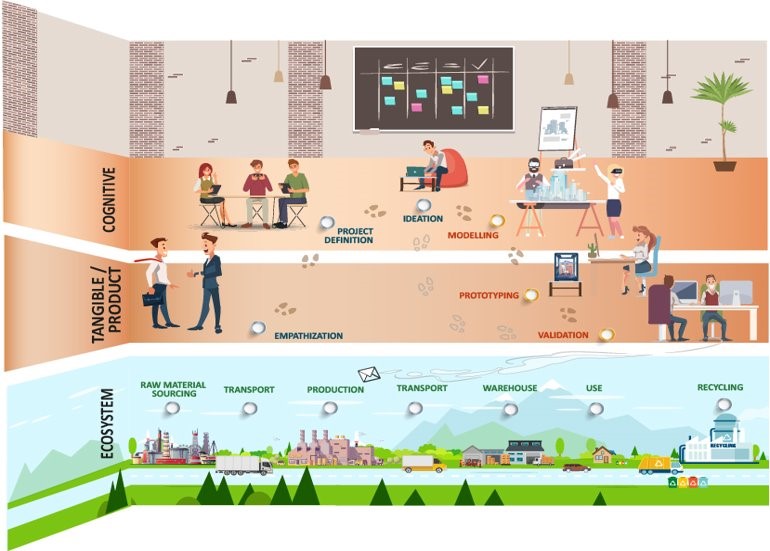
Launched over a year ago, the European research project INEDIT ("Open INnovation Ecosystems for Do It Together process") offers a new approach to co-creation and furniture manufacturing for all, thanks to a platform linking Open Innovation and Open Manufacturing. Here's an update on this project led bythe Institut Arts et Métiers Laval and the LAMPA research laboratory with Benjamin Poussard, coordinator of the INEDIT project for Arts et Métiers.
What is the INEDIT project?
This European project, with a budget of €7 million by the European Commission, brings together a consortium of 14 partners from 8 different countries (Germany, Spain, France, Italy, the Netherlands, Poland, Portugal, and Switzerland). It was conceived and is led by the Institut Arts et Métiers Laval with the support of the Europe des Arts et Métiers unit Arts et Métiers Paris.
The aim of the INEDIT project is to enable consumers to design their own furniture and have it manufactured locally. To this end, an open innovation and co-creation platform is being developed and tested on a European scale. There are many challenges involved, including:
- Promoting understanding of needs and creativity in the design phase
- RReduce the time between expressing a need and manufacturing the furniture
- Facilitating the manufacturing process within local production ecosystems in a circular economy context
In line with the "Do It Together" approach that has been developed, consumers can rely on a community of designers to assist them with their designs and on a European network of manufacturers to produce their furniture. INEDIT explores a wide range of features that go beyond furniture configuration and offer new opportunities to users:
- In terms of design, the aim is to make 3D scanning of living spaces accessible, virtual reality for creation, inspiration through 3D shape suggestions and a recommendation system, "smartification" through the addition of smart, connected sensors that make the furniture functional (e.g., fall alerts), and even an environmental assessment of the furniture before purchase.
- On the manufacturing side, various technologies are being explored in order to characterize the possibilities offered by this new approach, evaluate it, and make it replicable on a European scale: operations on wood panels, additive manufacturing of recycled plastic or wood. These use cases will be used to define "Open Manufacturing Demonstration Facilities," a model of physical platforms equipped with production resources and integrating the INEDIT approach. The entire digital chain is being studied to ensure the fluidity of the process.
The expertise of the Laval Institute at the heart of the project
Specializing in Human-Machine Interfaces (HMI) and innovative applications of immersive technologies (VR-AR), Arts et Métiers is responsible for developing the digital chain from idea to design, as well as features dedicated to the co-creation process. In addition to the technological aspect, the human factors impacting the experience of the tools used will be evaluated to maximize their ergonomics, acceptability, and performance. From the definition of the furniture to its modeling, the Laval Institute's mission is to answer technological and cognitive ergonomics questions that will facilitate the widespread adoption of such tools.
Combine drawing and design tools in a single immersive environment
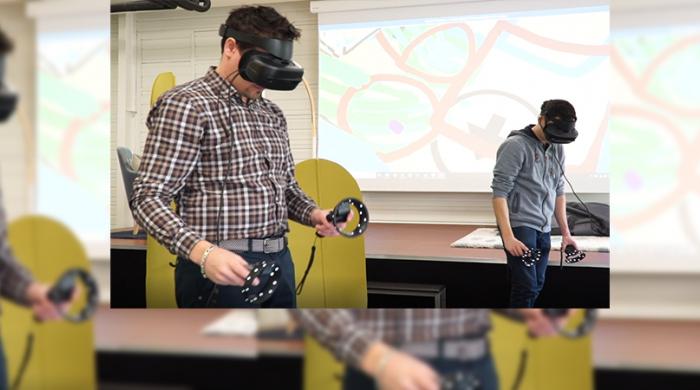
The Laval Institute is currently developing and testing a process that allows users to visualize their furniture in a room they have scanned using their smartphone. Why? No more measuring! Immersed in virtual reality in their own room, users can imagine without limits, communicate, and validate concepts that meet their needs. As a bonus, they can use their smartphone to validate the rendering of their furniture in augmented reality before it is manufactured.
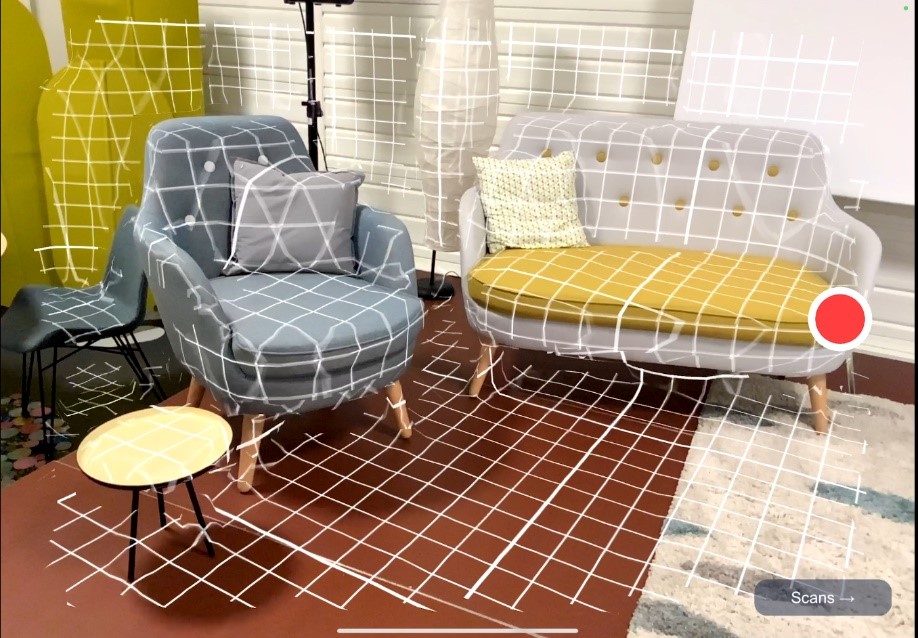 Figure 2. The user scans their room in a matter of seconds and finds it in their project management interface.
Consumers are offered a range of possibilities and solutions, allowing them to sketch and design their furniture using virtual reality. They can also seek help from a designer. "The aim is to connect consumers with designers in the scanned room. The furniture is then co-created in immersive environments during collaborative meetings, ensuring better mutual understanding," explains Benjamin Poussard.
Why virtual reality? "Scanning automatically captures the dimensions of the end consumer's living space, and virtual reality immersion allows the project owner to better visualize the final result. They can create shapes, contextualize them in relation to other furniture in the environment, and move around their design with a better idea of its proportions and functions. This allows them to visualize different representations of their furniture in an immersive environment. Being immersed in virtual reality improves decision-making by directly visualizing the possible advantages and disadvantages, " explains Benjamin Poussard.
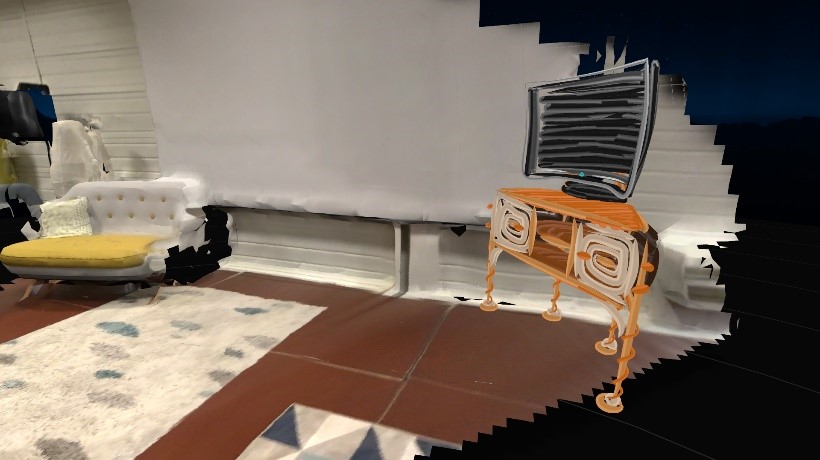
Figure 3. Example of a drawing made by a user immersed in the scanned room. The user also contextualized the use of the furniture by drawing a television.
Once the concept has been approved, the next step is to design the furniture. The challenge is to use the drawing to produce a CAD model of the furniture. The aim is to use the same virtual environment and switch from "creativity" mode to "design" mode using innovative design tools.
Consumers or designers can use virtual reality to take wooden boards, drill holes in them, assemble them as they would in real life, and create their furniture without hurting themselves, based on the initial design! They can also draw more free-form shapes, which can then be produced using additive manufacturing techniques such as plastic or wood!

Figure 4. A user relies on the drawing to cut and assemble the wooden panels in a matter of minutes, as if playing with building blocks, thus producing all the data necessary for production and assembly.
Cutting-edge virtual reality tools
Co-creation in virtual reality between consumers and designers is an essential aspect of the INEDIT project dedicated to "Do-It-Together." The tools developed by the Laval team, which also runs the "Time to Concept" Chair, make 3D furniture modeling more accessible and facilitate communication between stakeholders throughout the various stages of the project.
The key point of the project is the transfer and integration of these new methods and technologies into the entire platform process (website and dedicated applications).
When using this platform, production data is sent to the nearest partner manufacturer and an interactive assembly guide is created. All of this must be generated automatically, which is a significant technical challenge!
To carry out these projects, engineer Amani Ghadhab joined the Laval team in October 2020. She is working specifically on immersive design tools, and to take the experiments further, the Laval Institute is looking to hire two postdoctoral researchers in 2021 to further its research into ergonomics and human-machine interactions applied to INEDIT.
Arts et Métiers, project coordinator
Arts et Métiers, coordinator of the INEDIT project, has an overview of the entire process, from creativity to manufacturing. " Arts et Métiers well-placed to lead this type of multidisciplinary project because we develop knowledge across the entire chain, from design to manufacturing. We understand the challenges faced by each stakeholder, particularly industrial manufacturers and designers, for whom this approach could offer great opportunities,"says Benjamin Poussard.
Priority areas in 2021
In terms of tools, the 3D scanning application is currently being finalized, and the drawing tools will be tested and evaluated in April 2021. The design tools will be tested in October 2021. "Alongside technological development, we need to evaluate the factors that impact creativity, user experience, and user performance when using such tools, which we learned to do at Laval as part of the Time to Concept Chair," explains Benjamin.
For Benjamin Poussard, the objective is twofold: to evaluate each technology developed individually, then to evaluate the entire process integrating the tools on a single platform. A series of demonstrations and experiments is planned over the next 18 months to achieve this objective.
The INEDIT project is a multidisciplinary innovation project with a long-term vision. We are ahead of schedule and will be ready to offer essential services when the market is ready!
See you in 2022 to test the INEDIT platform!