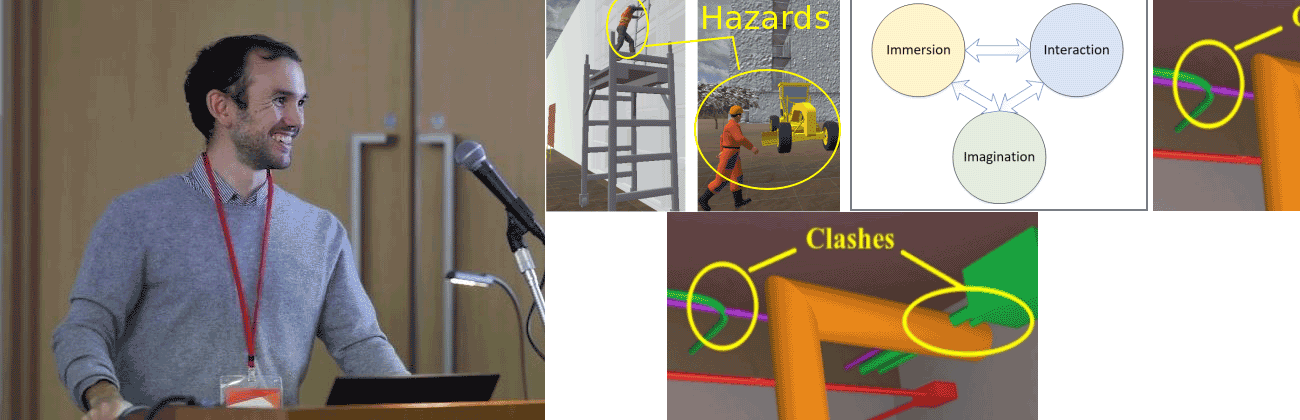
Pierre Raimbaud, a doctoral student at LISPEN, will publicly defend his thesis supervised by Frédéric Mérienne, Deputy Director ofthe Institut Arts et Métiers Chalon-sur-Saône, and Tiberio Hernandez of the Universidad de los Andes inColombia.
Due to the health crisis, Pierre Raimbaud will defend his thesis publicly via videoconference on "Virtual reality for the needs of the construction industry: guiding the design of user interactions using a task-centered methodology." Tuesday, November 17, 2020 at 3:00 p.m. (Paris time) in English.
Composition of the jury
Rapporteurs
- Guillaume MOREAU, Ecole Centrale Nantes,
- Frédéric NOEL, Grenoble Institute of Technology,
- Fernando DE LA ROSA, University of the Andes,
Examiners
- James Herman OLIVER, Iowa State University,
- Frédéric MERIENNE, Arts et Métiers,
- Jose Tiberio HERNANDEZ University of the Andes
Guests
- Florence DANGLADE Arts et Métiers
- Ruding LOU Arts et Métiers
- Pablo Figueroa University of the Andes
Keywords
Virtual reality, Task-centered design methodology, User-centered design methodology, Building Information Modeling, Practical guide
Virtual reality, Task-centered design methodology, User-centered design methodology, Building Information Modeling, Practical guide
Summary
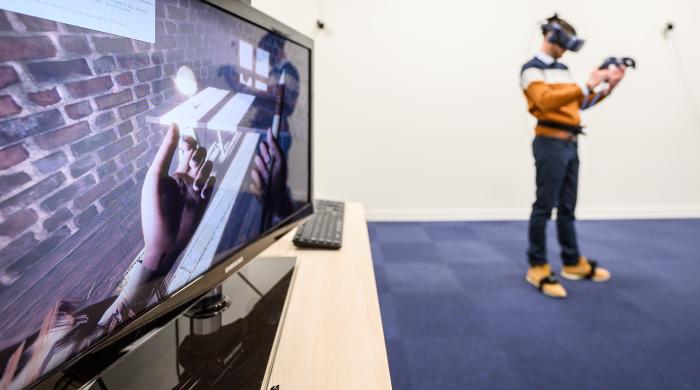
The field of virtual reality (VR) has undergone significant development in recent years due to the
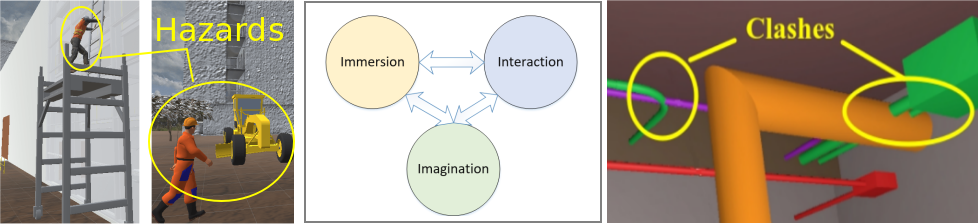
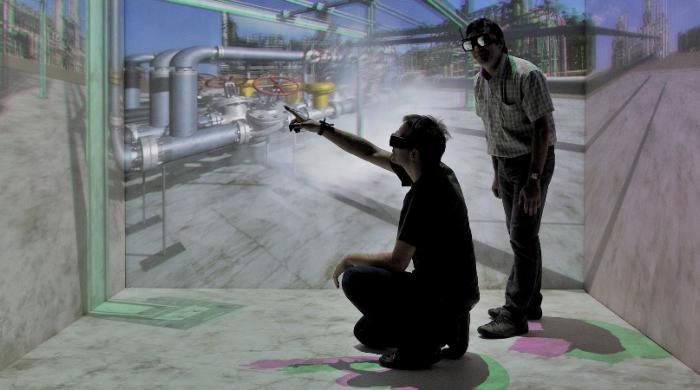
increasing maturity of this technology. This has enabled its widespread use in many fields, particularly in construction. However, one problem resulting from the use of VR in this field is that the VR interactions provided to users are often not sufficiently adapted to their needs. It is indeed difficult to synthesize the expertise of the construction trades with that of VR. This raises the research question of how to enable experts in a specific field, who have no expertise in VR, to define and obtain the specifications for VR interaction techniques independently.
To answer this question, in this research we propose a new methodology focused on task-
for the design of VR interactions. This methodology includes semi-automatic systems that enable the decomposition of user tasks and the determination of proposed interaction techniques—i.e., the obtaining of the two types of specifications expected. This methodology has been tested and evaluated on two case studies in the construction sector. The results show that our methodology can be used independently by construction experts and that they obtained specifications similar to those obtained using a traditional user-centered design methodology.