The global energy context requires us to rethink traditional means of energy production. Now more than ever, it is necessary to innovate and propose alternative solutions, particularly in the field of mobility and transportation.
-
A full-scale academic project
The project began in December 2017 when Thomas GROSJEAN, a student in Grande Ecole Engineering Programme class of 2017), visited the Monaco Yacht Club and was invited to participate in the international “Solar & Energy Boat Challenge.” The goal: to compete against hundreds of other engineers from teams around the world and present a single-seater prototype that met certain specifications: limited onboard weight and energy capacity, selection of a clean energy source...
In 2018, Thomas GROSJEAN teamed up with his classmate, Joan ROIG. They chose to design the cockpit of a single-seater catamaran with electric propulsion and hydrogen storage.
The adventure begins. They decide to create an association HydroGadz (a non-profit organization under the French law of 1901) in order to be able to manage a budget and receive funding from future sponsors, which is tax deductible.
-
Objectives of the HYDROGADZ project: between technology and education
Technological objectives
Hydrogadz's work contributes to supporting the technological development of the hydrogen sectorby offering innovative and alternative solutions innovative and alternative modes of transportation and energy consumption.
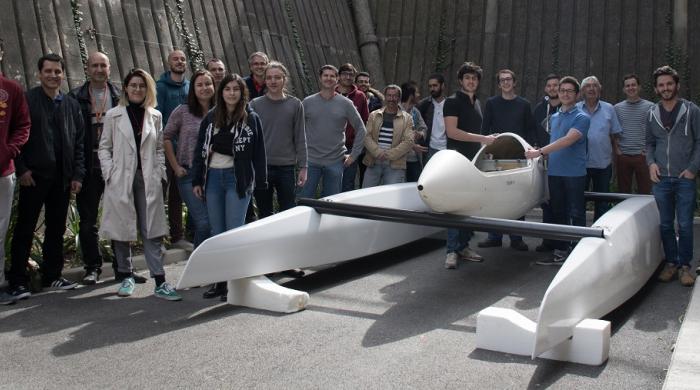
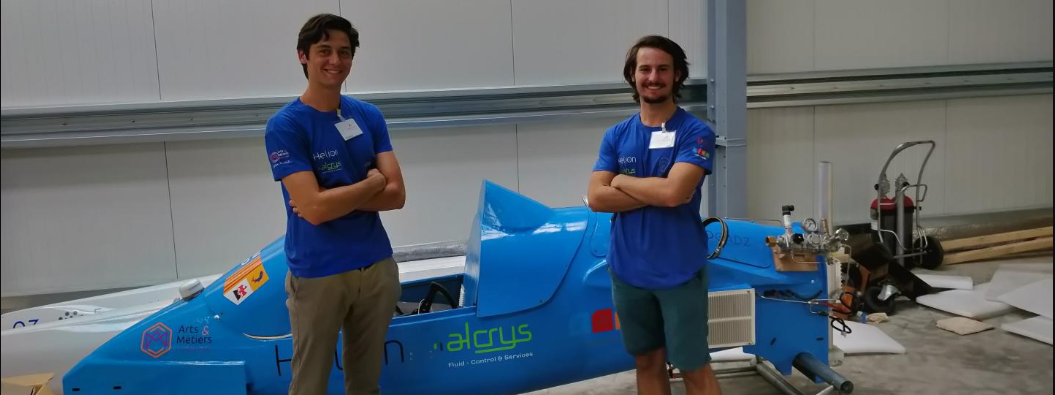
The project involves creating a cockpit with the insertion of a hydrogen tank, a fuel cell, sensors, the engine, and electrical controls. This is a real challenge when you consider that this technology has not yet found its market in land transport. Thus, Blue² was born.
Educational objectives
This work is carried out as part of academic projects (PJT). The educational objectives of PJTs are to acquire and implement skills inherent to the engineering profession (hard and soft skills). PJTs are multidisciplinary projects multidisciplinary carried out in groups (3/4 students) over a period of 40 supervised hours.
Putting a dozen PJT groups and professors to work on energy transition means promoting everyone's contribution to these collaborative projects collaborative, bringing together Organization, Design (mechanical, energy, electrical engineering), and Manufacturing.
These PJTs mobilize the skills acquired during their training: 3D modeling in Catia V5, data processing and analysis, computer programming, stress calculations, molding, and project management , etc.
Support is provided in three ways areas: enabling students to use their knowledge and expertise to acquire new skills, providing them with the necessary and useful resources, assisting them with their industrial partners, and guiding them from a methodological standpoint in order to foster a wealth of innovative ideas.
Such projects are intended to be long-term, forming partof the educational model in order to develop teaching methods based on the concept of "learning by doing." The challenge for this second year of experimentation is thus defined.
-
2020 objectives: Challenge ourselves based on blue²'s excellent results last year
The handover
Hugo AUBERTIN and Jérémi GUERIN, students in Grande Ecole Engineering Programme (Class of 2018), and their team are taking up the torch. Blue² is in their hands.
The challenges facing the new team
Taking over the project means making technical and organizational improvements. The main innovations that will be made to the boat will enable its current potential to be developed and increased: autonomy, reliability, maneuverability, and maximum speed.
Current performance of Blue²:
Cruising speed: 8 knots
Maximum speed: 11 knots
Onboard energy: 5kWh
Range: 16 km
Improvements in technical performance will be achieved through:
- Installation of a more powerful motor (7.1 kW)
- The increase in fuel cell power (which will significantly increase the weight of the boat)
- Reducing drag by working on weight distribution in the cockpit
- Choosing a more suitable propeller
- The development of greater autonomy (16NM)
- The design of a new cockpit. With a weight restriction of 260 kg, the cockpit will need to be made lighter and the space available on board increased.
- Boat safety
Perfectly integrated into the school's teaching program, the HydroGadz project is the subject of six second-year PJTs carried out over two semesters. The themes of these projects cover all the elements of the above synoptic diagram of the boat:
- Hydrogen Storage
- Hybridization
- Cockpit renovation and improvement
- Transmission/Engine
- Communication system
- Design of a new cockpit
The team plans to conduct several sea trials before presenting the boat at the 6th edition of the Energy & Solar Boat Challenge. Thegoal is to take first place in the overall ranking of the 2020 edition, while retaining the title of winner in the "Hydrogen" category.
For the record, during the 2019 Solar & Energy Boat Challenge, the HydroGadz team took fourth place overall and first place in the Hydrogen category. HydroGadz also received the ZERO EMISSION Award and a check for €2,000.
Hydrogadz has received support from the Arts et Métiers Foundation with the award a prize of €5,000 in January 2019, with support renewed this year.
Blue² also won the innovation award for Best Community Project organized by PEYMPA last April.
Some figures
€80,000 budget
30 students and 10 professors
16 sponsors
5 partners
Testimonial from Julien Gomand, Senior Lecturer in Electrical Engineering at the Arts et Métiers campus Arts et Métiers
How do you support students in their challenge?
The successful integration of project activities into teaching requires students to take ownership of these projects. Participating in an official competition is a powerful lever for making this alchemy work. To achieve this, a group of students motivated by this goal must be behind the project's inception and take responsibility for its management. This activity, including the search for sponsors, represents a significant amount of personal work for the students responsible for the Hydrogadz project. We thank them for their investment, which is essential to the life of the project.
The teaching team at the Arts et Métiers campus Arts et Métiers then happy to provide support whenever students identify a difficulty requiring new skills, and to ensure that engineering methodology remains a priority despite the focus on results.
What support does the campus provide to Hydrogadz?
The campus also supports Hydrogadz by providing access to premises and equipment for building the boat. The campus also funds student travel to trade shows and company visits.
Hydrogadz is invited to present its project at various events aimed at the general public: science festivals, recruitment and university promotion events, open days, etc.
The school's communications department also regularly disseminates information both externally and within the school.
Introducing the teaching team supporting the HydroGadz project
Camille Favarel, Pierre Garambois, Julien Gomand, Alain Lagier, François Malburet, Lionel Martin, Arnaud Polette, Lionel Roucoules, and Philippe Véron