The Bordeaux Institute of Mechanics and Engineering (I2M) is partnering with four universities in Australia to optimize materials obtained through additive manufacturing. This international project aims to strengthen the synergy between academic research and industrial applications.
An IRP-CNRS at the forefront of innovation in additive manufacturing
The Bordeaux Institute of Mechanics and Engineering (I2M / Arts et Métiers, Bordeaux INP, CNRS, Inrae, University of Bordeaux) has been working since 2020 with the University of Canberra, the University of Sydney, Monash University, and Swinburne University, four major universities in Australia, to develop an international research project led by the CNRS as part of the IRP (International Research Project) programs. The AMHELIE project is dedicated tooptimizing architectured materials obtained through additive manufacturing, covering the process and sustainability aspects related to this process. This partnership aims to improve the performance of materials used in cutting-edge sectors, particularly biomedicine and aeronautics.
Objective: to establish links between the development of new alloys, process optimization, mechanical behavior, and simulation, particularly in the field of microstructure-process relationships and engineered materials.
The collaboration between I2M and Australian universities is based on complementary expertise. I2M stands out for its recognized know-how in analyzing damage mechanics in relation to the microstructure of materials, while the Australian teams bring leading expertise in metallurgy and additive manufacturing processes.
Technological advances and practical applications
The research program is structured around several complementary areas:
Development of new alloys: The University of Sydney and Monash University are working on titanium alloys offering enhanced mechanical performance, while Swinburne University is focusing on TiNi alloys for biomedical applications.
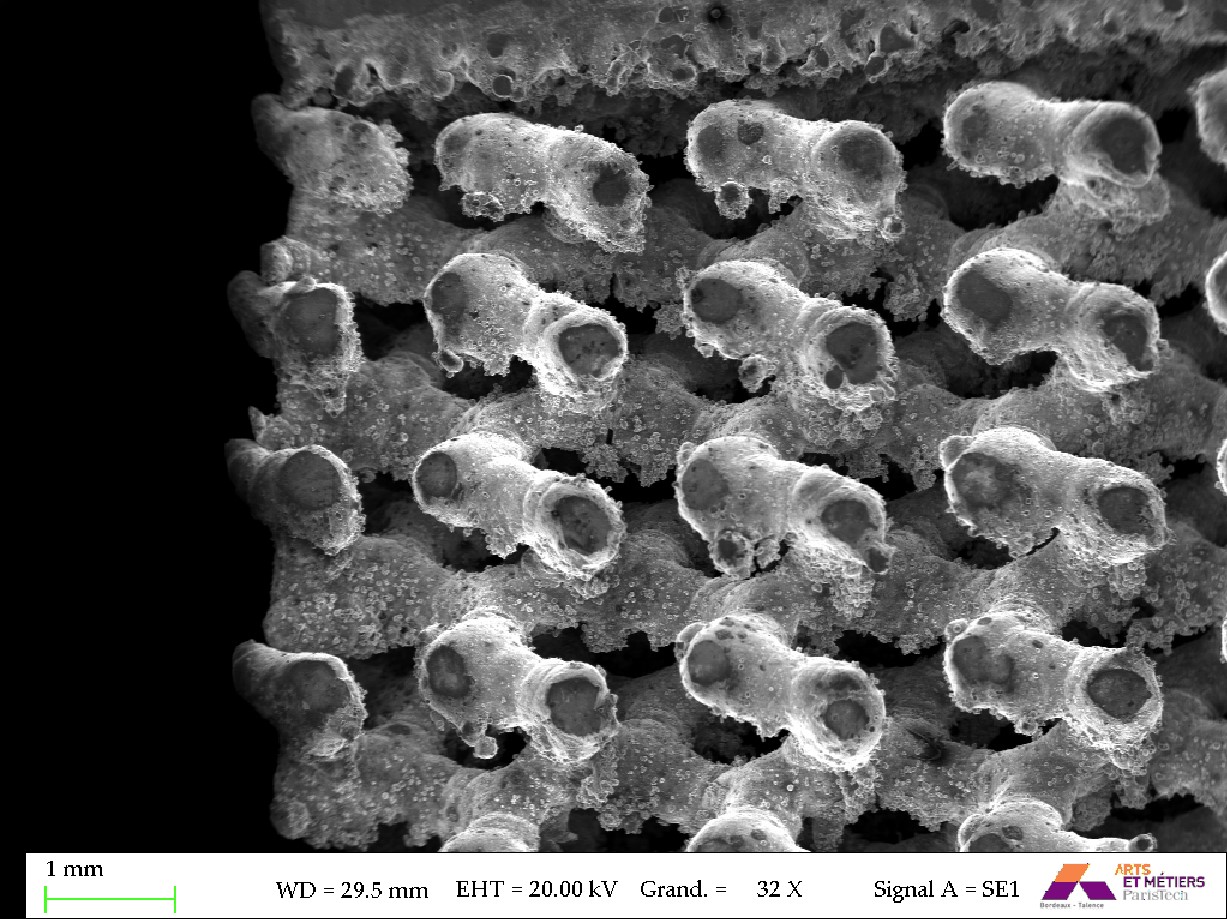
Material analysis and characterization: Teams from I2M and the University of Canberra examine the microstructures and mechanical behavior of materials under extreme conditions, particularly fatigue and dynamic stress.
Advanced modeling and simulation: The objective is to better understand damage and deformation mechanisms in order to optimize designs and predict the service life of materials.
Structural optimization: These structures, produced using additive manufacturing, combine lightness and strength, opening up new industrial possibilities.
Mechanical tests and in-depth microstructural studies are carried out to better understand the impact of manufacturing processes on the final properties of materials. Collaborations with industry partners also enable the adaptability of structures to real-world stresses to be assessed, particularly in aerospace and regenerative medicine. In addition, experiments are underway to reduce defects and take them into account in dimensioning methods and to improve surface finishes in order to perfect the quality of parts produced by additive manufacturing.
A forward-looking collaboration
This partnership is part of a strategy of major structural projects, notably the BEST 4.0 project, in which additive manufacturing and engineered materials play an important role. It also provides an opportunity to develop strategic industrial collaborations with , for example, the naval sector.
Furthermore, this collaboration represents a first step toward creating an international research network aimed at broadening the scope of research and identifying new academic and industrial synergies.
This cooperation strengthens ties between France and Australia, particularly through researcher exchanges and jointly supervised theses. Ultimately, the advances resulting from this project will contribute to the development of innovative solutions for the materials and structures of tomorrow.