For more than twenty years, the Microstructures and Materials Mechanics Laboratory (LEM3) on the Metz campus has been supporting manufacturers in the development of more environmentally friendly steels. This expertise is also put to good use in the training of engineering students in the Grande École Program.
Lightening steels
One solution for producing greener steels is to make them thinner with improved mechanical properties. Requiring less raw material, these steels also make it possible to lighten the structure for which they will be used.
The campus's teaching and research staff work closely with industry partners in two main areas:
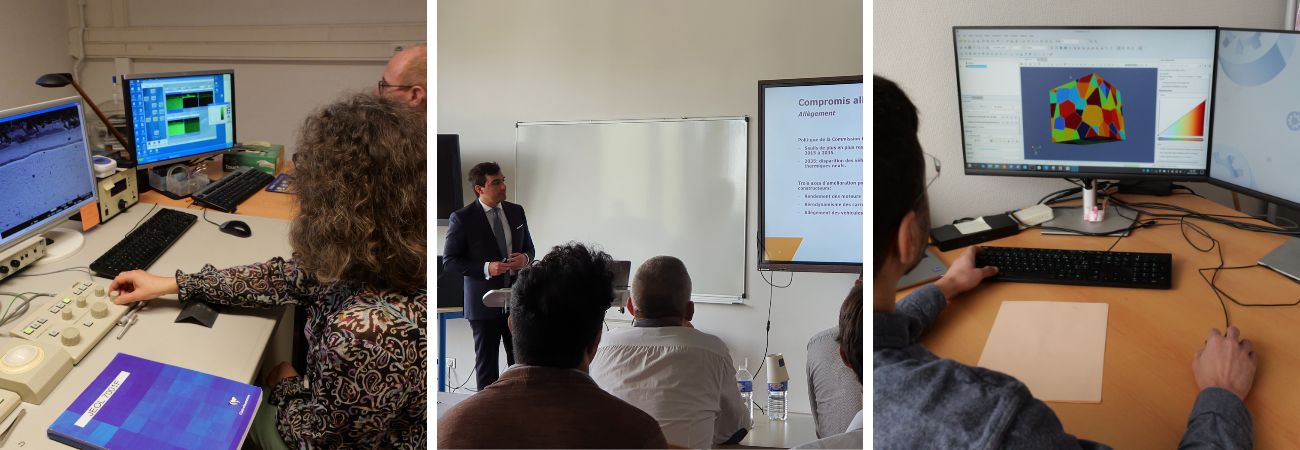
- Experimental analyses using, for example, X-ray diffraction or synchrotron radiation and neutrons. These analyses enable us to understand and optimize the behavior of steels according to the parameters used to manufacture them: heating, deformation, and cooling temperatures, etc.
- The development of advanced numerical simulation models that take into account microstructure and size effects to predict how structural weight reduction can influence the macroscopic behavior of materials.
Producing recycled steel
Another approach to producing more environmentally friendly steels is to produce them using greater recycling.
The LEM3 teams are also working on characterizing and optimizing recycled steels. These may contain residual elements that are undesirable in the chemical composition and likely to impact the shaping and behavior of the material.
This area of research is currently being developed at the Metz campus, notably thanks to the launch of the Reclassif project.
Raise awareness among engineering students about the use of new, more environmentally friendly steels.
Since January 2024, second-year students in the Grande École Program at the Metz campus have been taking new tutorials (ED) in which they compare the carbon impact of old and new steels, known as "green" steels. This is an exercise that they will undoubtedly be able to replicate in their professional lives: 90% of the steels used today did not exist fifteen years ago!
Since the start of the academic year, second-year students have also been participating in projects to characterize the impact of recycling on the properties of steel. These approaches will be useful in their future professional lives, as the issues encountered in recycling other materials may be similar.
More generally, starting next year, students in their final year will be able to tackle the challenges of industrial decarbonization thanks to new expertise in carbon-free materials and energies for a sustainable industry.