A look back at the progress made by the JENII project in recent months. On the agenda: technological improvements, a symposium, and new means of dissemination.
"The JENII project is a building block of the Evolutive Learning Factory program Evolutive Learning Factory give our students a better understanding of the digital transition in industry," explains Véronique Favier, Deputy Director General and Scientific Director of the project.
The Digital, Immersive, and Interactive Teaching Twins project, launched in November 2021, aims to develop digital twins for teaching. The goal is to clone real work environments in a virtual environment for remote training, freeing users from physical constraints.
A project coordinated by Arts et Métiers
Coordinated by Arts et Métiers, this project is also supported by CEA Tech, the Conservatoire National des Arts et Métiers CNAM) and CESI.
It is organized into several working groups, including various Arts et Métiers representatives Arts et Métiers
- WP0: Management and coordination (Sébastien Fernandez)
- WP1: Development and improvement of educational pathways (Saïda Mraihi, Maëva Coffin)
- WP2: Development and integration of digital platform and technological modules (Emmanuelle Chavanne, Benjamin Poussard)
- WP3: Evaluation of training programs (Sylvain Fleury)
- WP4: Dissemination of training programs (Ivan Iordanoff)
Technological advances
The JENII project is based on four application units:
- the representation that focuses on making virtual twins look as realistic as possible,
- physicalization that reproduces the mechanics and interactions of objects as in the real environment,
- the interaction that enables the relationship between the user and the twin
- Connectivity, which aims to connect the twin to its real environment in order to improve its accuracy.
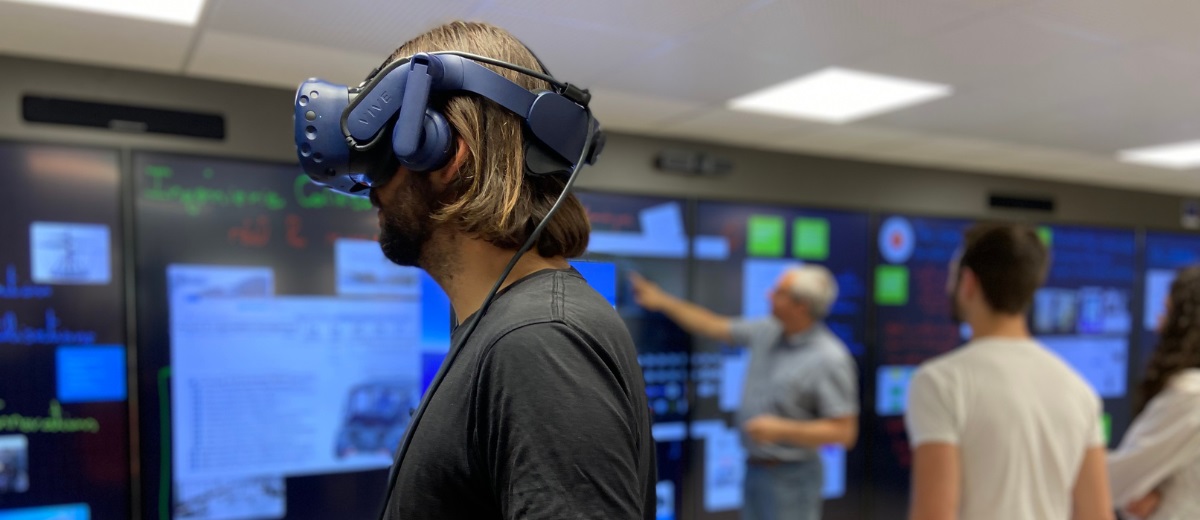
This year, the representation has evolved significantly. For example, it is now possible to put on a headset and walk around the "Procédés de fonderie Coquille Coulée Gravité" (Shell Casting Gravity Foundry Processes) digital platform in Angers. To achieve this, a 3D model has been developed along with several animated sequences, adding an environment and opportunities for interaction.
As it stands, users can interact with the digital twin using simple mechanisms with a few animated sequences.
The next step will be to integrate physical models that require computation into all platforms and to integrate data feedback from real machines to enhance connectivity.
A first major event
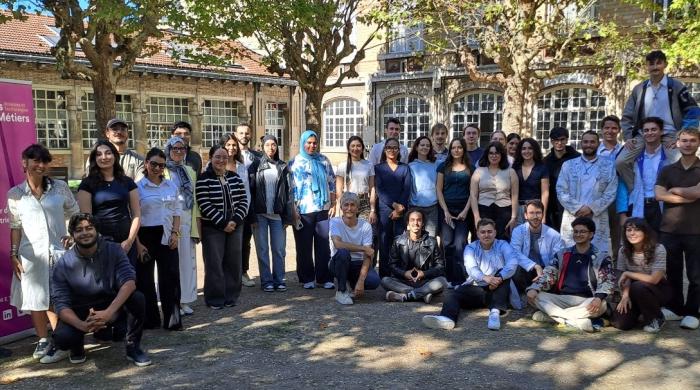
JENII also got off to a brilliant start in 2023 by organizing a symposium open to the public on March 23.
Entitled "Metaverse and digital twins, immersive technologies for training," it took place in two parts. The morning was devoted to presenting the project, its objectives, and its two pillars: educational and technological innovation. The speakers reviewed the first 18 months of the project and conducted the first demonstrations. Participants were able to use VR headsets to experience immersion in the workshops.
In the afternoon, participants attended two round tables that opened the debate on two topics: inclusion and the uses of immersive technologies.
This was an important opportunity for discussion, highlighting the challenge facing JENII: to enable everyone to learn remotely, with the help of new technologies.
During the conference, use cases were also presented in industry with Stellantis, Safran, and Renault, as well as in higher education with Neoma Business School and with an intensive care physician at UPEC. The entire conference is available on the project's YouTube channel.
Finally, this event was an opportunity to present the first version of the white paper "Teaching with immersive and interactive digital twins" developed by the project team.
Writing a white paper
The idea of creating a white paper arose from an observation: there is a wealth of scientific literature on immersive technologies, but very little on their use in training. For example, out of approximately 4,000 articles dedicated to digital twins, only about 30 deal with the subject of learning. This white paper is the first of its kind and will be expanded as the project progresses. The first version, published on March 13, 2023, is already available for free on the RELIAM platform.
A dissemination strategy taking shape
In addition to the white paper providing information on teaching in immersive environments, JENII is working on dissemination in high schools, particularly in Metz as part of a test phase. Cyrille Baudoin, leader of the Vulcain platform, has been working with high schools in the region for a long time. The aim is to identify their training needs and build bridges between teachers and the themes developed in the project.
Digital twins themselves can be used as a support, as they allow us to visualize the invisible and phenomena that are difficult to perceive in the real environment.
The team is working on a discovery module for the community to explain what a digital twin is and what it can be used for. A student ambassador program will also be set up to promote the project to theArts et Métiers student community.
Sébastien Fernandez, project manager and coordinator, is delighted with the progress of the project and hopes to further develop the educational aspect in the near future: "We are extremely satisfied with the progress made by the JENII project this year. We have been able to present our first demonstrations, publish our white paper, and strengthen our presence at various trade shows. Our commitment will continue with a focus on dissemination to the educational community. We look forward to sharing our work and continuing to advance the use of digital twins in the field of learning."
The eight physical platforms ofArts et Métiers
- Cobotic platform and assembly line (Richard Béarée, Lille)
- Practice 4.0 Platform (Emmanuelle Chavanne, Bordeaux)
- Vulcain Platform (Cyrille Baudouin, Metz)
- Energy and Fluid Systems Platform (Florent Ravelet, Paris)
- Platform Foundry Processes Shell Casting Gravity Casting (Julien Artozoul, Angers)
- Low Pressure Platform (Jérémie Bourgeois, Aix-en-Provence)
- Unwinding platform (Louis Denaud, Cluny)
- High-performance machining platform (Guillaume Fromentin, Cluny)