Establishment of a training facility on the Paris campus

Establishment of a training facility on the Paris campus - ELF
News
Evolutive Learning Factories

Until recently, theEvolutive Learning Factory ELF) project in Paris was just an idea floating around, a concept for a factory-school whose potential was recognized but whose concrete achievements were not yet apparent. Today, its implementation is gathering pace!

The dominant theme chosen for the Paris campus, "sustainable health," is based on the observation that it is possible to bring together the campus's five laboratories around this theme. 
For example, a prosthetic foot designed at IBHGC is being designed and tested at LCPI, produced using processes studied at PIMM, and incorporates a hydraulic motor combining LIFSE and flow calculations at DYNFLUID. Students will thus learn about Industry 4.0 industrial systems and demonstrators through an iconic product.

Today, the implementation of ELF is accelerating:

  • The ELF project team, led by campus management, has been set up and benefits from the expertise of the ELF correspondent (Vincent Meyruies), the representatives from each laboratory, and the Learning Center representatives (Morgan Dal and Sébastien Rolland). A new ELF support service integrating the 2CRP and the Learning Center (Jean-Baptiste Septiers, Isabelle Feral, and Carole Wahnoun) completes this organization. 
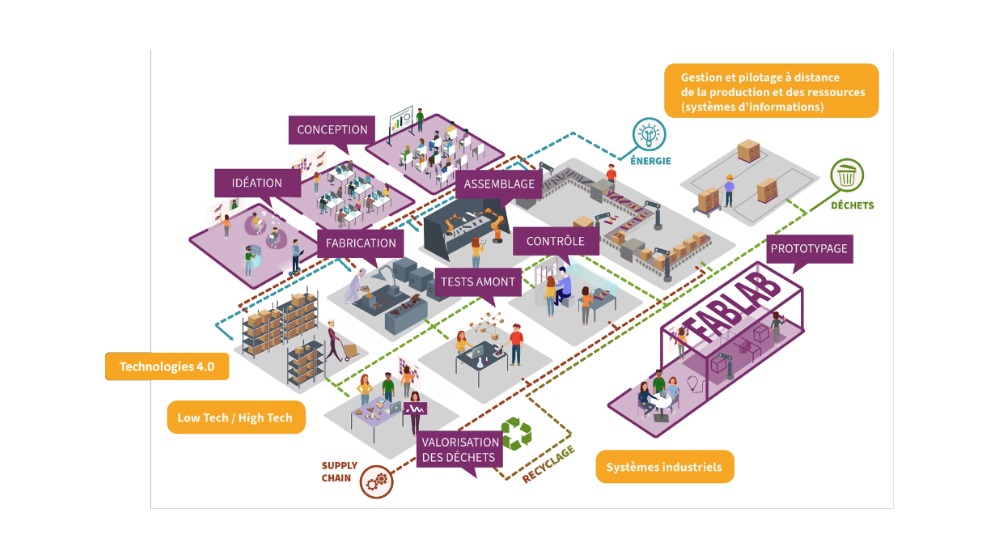
  • The €14 million in state/regional funding from the 2021-2027 CPER (State-Region Economic Development Contract) aimed at renovating halls 3 and 4, the sheds, and developing the ELF requires planning now, during the programming phase, for the various target areas of the ELF: machining, metal forming, composites, assembly-manufacturing, mechatronics, additive manufacturing, in addition to the ELF's management and control area, quality monitoring ("Obeya"), control/testing, CAD spaces, calculation, simulation, showroom, not to mention stores, office automation, logistics, changing rooms, etc.. 
  • Funding and equipment contributions from manufacturers are in the process of being secured (bearing in mind that half of the funding for ELF equipment can be provided by the institution), which offers new opportunities for both teaching and research: high-power lasers, fuel cell test benches, injection molding machines, etc. 
  • Spaces near the library will be freed up (first phase in July 2024) to offer new opportunities for teaching methods that more easily incorporate independent learning, free design, and prototyping. 

The ELF on the Paris campus is therefore moving forward and gradually taking shape thanks to the skills available on site and the many ideas shared recently, which are helping to promote innovative teaching methods geared towards industry.

The dominant theme chosen for the Paris campus, "sustainable health," is based on the observation that it is possible to bring together the campus's five laboratories around this theme.  For example, a prosthetic foot designed at IBHGC is being designed and tested at LCPI, produced using processes studied at PIMM, and incorporates a hydraulic motor combining LIFSE and flow calculations at DYNFLUID. Students will thus learn about Industry 4.0 industrial systems and demonstrators through an iconic product.   Today, the implementation of the ELF is accelerating:   the ELF project team, led by the campus management, has been formed and benefits from the expertise of the ELF correspondent (Vincent Meyruies), the representatives of each laboratory, and the Learning Center representatives (Morgan Dal and Sébastien Rolland). A new ELF support service integrating the 2CRP and the Learning Center (Jean-Baptiste Septiers, Isabelle Feral, and Carole Wahnoun) completes this organization.  The €14 million in state/regional funding from the 2021-2027 CPER (State-Region Partnership Contract) aimed at renovating halls 3 and 4, the sheds, and developing the ELF means that the various target areas of the ELF must be planned now during the programming phase: machining, metal forming, composites, assembly-manufacturing, mechatronics, additive manufacturing, in addition to the ELF's piloting and control area, quality monitoring ("Obeya"), control/testing, CAD spaces, calculation, simulation, showroom, not to mention the stores, office automation, logistics, and changing rooms.Funding and equipment contributions from manufacturers are in the process of being obtained (bearing in mind that half of the funding for ELF equipment can be provided by the institution), which offers new opportunities for both teaching and research: power laser, fuel cell test bench, injection molding machine, etc.  Space near the library will be freed up (first phase in July 2024) to offer new opportunities for teaching methods that more easily integrate independent learning, free design, and prototyping.  The ELF on the Paris campus is therefore moving forward and gradually taking shape thanks to the skills available on site and the many ideas shared recently, which are helping to promote innovative teaching methods geared towards industry.
Latest news

Sourish GHOSH will defend his thesis on Monday, March 23, 2026, at the Arts et Métiers campus Arts et Métiers .

Search

On March 11, 2026, the CAIRE project’s general meeting was held at the University of Burgundy Europe (UBE) in Dijon.

News, Evolutive Learning Factories

David Prat, a professor at the Cluny campus, shares his experience with the CAIRE project and explains how he helps students and staff use AI critically and responsibly.

Evolutive Learning Factories, Innovation

Alongside five other Arts et Métiers students, Léontine Laurent and Solène Molima

Sustainable Development, Testimonial