The European MAXIMA project is celebrating its 18-month anniversary. Stéphane Clénet, project coordinator, explains its objective and progress.
What progress has MAXIMA made in recent months?
We are in the final stages of designing an electric motor to achieve the performance required for motor vehicles. We have compared different structures to find the solution that meets performance requirements in terms of speed, torque, energy efficiency, and low environmental impact.
We evaluate it using two indicators: its impact on global warming and on resource depletion. These indicators help us make decisions about our technological choices.
The results are not yet fully consolidated. We are currently comparing it with a motor available on the market.
Who is involved in this project?
On the Arts et Métiers side, there are three laboratories involved. L2EP contributes significantly to electrical engineering and digital twins, MSMP to design/manufacturing and processes, and i2M to the entire life cycle analysis, particularly the engine recycling phase. In terms of partnerships, we are working with 10 partners from six European countries, each with their own expertise (see below).
What are the important steps in manufacturing an engine?
There is the manufacturing phase, the usage phase, and the end-of-life phase of the engine, which is linked to its recycling or reuse. It turns out that the usage phase of the engine has a significant environmental impact, particularly in terms of its energy efficiency, i.e., the ratio between the electrical energy absorbed and converted into mechanical energy. Unfortunately, physics dictates that there are losses between the two that need to be reduced. For example, we are developing digital twins as part of the project to control the engine in order to optimize its energy efficiency.
What other methods do you use?
We analyze the motor's life cycle. An important aspect of MAXIMA is the recycling of materials, particularly permanent magnets. This is because rare earth elements, known as "heavy" rare earths, are used to manufacture magnets in electrical machines. These materials are critical in the sense that they are expensive and difficult to source. The idea is to implement measures during the design phase that will limit the use of heavy rare earths and make it easy to extract the magnets from the machine for recycling. This will help to reduce the depletion of resources.
The prototype design should be completed in early 2025, after which we will move on to the manufacturing phase.
MAXIMA ( Modular AXIal flux Motor for Automotive) is a four-year green mobility project aimed at developing a high-performance synchronous axial flux motor by removing the technical and financial barriers to its production.
The objective is to comply with European regulations, which have set 2035 as the end date for the production of combustion engines in new cars. To achieve this, the partners are working to limit the use of rare earths in production and are studying the environmental impact of engine manufacturing using life cycle analysis methods.
This project is part of the Horizon Europe program and brings together a consortium of six European countries, including research teams and industrial companies from Sweden, Germany, Belgium, France, Spain, and Romania.
MAXIMA's European partners and their areas of expertise
Manufacturers
- ArcelorMittal / OCAS (Belgium): production of ferromagnetic sheets
- Stellantis (France): Specifications and integration into the vehicle
- Höganäs AB (Sweden): production of composite magnetic materials
- MIMplus (Germany): production and recycling of permanent magnets
- 4Multiphysics (Romania): engine design
- Emotors (France): design of the motor and its manufacturing process
Academics
- Arts et Métiers France): coordination, material lifecycle, manufacturing, processes, digital twins
- University of Lille (France): digital twins, magnetic materials
- Polytechnic University of Catalonia (Spain): engine power supply and control, cooling, digital twins
- Fundación Universidad Empresa Gallega (Spain): communication and dissemination of the project
- Technical University of Cluj-Napoca (Romania): engine design
- EVERGi, Vrije University of Brussels (Belgium): life cycle analysis
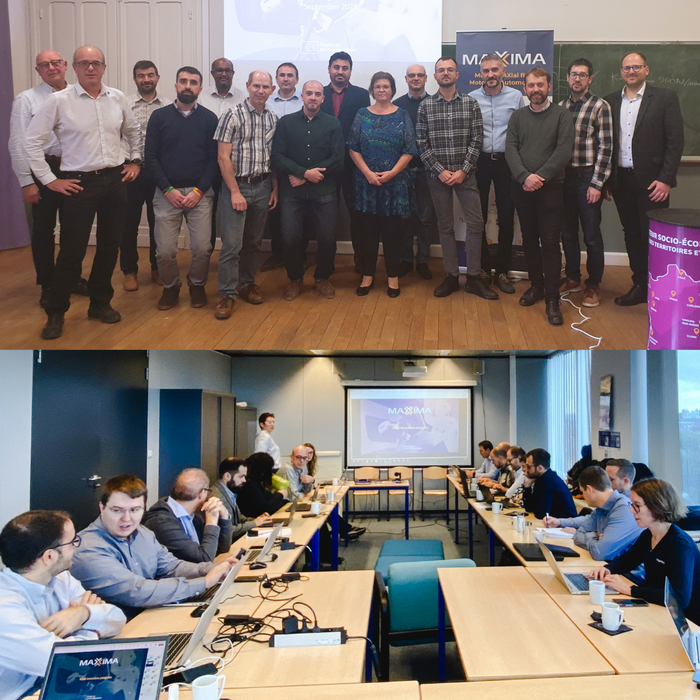
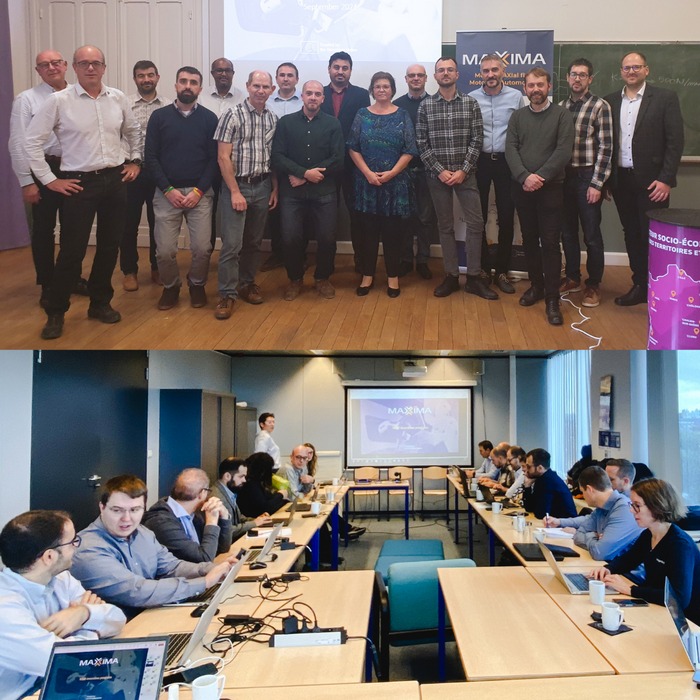
Two MAXIMA events: the advisory board meeting on September 18, 2024, on the Paris campus and the 18-month project review on Thursday, October 10, 2024, in Brussels.