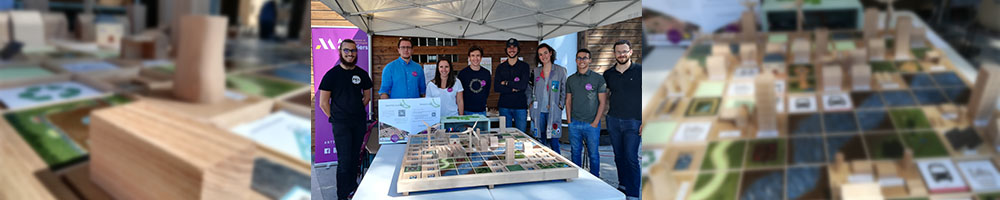
How can we make a city environmentally sustainable? That is the question students in the Grande Ecole Engineering Programme Angers campus are trying to answer through the Sustainable Construction Engineering and Management (IGDC) track with the board game “SimCities Durables.”
Arts et Métiers the podium!
As part of an educational project initiated in the second year and continued in the third year, students at the Angers campus developed a board game called "SimCities Durables" (Sustainable SimCities), which was entered in the "Les génies de la construction"(Construction Geniuses) competition in the higher education category. Out of 24 competing teams, theArts et Métiers teamArts et Métiers third place, an impressive achievement for a general engineering school! "We are very happy. This competition showcases the work carried out by the students over several months and also highlights our IGDC program, which allows students to develop their skills in areas related to construction in the broadest sense," explains Guillaume Grampeix, a civil engineering and construction teacher who supervises the students involved.
"Sustainable SimCities," a game combining education and strategy
Today's students are increasingly aware of environmental issues. The board game "Sustainable SimCities" provides an educational way to highlight actions that benefit the environment. The game is based on a medium-sized French city with 100,000 inhabitants, spread over a board with 100 squares to be filled with tokens divided into nine categories: energy production, housing, industry, transportation, etc. The game is based on three factors: the correct sizing of the categories (e.g., enough housing for all inhabitants), pollution (taking into account greenhouse gas emissions), and the placement of each category on the board. Players must therefore be strategic in placing their pieces and choosing categories and subcategories. For example, should we prioritize a nuclear power plant or a wind farm? This is a thinking game that allows everyone to understand the challenges of sustainable development in a city. To earn the most points, you have to make the right choices!
Developing a variety of skills through an innovative project
Digital tools, computer code, simulation, electronics, CAD/CAM—we worked on the theme of construction in the broadest sense and also developed our knowledge of topics related to sustainable development, which is very important today. These are skills that will serve us well later in our engineering careers, the studentsconclude .
This project has enabled us to develop our skills through a very concrete project that addresses a current and real issue.
The jury for the "Les génies de la construction" competition, composed of representatives from the Ministry of National Education, Higher Education, teachers, and construction industry stakeholders, appreciated the approach taken to design and develop a multi-criteria game that addresses a well-defined and topical issue, as well as the relevance of the data provided by this game. "Sustainable SimCities"is a game that addresses the issues raised by the evolution of a smart territory, an innovative and unique game on the market!
The "Construction Geniuses" competition is organized by the Ministry of National Education, the École Française du Béton foundation, the Fédération Française du Bâtiment, the Fédération Nationale des Travaux Publics, the Committee for Consultation and Coordination of Apprenticeships in Construction and Public Works, and the Association for Knowledge of Public Works, in partnership with the National Association for Technology Education, the Association of Teachers of Construction and Public Works, and the University Association of Civil Engineering. Find out more about the competition: https://geniesconstruction.information-education.org/2020/index.php#site-nav
A game already presented to the public in September 2019
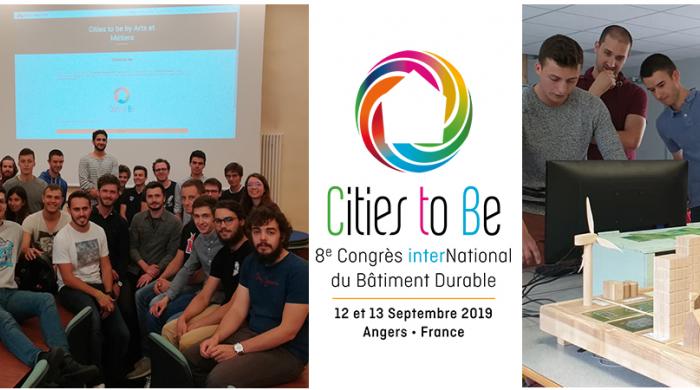
The board game "Sustainable SimCities"was presented to the public for the first time in September 2019, during the event "Angers 2030 - imagining the city of tomorrow," which took place in parallel with the international sustainable building conference "Cities to Be." Supported by Novabuild, the cluster that brings together construction companies in the Pays de la Loire region, COBATY, the international federation for construction, urban planning, and the environment, the engineering students worked closely with students from the CFA in Maine-et-Loire.