Arts et Métiers its commitment to ecological transition and social responsibility and structures the actions already initiated in these different areas of activity by adopting its DDD&RS action plan. The plan is based on the five pillars of the DD&RS label, in line with the objectives of the French government's energy efficiency plan, the Convention for the Transition of Higher Education Institutions (CTES), the Ademe framework, and the United Nations' 17 Sustainable Development Goals.
Find out more about Priority 1: "Strategy, governance, and local roots"
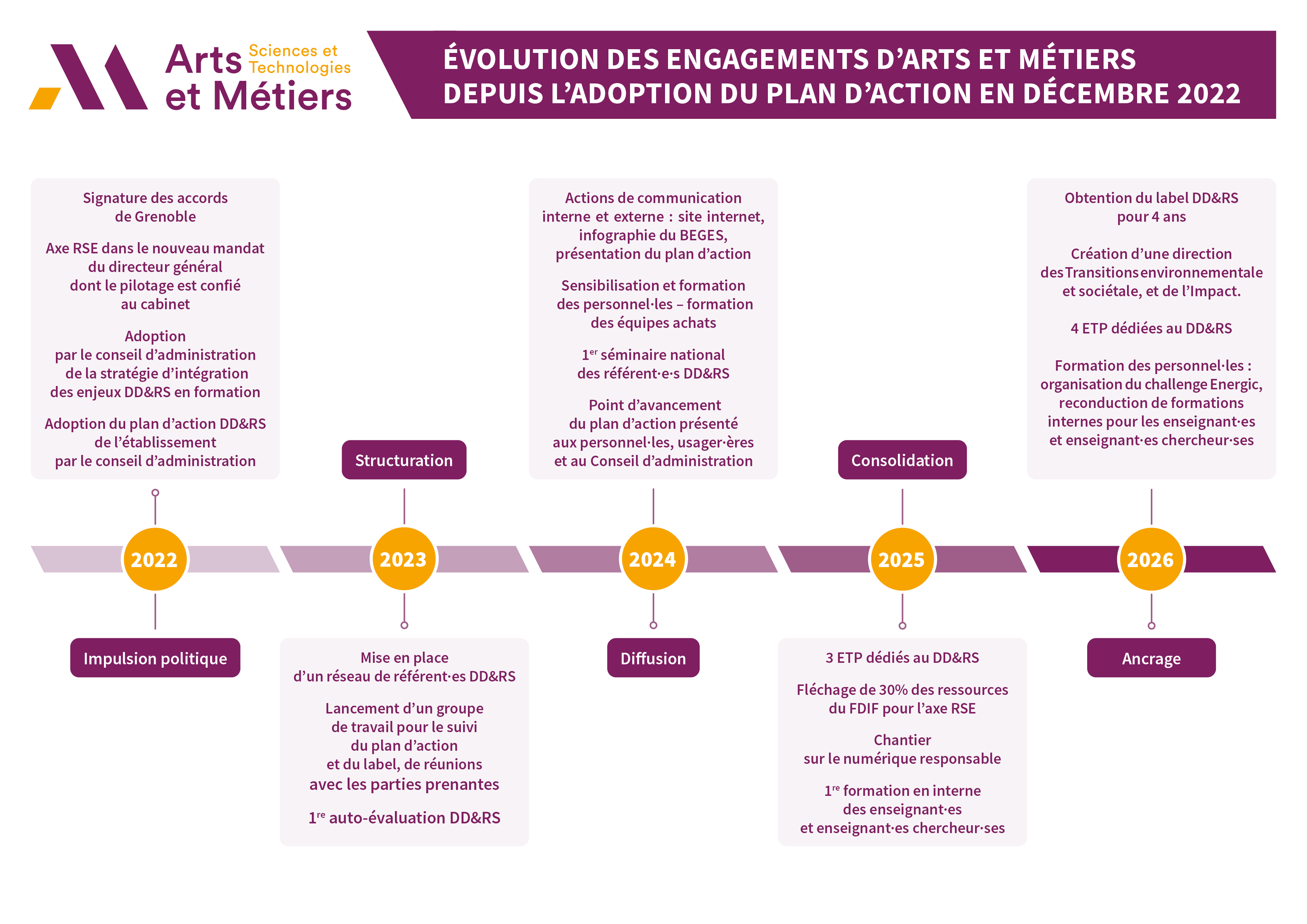
Arts et Métiers continues its commitment to the environmental transition and social responsibility. Over the years, the institution has structured its approach by establishing governance bodies, implementing concrete actions, and earning national recognition. The chart below outlines the key milestones that have shaped this momentum and illustrates the gradual integration of environmental and societal transition issues into the School’s activities.
Governance
Leading the transition
Arts et Métiers places sustainable development at the heart of its strategy. To support this initiative, the institution has established a governance structure dedicated to the Ecological and Societal Transition (TES). This structure oversees the implementation of initiatives, promotes dialogue among the various stakeholders, and ensures that environmental and societal issues are integrated into all of the School’s missions. The TES is reviewed weekly by the Executive Committee ( COMEX) and monthly by the Management Committee (CODIR), with an annual review by the Board of Directors. The institution also relies on its Regional Council to enrich its thinking and strengthen its ties within its local ecosystems. Finally, the School has partnered with student associations and the alumni association to train leaders for responsible industries.
A clear and cross-functional organization
TES governance is based on:
• Oversight by a TES department reporting to the CEO
• Regular monitoring of the initiative by the Executive Committee, the Management Committee, and the Board of Directors
• Three full-time equivalents (FTEs) are entirely dedicated to CSR
• A network of TES liaisons on each campus and within each of the DGA departments
• A dedicated task force for integrating TES into academic programs
• Working groups bringing together students, staff, and administrative departments
• The contribution of the regional council to strategic planning and the institution’s regional roots
Transparency and visibility
The school keeps its community well informed and involved through web news, newsletters, social media, conferences, videos, podcasts, annual CSR reports, and board meeting minutes.
The aim is to make its actions visible, understandable, and accessible to all stakeholders.
🔗 More information is available in the Arts et Métiers CSR report and on the Arts et Métiers CSR YouTube channel.
A recognized approach
 On July 7, 2026, Arts et Métiers awarded the DD&RS (Sustainable Development and Social Responsibility) certification for a period of four years. This national recognition highlights the institution’s long-term commitment to its educational and research missions. Receiving this certification marks a new milestone for Arts et Métiers, which intends to continue and strengthen its commitments to sustainable development and social responsibility.
Arts et Métiers every year in impact rankings such as the Times Higher Education Impact Rankings and Change Now.
The institution positions itself as a responsible and leading player in higher education.
Local roots
A network of campuses at the heart of the regions
With 13 sites in France and one in Morocco, Arts et Métiers close to the regions. This decentralized presence allows it to anchor its ecological transition, innovation, and training initiatives in local realities. The school has a regional council that is consulted on the direction of the school's regional policy. Center councils on each campus discuss local implementation and can make recommendations.
Cooperate with local stakeholders
Each campus builds active partnerships with:
- local authorities,
- companies and industrial sectors,
- academic actors,
- citizen associations and ecosystems.
These relationships shape joint projects in energy, mobility, sustainable housing, biodiversity, the circular economy, and support for industrial change.
Concrete and visible projects
Each territory has its own initiatives:
- Aix-en-Provence: water and fire management, greening, hackathons
- Angers: district heating network, green walls, student housing
- Bordeaux: sustainable transportation, waste management, geothermal energy
- Châlons-en-Champagne: recycling, biodiversity, biotechnology
- Cluny: Natura 2000 site, educational hedgerows, water management, soft mobility, wood processing
- Lille: research into low-carbon mobility and sustainable industry
- Metz: Green ELF, Green Fund Award, Energy Award, AI projects
- Paris: social initiatives, energy renovation, citizen workshops
- Chambéry Institute: the industry of the future, robust and socially responsible, transforming towards sustainability and robustness at the local level
🔗 More information on group dynamics
International
The institution has an international development policy based on academic partnerships with nearly 145 universities in 38 countries, facilitating mobility. The school has strategic collaborations with internationally renowned institutions in the fields of research and teaching. To promote the Arts et Métiers model, Arts et Métiers branch was established in Morocco in 2024.
A real economic impact
Through its training programs, laboratories, chairs, innovation projects, apprenticeships, and incubator, the institution makes a measurable contribution:
85.5% of graduates work in France, two-thirds of them in regional areas, reinforcing this territorial impact.
- 23_041_brochure_Professional integration_2024_09_13.pdf
- [ODD 2025] Student aspirations and graduate employability.pdf
Training Focus: The Grenoble Agreement
Arts et Métiers to raising awareness or training 100% of its students and staff.
By signing this agreement, initiated by COP2 Etudiante to accelerate the socio-ecological transition (TSE) in higher education and research, Arts et Métiers committed to:
- As a school: to raise awareness among 100% of learners during their first year and to provide teaching dedicated to understanding the issues witha systemic approach, to evaluate the teaching and initiate changes with regard to the specializations followed, during the next evolution of the educational model.
- As an employer: offer training to 100% of staff.
Download the Grenoble Agreement adopted and signed in January 2022.
Workshops to raise awareness of sustainable development
Arts et Métiers committed to offering 100% of its staff (including teachers) and 100% of its students awareness training on the challenges of ecological and societal transition: climate, digital technology, diversity, 2tonnes, etc. in the form of Fresques-type workshops based on scientific research. The milestone of XX staff members trained was reached in early 2023.
SOCIAL POLICY AXIS - COMMITMENT TO DIVERSITY AND EQUALITY
Building on its commitment to gender equality, in 2021 the school adopted a gender equality action plan centered on four main areas:
- Preventing and addressing pay and career gaps
- Ensuring equal access to professions and responsibilities
- Promoting work-life balance
- Combating gender-based and sexual violence, harassment, and discrimination
In January 2022, Arts et Métiers to taking action against everyday sexism in the workplace and joined the #StOpE. The organizations that have signed up to this initiative are committed to making a lasting impact on everyday sexism by rolling out eight priority commitments over time.
In September 2022, Arts et Métiers its commitment by signing the charter Cpas1option by the senior management, represented by the director of the Cluny campus and the Student Union. By signing this charter, the school affirms its desire to take concerted action to combat risky behaviors and practices associated with partying and addictive behaviors, as well as harassment, discrimination, and sexist and sexual violence (VSS), through a comprehensive prevention approach based on best practices in educational institutions.
Since 2008, the school has been a partner of the association Elles Bougent, whose goal is to introduce young girls to engineering and technical studies and careers.
Arts et Métiers female students Arts et Métiers participate in all events organized by the association (Networking and Career Forum, "Women in Engineering" or "Women Innovating for Digital Technology" days, etc.). Many of them are also involved as mentors for Elles Bougent, sharing their career experiences.
In 2017, the school launched an original campaign to promote technology and engineering among young girls, called " Technology, feminine noun ."
The school is a signatory to the Diversity Charter and the Gender Equality Charter of the Conférence des Grandes Écoles.
In addition, Arts et Métiers set up a support and reporting system (restricted access) available to all staff and students who are victims or witnesses of harassment, gender-based and/or sexual violence (HVSS) or, more generally, personal attacks (discrimination, racism, etc.).