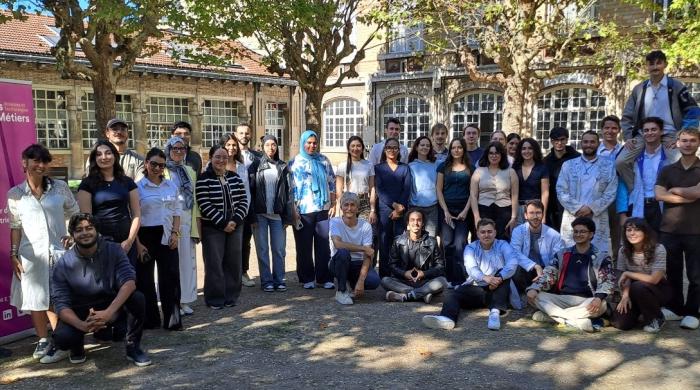
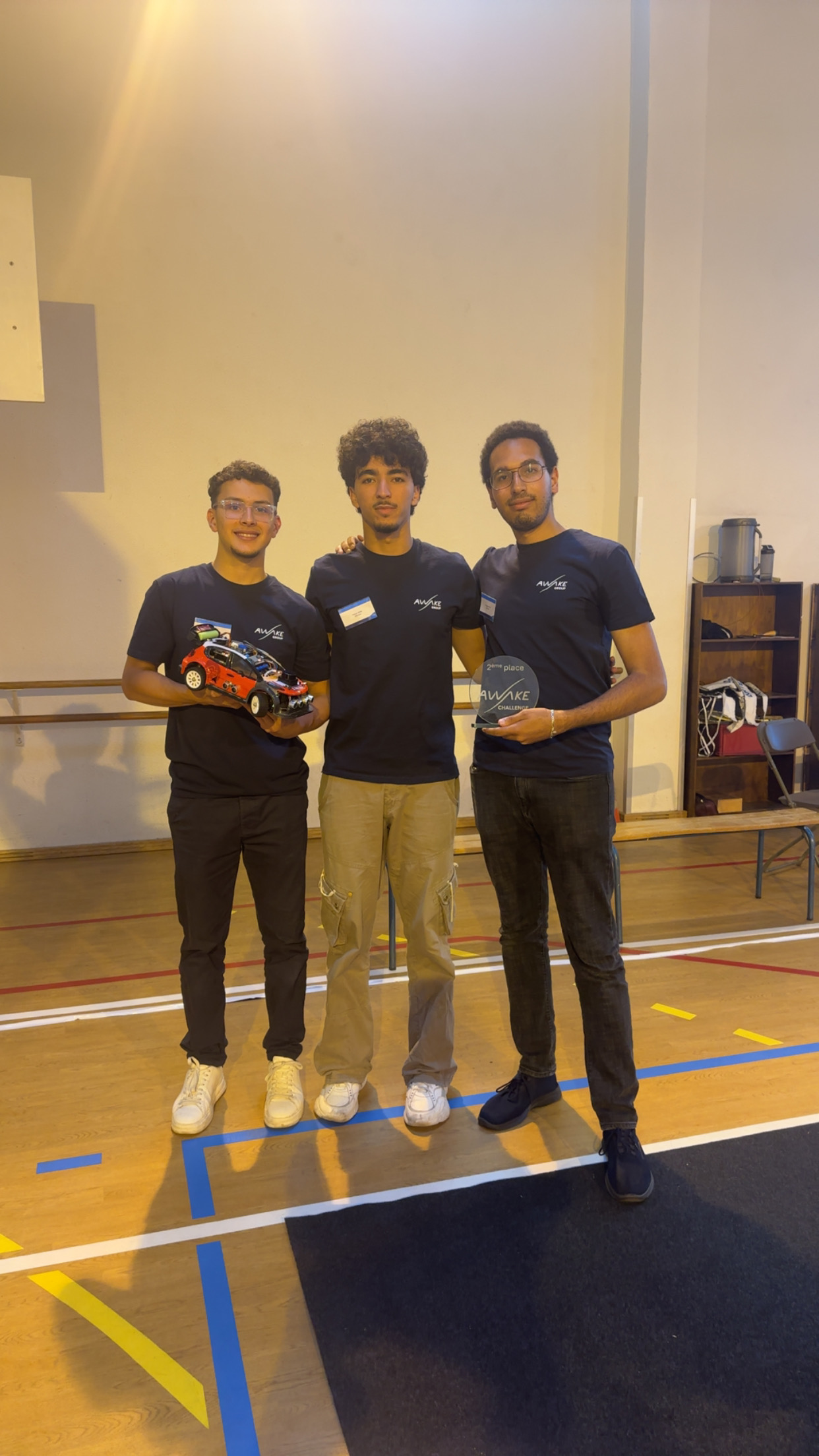
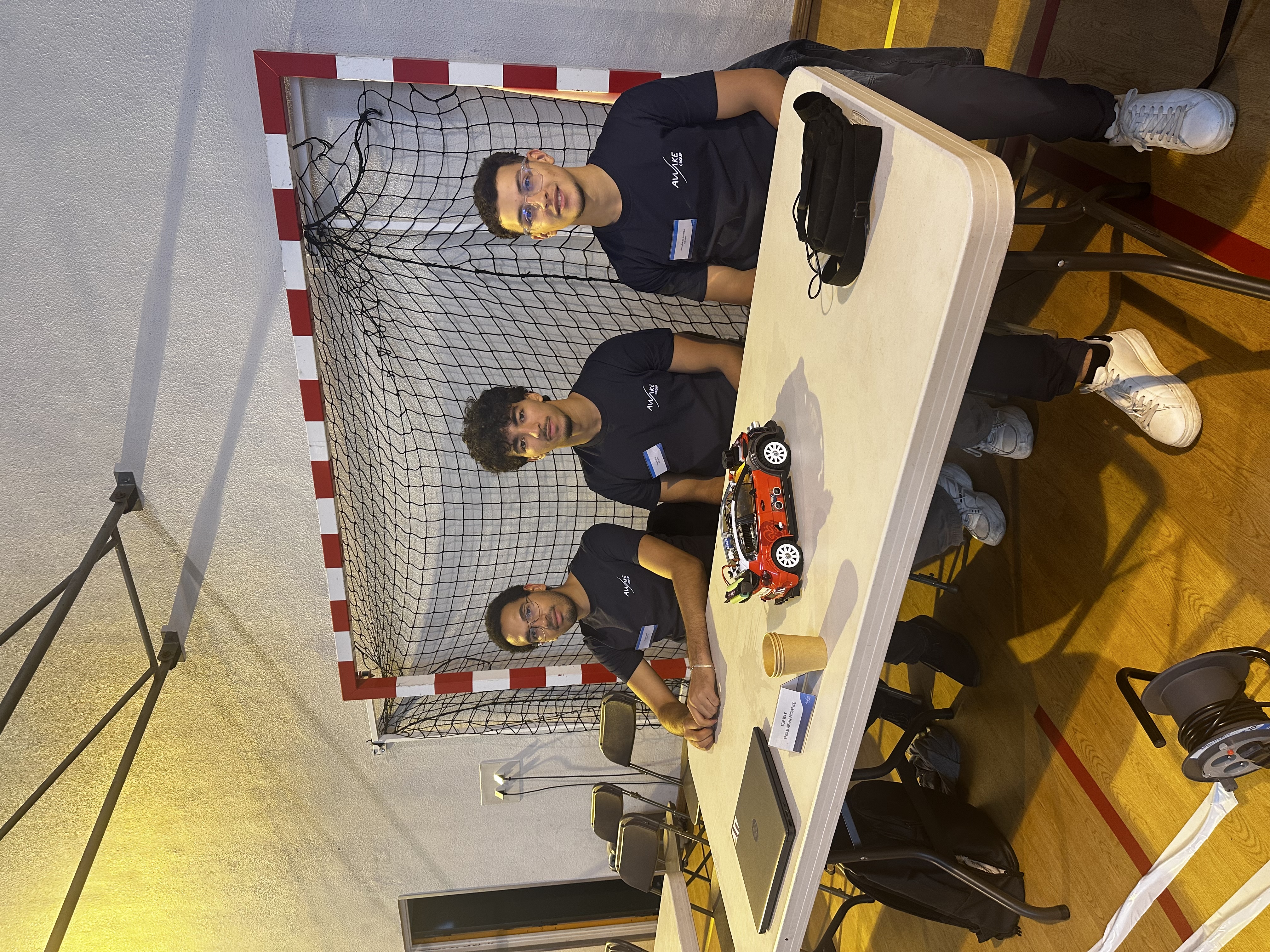
This outstanding result is the reward for several months of particularly intense work. To balance the demands of their studies with the ambitions of this challenge, Haitam AZZAL, El Mahdi BAHIR, and Youssef AKBIB BUKRABA—second-year students in the Grande École Program—gave their all, devoting a great deal of time to the project. Thanks to strong team cohesion, a great ability to adapt, and consistent technical rigor, they surrounded themselves with the right people to successfully meet this challenge.
Unpacking a Success Story: Students and Their Teachers Share Their Experiences.
Our Story: Why the Awake Challenge?
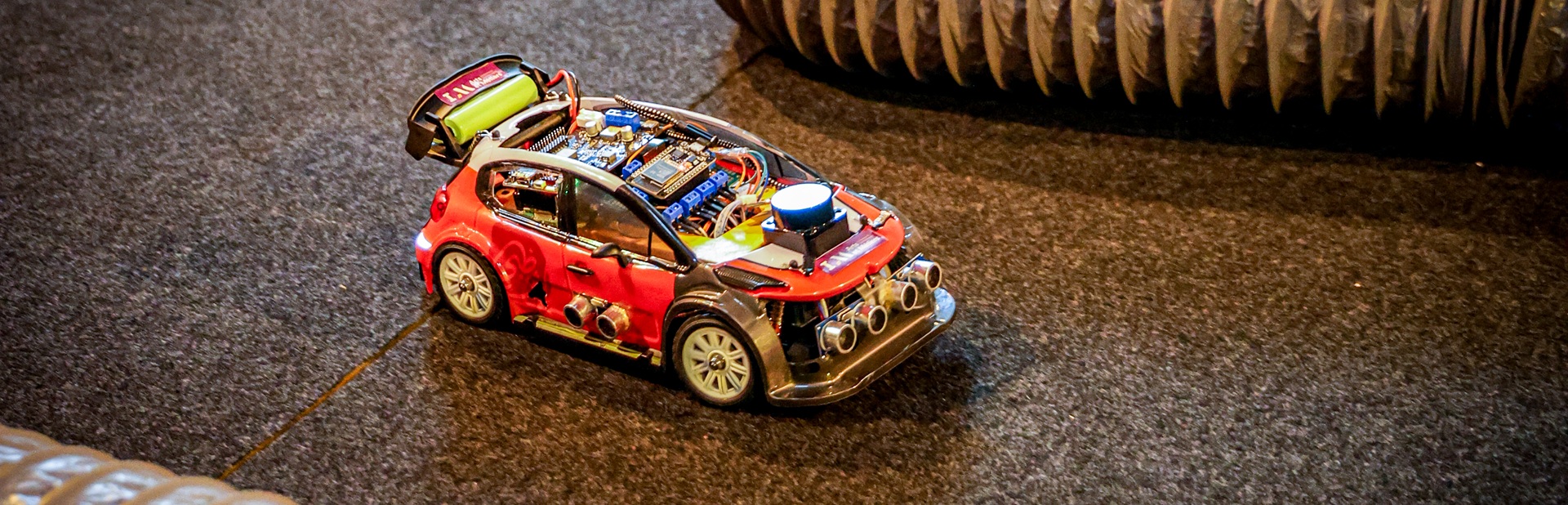
We found out about the competition in mid-September, after receiving an email from Ms. FOURNIE, the campus’s corporate relations manager, who invited interested students to participate. We were immediately drawn to the idea: to carry out a complete engineering cycle, from the specifications to a functional prototype under competition conditions. To design, size, and build a miniature model of an autonomous vehicle that incorporates everything we’re passionate about: mechanics, electronics, signal processing, and embedded intelligence. And so SCIEWAY was born.
The Challenge in a Nutshell
The Awake Challenge is a national technological creativity competition organized by AWAKE Group (founded by Innovateam) among leading French engineering schools.
The 2026 edition focused on designing a 1/10-scale autonomous mini-vehicle, with a budget of €900.
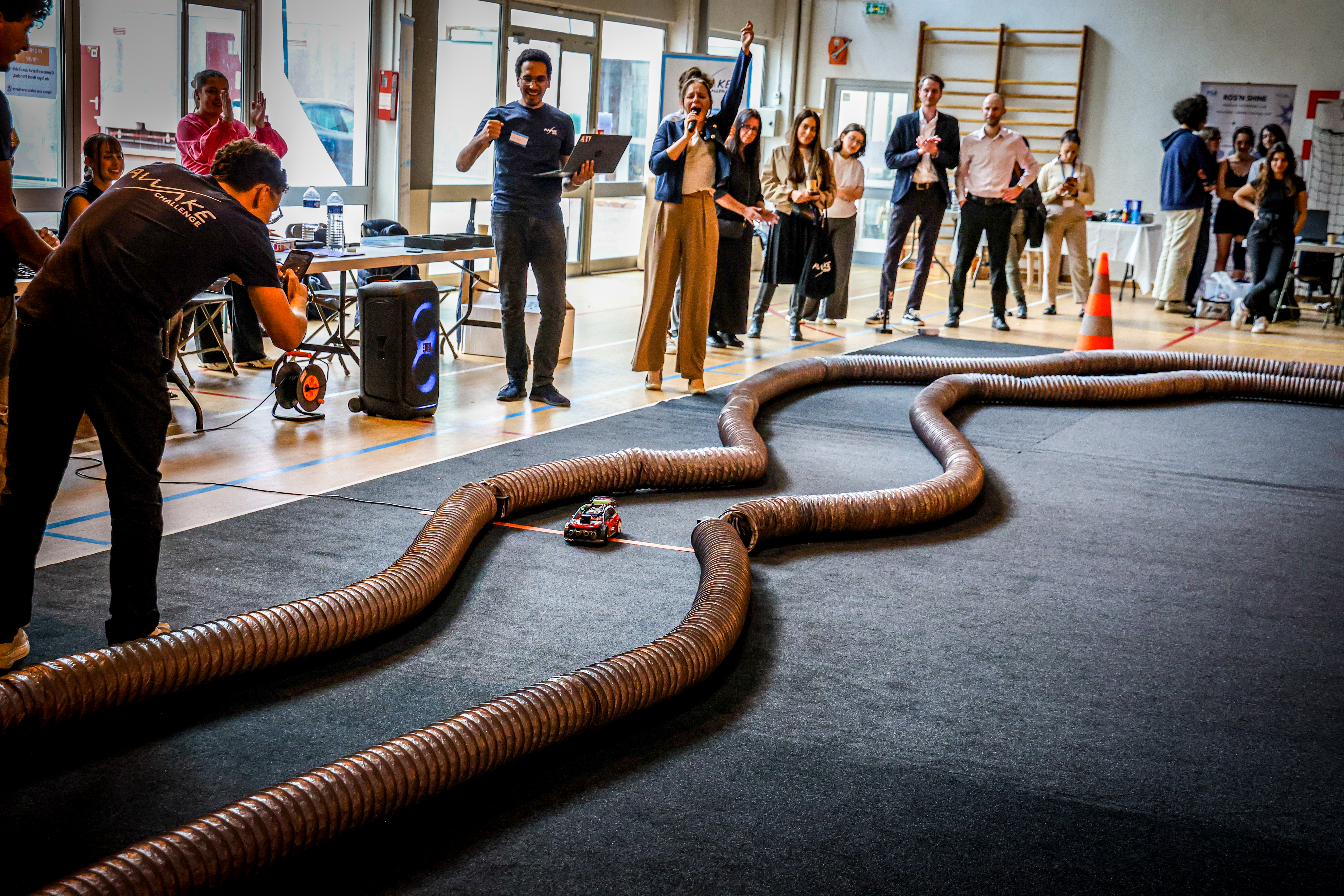
The challenge consists of a time trial on a closed, predefined indoor circuit—unknown until the day of the competition—over five consecutive laps; the vehicle must navigate on its own, without any human control. Teams were judged on distance traveled, time, technological choices, the quality of project management, and originality. The final took place on June 3, 2026, at the Henri Planchat Gymnasium in Puteaux, with 13 teams from various engineering schools competing.
How did the big day go?
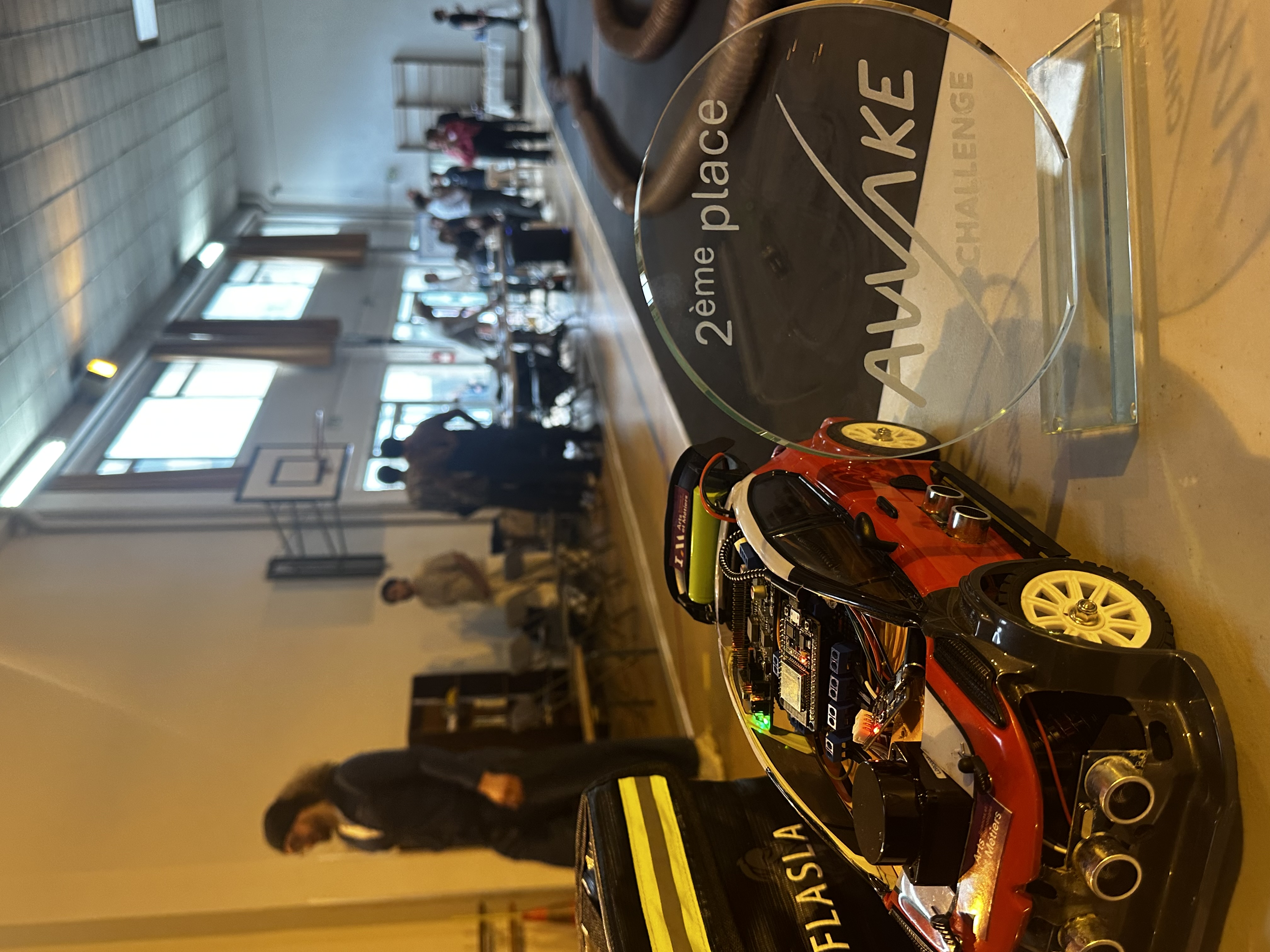
We left very early by TGV, around 5 a.m., to arrive at the competition site around 11 a.m. We immediately began a series of test runs to make sure everything was working. It was a good thing we did, because we discovered that a cable had come loose, probably during transport. Fortunately, we had brought all our backup equipment. We made the repair on site, then performed a few final adjustments to tailor the car’s performance to the final track, which was revealed only that same day. At 4 p.m., our vehicle completed the promised five laps, running entirely on its own power, and we took second place out of 12 teams.
How did you prepare? What were your main challenges?
The project followed a rigorous engineering approach: functional analysis, preliminary sizing, experimental system identification, modeling, and then control synthesis. Our main technical challenges:
- Electromagnetic noise from the brushless motor, which rendered our initial speed measurement method unusable. We switched to a robust solution: a Hall-effect sensor and two magnets on the drive shaft.
- Circuit mapping (scan matching): our algorithm was accumulating too much drift. We made a conscious decision to prioritize reliable, responsive navigation (the “Follow The Gap” algorithm) rather than persist with the original approach.
What are your main strengths?
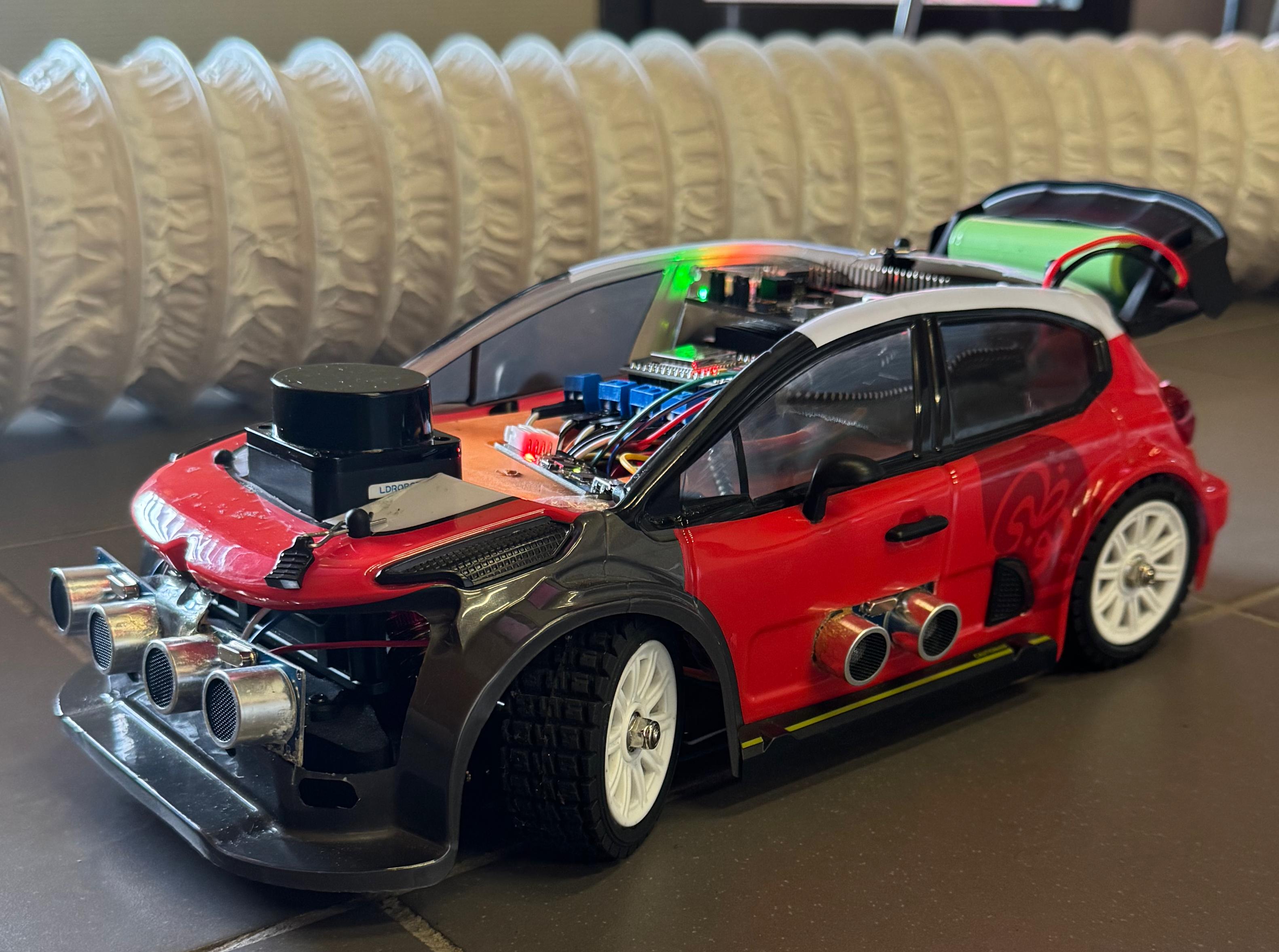
Team cohesion and technical rigor. Our distributed architecture—a Raspberry Pi 5 for perception and high-level decision-making, and an ESP32 microcontroller for real-time control—allowed us to ensure the vehicle’s reliable performance. Above all, our ability to pivot in the face of a technical setback rather than stubbornly persist was decisive.
How did the team work?
By area of expertise (management/finance, systems/electronics, design/development), while sharing the workload on algorithms and deliverables.
We quickly defined each person’s role:
Haitam AZZAL, project manager (management, finance, component procurement) and algorithms
El Mahdi BAHIR, head of electronics and software development (hardware architecture, sensor integration, speed and steering control loops)
Youssef AKBIB BUKRABA, design and fabrication lead (requirements analysis, CAD, 3D printing, assembly) and algorithm
This allowed us to work in parallel while maintaining a shared system-level vision through regular technical reviews and a centralized GitHub repository.
How has Arts et Métiers helped Arts et Métiers ?
The AWAKE Challenge was to be integrated into a school project and supervised by a teaching team throughout the project. We chose to offer this topic as part of the 2nd-year PJT project hours in the second semester.
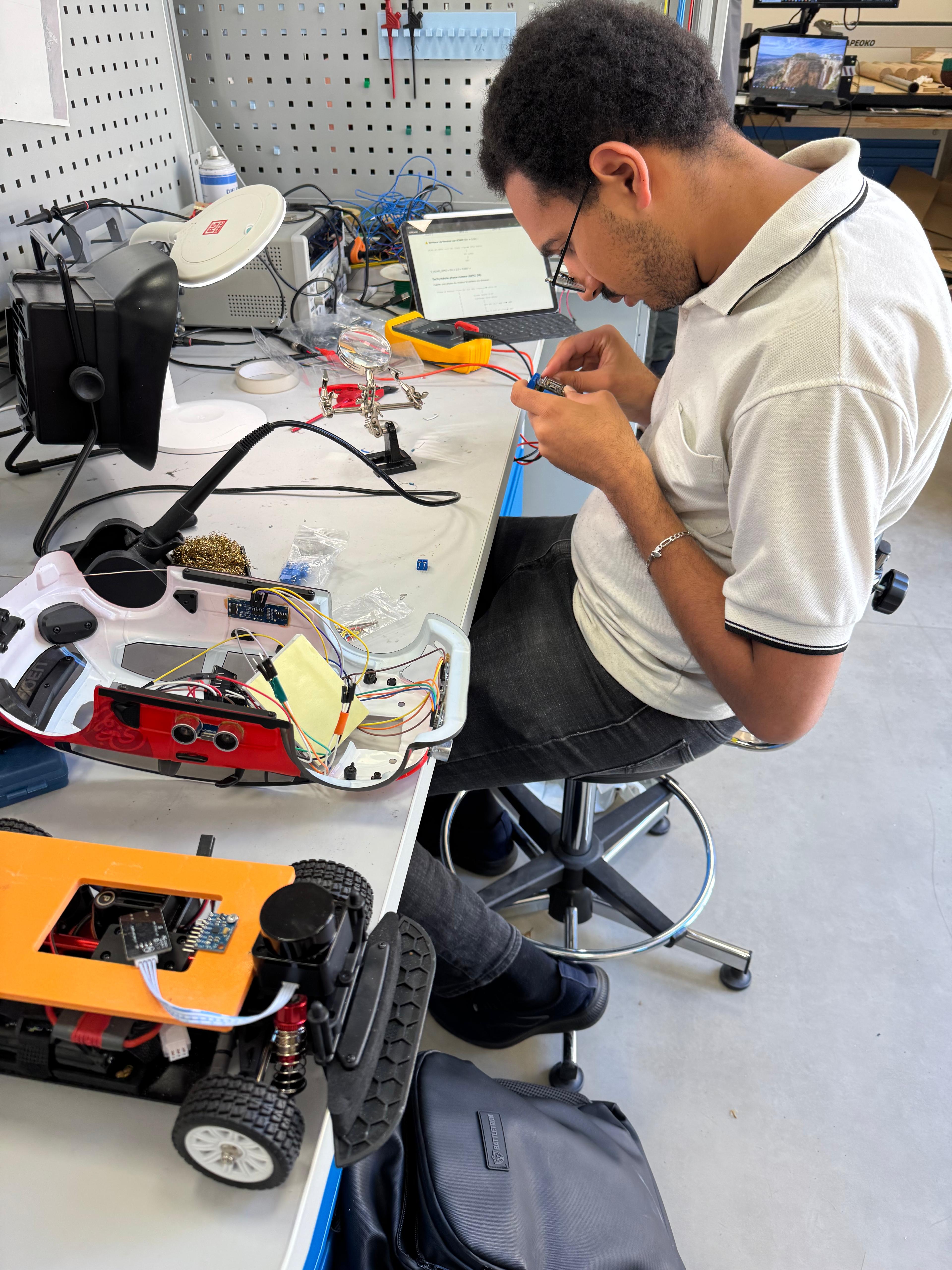
The campus provided us with access to essential manufacturing resources: 3D printing for the fitting parts and welding equipment to assemble our circuit boards. The guidance provided by Mr. GOMAND and Mr. FAVAREL was also invaluable during the modeling and control tuning phases.
What have you gained from this experience?
A complete engineering cycle experienced from start to finish, and an engineer's instinct that competition has helped us develop: knowing how to choose an alternative solution when faced with failure rather than persisting in vain.
What advice would you give to prospective Arts et Métiers students Arts et Métiers
Our main piece of advice: incorporate the challenge into your school project starting in the first semester. Topics are selected in early September, and the competition announcement comes in mid-September. So you need to plan ahead even before the official announcement. For our part, we didn’t incorporate the challenge into our school project until the second semester. If we had started earlier, we could have gone even further, particularly in terms of mapping and speed optimization.
What are your goals after this challenge? What are your career plans?
This experience has reaffirmed our passion for design and complex systems, and naturally guides the next steps in our journey.
Youssef will continue his studies in High-Speed Machining (HSM) at the Cluny campus, while Haitam and El Mahdi will continue in Aix-en-Provence, focusing on Digital Engineering of Complex Products and Systems (INNUI). These are complementary paths, spanning precision manufacturing and intelligent systems engineering.
3 words to sum up your experience
Boldness · Ingenuity · Perseverance
Julien GOMAND and Camille FAVAREL, you are professors on campus. How did you support and guide the students as they took on this challenge?
We met with the team at the start of the project to establish the framework, define the objectives, and set a few key milestones. Starting from scratch in January, the students made remarkable progress thanks to their dedication and work ethic.
Throughout the challenge, we organized several technical meetings to guide them in their decisions, but above all to familiarize them with the engineering process: analyzing, justifying, experimenting, and validating. We encouraged them to support their decisions with evidence, break down problems into successive steps, and adopt a rigorous approach based on progressive testing and validation.
Youssef, El Mahdi, and Haitam formed a particularly self-reliant, dedicated, and enjoyable team to work with. Faced with difficulties encountered with the initially proposed solution for mapping the track using LIDAR, they demonstrated adaptability and creativity by devising a highly effective alternative on their own. They also showed great maturity in using artificial intelligence tools, which they integrated effectively into their developments.
Finally, we also supported them in preparing the various deliverables required for their project—including a report, a poster, and a presentation—to ensure that the structure of this school project was optimally aligned with the competition’s requirements.
What are the benefits, for the school and for the students, of participating in such a challenge?
For the School, this type of competition serves as a wonderful showcase for our students’ expertise and the quality of their education. This year’s results are a fine illustration of that. The team secured a remarkable second-place finish, just three points behind the winners out of a total of 100 points. Beyond the rankings, their vehicle stood out for the smoothness and elegance of its performance, reflecting the quality of the control architecture they developed. The close margin between the top two teams’ scores is, in fact, a first in the history of this competition.
For students, the experience is particularly enriching. It exposes them to a real-world project management situation with specific objectives, deadlines set by an external organization, and a budget to manage. This context allows them to develop not only technical skills but also organizational, interpersonal, and budgetary skills in a truly “authentic” learning environment under real-world conditions.
What message would you like to share with students to encourage them to participate in challenges or contests?
Competitions and challenges are unique experiences that allow you to put your knowledge into practice, build confidence, and develop skills that are highly sought after in the professional world. While they certainly require dedication and motivation, the learning opportunities and sense of satisfaction they provide are well worth the effort.
So, go ahead and give it a try!
Even when the obstacles seem insurmountable, it’s often the most ambitious challenges that lead to the greatest successes. And above all, know that you won’t be alone: the teaching staff is here to support you every step of the way.