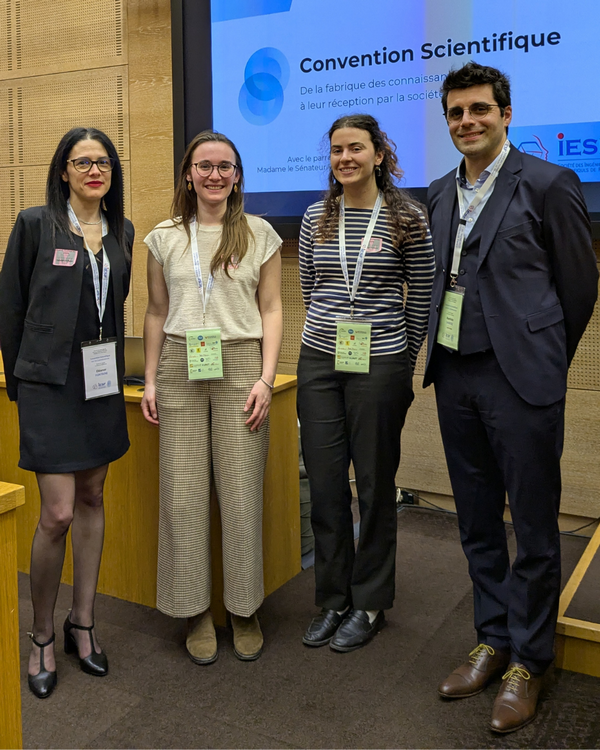
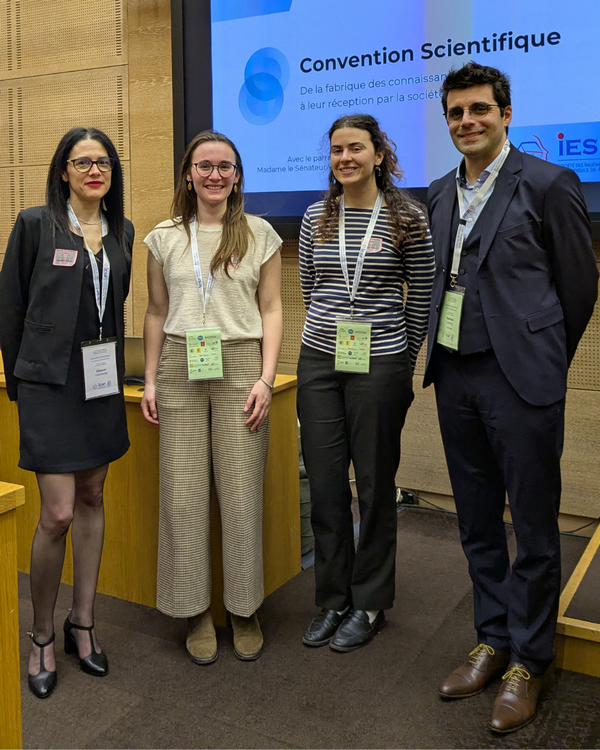
Baptiste Sandoz and Agathe Navailles are among the 50 scientists selected at random who participated in the Scientific Convention on Knowledge.
How is scientific knowledge generated, disseminated, and received by society? How can we build trust between science, institutions, and citizens? These questions were at the heart of the Scientific Convention on Knowledge, organized by Ingénieurs et Scientifiques de France (IESF).
“A very interesting way to explore the relationship between science and society”
“I’ve always been interested in science communication to the general public,” explains Baptiste Sandoz, a lecturer at the Georges Charpak Institute of Human Biomechanics who participated in the event. “This conference struck me as a very interesting way to explore the relationship between science and society—how science is communicated and perceived by society. “I am particularly interested in—and concerned about—the mechanisms that lead to the spread of fake news and decisions that run counter to scientific data.”
“I was aware of everything we lose when we compartmentalize society’s research”
Agathe Navailles, a doctoral student at the Laboratory of Mechanical and Materials Engineering, also took part in the discussions: “I agreed to participate in this conference during my first year of doctoral studies, which focused on plastic recycling. Those early months first introduced me to the academic research ecosystem. Furthermore, given the inherently societal nature of my research topic, this early stage of my dissertation made me realize just how much we lose by compartmentalizing research from society.”
In addition, on the Arts et Métiers side, Lou Grimal, a faculty member and researcher in Chambéry, served on the steering committee.
Envisioning the evolution of the relationship between science and society
During the discussions, a wide range of contemporary issues were addressed, including citizen science, science communication at the local level, the relationship between scientists and public policymakers, the workings of the academic publishing system, and the role of science influencers in the public sphere.
Approaching a research question from various possible angles
Participants also addressed the central issue of trust in science during roundtable discussions and forward-looking workshops designed to envision how the relationship between science and society will evolve by 2050.
“It was fascinating to talk with researchers from fields very different from my own,” adds Baptiste Sandoz. “It reinforced my belief that it’s necessary to approach a research question from various possible angles, whether in engineering, the humanities, the social sciences, and so on.”
Fully integrate science communication into research work
“The discussions at the scientific conference confirmed to me the need to fully integrate science communication into research work,” says Agathe Navailles. “However, I hadn’t realized the impact of time constraints—particularly those associated with project-based funding—on scientific output.”
Widely publicize the recommendations
The challenge now is to put the convention’s recommendations into practice by disseminating them to the academic community, institutions, organizations, and the general public.
“We are working to widely publicize the existence of these recommendations and have already presented the convention’s principles at the laboratories’ general meeting,” notes Baptiste Sandoz. “We remain available to anyone wishing to organize a meeting, discussion, or roundtable on how the convention operates and its report. The convention’s organizers are also ready to make themselves available to visit campuses.”
“Some of these recommendations are supported by Arts et Métiers,” explains Agathe Navailles. “For example, training in science communication is being considered for the school’s doctoral students during the annual J1A or J2A events.”
Initiatives are already underway at Arts et Métiers
“Six recommendations from this report are particularly relevant toArts et Métiers DD&RS roadmapArts et Métiers its research and innovation focus at various stages of maturity (more information),” explains Eléanor Fontaine, Director of Research at DGARI. For example, among our current initiatives, we are working with DISSO to train those involved in scientific knowledge production to format their data to make it FAIR (Findable, Accessible, Interoperable, and Reusable), establishing dedicated group sessions for scientific outreach and culture (Science Festival, Open House Days, etc.), and making research infrastructures visible and attractive to the general public, particularly through ELF projects. Similarly, we have begun integrating science communication into training programs and career paths. For example, an inaugural Master of Science and a workshop on science communication were organized in February and March.”
In addition, discussions have already begun between the DGARI and the Communications Directorate to launch initiatives in response to recommendations aimed at increasing the presence of scientists and research organizations on social media and strengthening scientists’ communication skills.
Between October 2025 and January 2026, the Scientific Convention on Knowledge brought together 50 scientists from a variety of disciplines and backgrounds to collectively reflect on how knowledge is produced, communicated, and appropriated by civil society. Inspired by the principle of citizens’ conventions, the initiative took place over several working sessions organized at various institutions of higher education, including the University of Paris-Est Créteil, the Arts et Métiers Institute Arts et Métiers Chambéry, the University of Technology of Troyes, and the University of Nantes.
Following this work, a report containing 58 recommendations was officially submitted to the Senate in February 2026. These proposals aim to improve the dissemination of scientific knowledge, enhance its communication to the general public, and foster closer dialogue between researchers, institutions, and citizens.