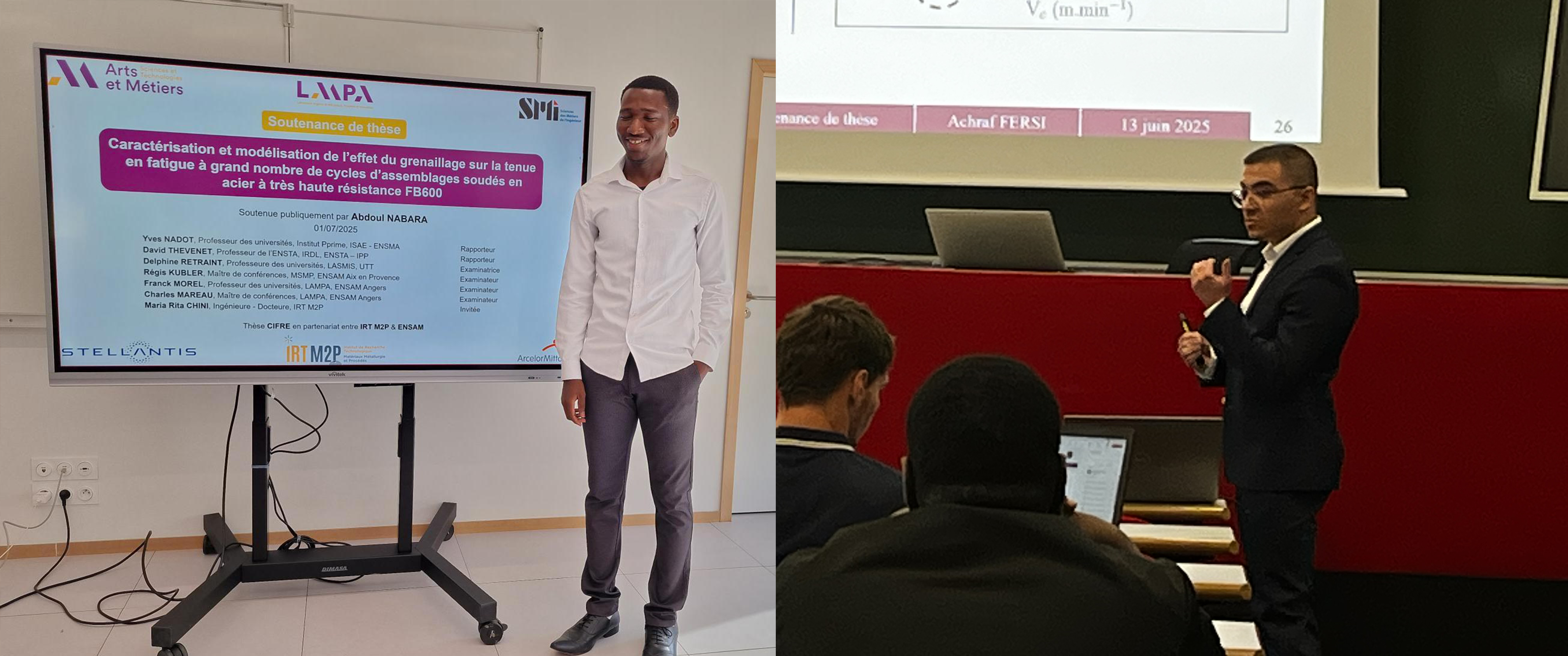
On the Arts et Métiers campus Arts et Métiers , two doctoral students from the LAMPA laboratory defended their theses.
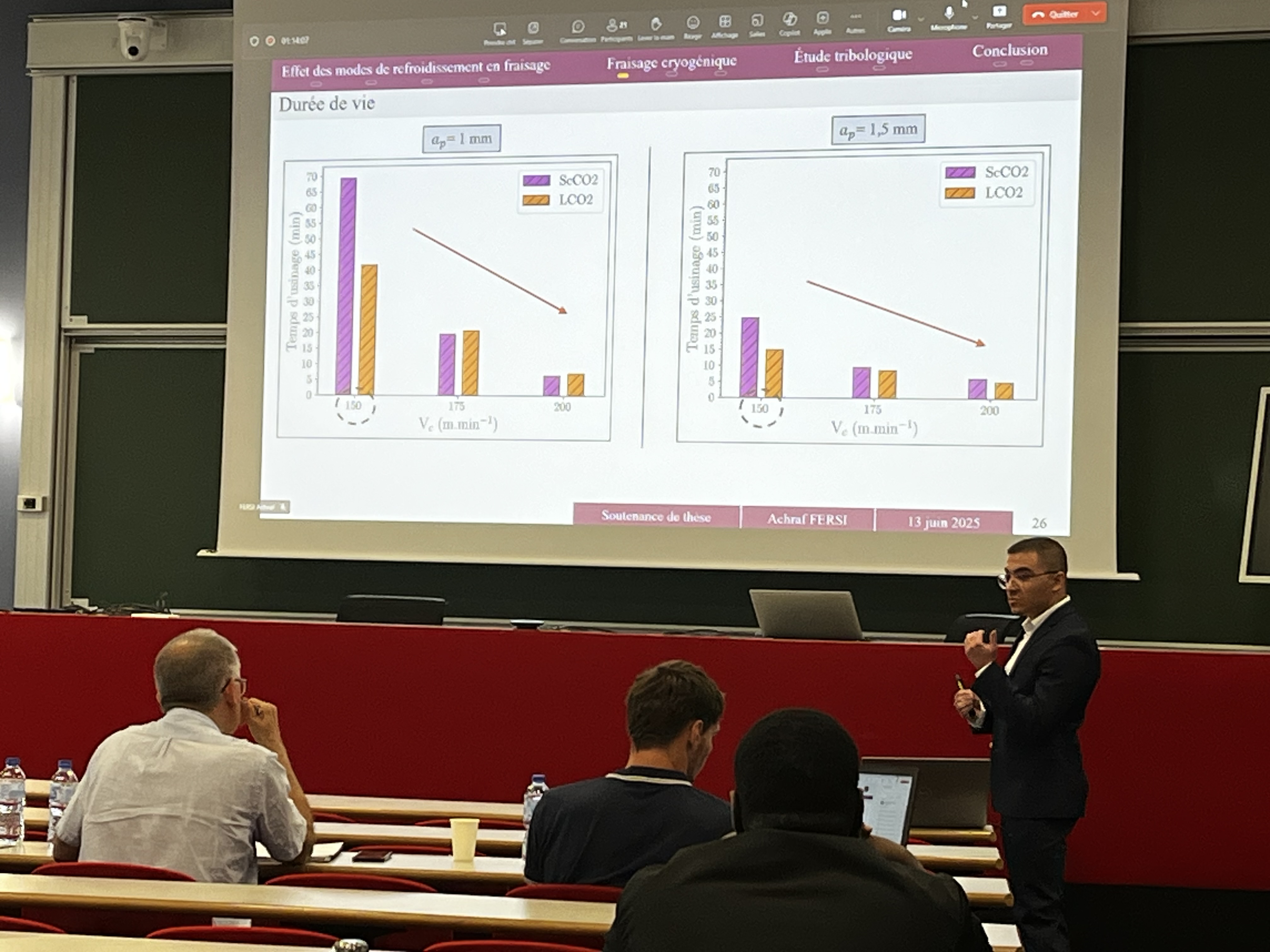
Achraf Fersi
Thesis entitled "Impact of cryogenic fluids on the surface integrity of parts" conducted as part of the ScCryo2 project at the ARTS Carnot Institute, in partnership with Cetim and co-financed by the Pays de la Loire Region and Aldev.
Summary
Titanium alloys possess excellent mechanical properties, but they are difficult to machine. Among the solutions proposed to address this problem is cooling the cutting zone with cutting oils. However, these substances have a harmful impact on the environment and the health of operators. To limit their use, cryogenic assistance emerges as an alternative. This thesis focuses primarily on the effect of cryogenic assistance on tool life, wear mechanisms, and surface integrity during the milling of the Ti-6Al-4V alloy. Several lubrication techniques were tested (emulsion, LCO2, ScCO2, etc.) under operating conditions. The results show that the use of LCO2 and ScCO2 extends tool life by 191% and 385%, respectively, compared to emulsion. This improvement is likely attributed to the cooling capacity of cryogenic fluids, which slows down certain degradation and wear mechanisms, such as adhesion and chipping. Regarding surface integrity, the use of LCO2 and ScCO2 reduces the average roughness by 35% and 41%, respectively, compared to the emulsion. Residual stresses are similar for all lubrication conditions, with the exception of ScCO2, which reduces these stresses by 40% at the surface level. Given the exceptional performance of cryogenic assistance, a sensitivity study was conducted to evaluate its effectiveness in response to increased cutting parameters (Vc and/or ap). Even under more severe machining conditions, cooling with LCO2 or ScCO2 extends tool life by 36% to 73% compared to the emulsion. For a given tool life, cryogenic cooling increases productivity by approximately 20% with LCO2 and 22% with ScCO2, raising the cutting speed from 150 m/min with emulsion to 180 m/min with cryogenic cooling.
Composition of the jury
- Mr. Tarek MABROUKI, University Professor, LMAI, ENIT Rapporteur
- Mr. Pedro ARRAZOLA, Professor, University of Mondragon Rapporteur
- Ms. Anna Carla ARAUJO, University Professor, ICA, INSA Toulouse Examiner
- Mr. Vincent WAGNER, Associate Professor-HDR, LGP, UTTOP Examiner
- Mr. Guénaël GERMAIN, University Professor, LAMPA, ENSAM Angers Examiner
- Mr. Yessine AYED, Senior Lecturer, LAMPA, ENSAM Angers Examiner
- Mr. Bruno LAVISSE, Senior Lecturer, LAMPA, ENSAM Angers Examiner
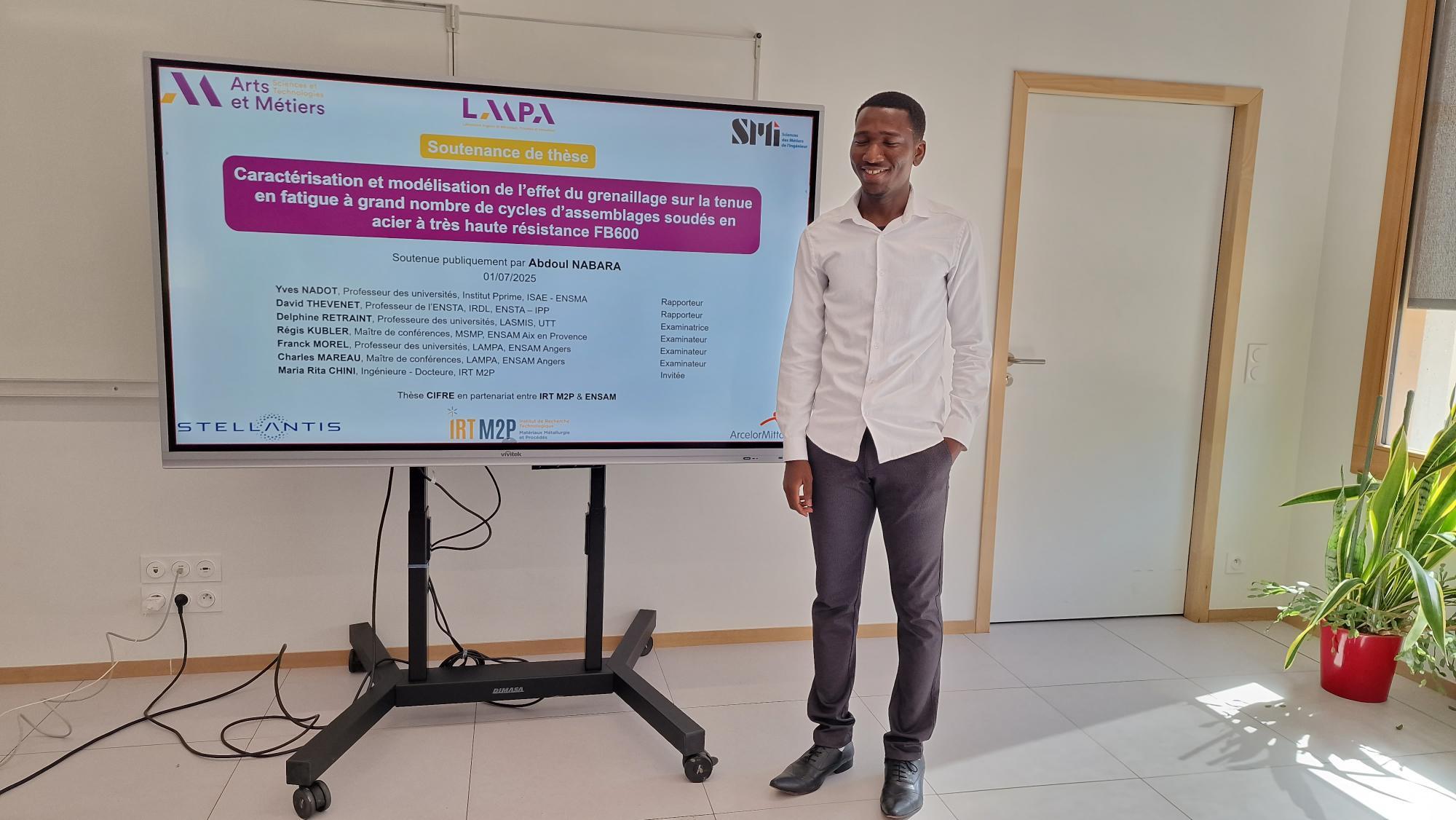
ABDOUL NABARA
This thesis, carried out as part of the IRT M2P SGN project (a partnership between ArcelorMittal, Stellantis, and the LAMPA and MSMP laboratories), is entitled: Characterization and modeling of the effect of shot peening on the fatigue life of welded assemblies with a high number of cycles in FB600 ultra-high-strength steel.
Summary
Ultra-high-strength steels are used in the automotive industry to manufacture ground connection components due to their excellent strength-to-weight ratio. However, when assembled by welding, their fatigue resistance becomes a critical issue due to the presence of the weld bead, residual stresses, and an induced microstructural gradient. Thanks to their work hardening potential, post-welding treatments such as shot peening can improve their fatigue resistance. Although the overall influence of shot peening is known, the specific contributions of residual stresses, work hardening, and geometry induced by the treatment remain poorly quantified. Due to the difficulty of evaluating the major effects of this process, the fatigue design of shot-peened welded joints represents a significant challenge. The objective of this study is to investigate the fatigue behavior and propose a method for designing these structures. To this end, an approach combining fatigue testing and finite element analysis was developed. Fatigue tests were first carried out on different batches of test specimens (shot peened, pre-deformed, stress-relieved) and their fatigue strengths were compared. These tests were supplemented by XRD analyses and roughness and geometry measurements. The results show that residual stresses, the load ratio, and the macrogeometry of the bead are the primary factors affecting fatigue strength. In comparison, work hardening and roughness appear to be secondary parameters. Two fatigue design approaches incorporating the major effects were then proposed. They are based on the calculation of a design stress from local mechanical fields and the application of a fatigue criterion. A single S-N design curve, valid regardless of the loading conditions and preparation of the assemblies, is obtained.
Composition of the jury
- Mr. Yves NADOT, University Professor, Institut P’, ISAE-ENSMA (Rapporteur)
- Mr. David THEVENET, Professor at ENSTA Bretagne, IRDL, ENSTA Bretagne (Rapporteur)
- Ms. Delphine RETRAINT, University Professor, LASMIS, UTT (Examiner)
- Mr. Régis KUBLER, Associate Professor, MSMP, ENSAM Aix en Provence (Examiner)
- Mr. Franck MOREL, University Professor, LAMPA, ENSAM Angers (Examiner)
- Mr. Charles MAREAU, Associate Professor, LAMPA, ENSAM Angers (Examiner)
- Ms. Maria-Rita CHINI, Doctor, IRT M2P (Guest)