The Arts et Métiers campus Arts et Métiers soon Arts et Métiers the AUCTUS team from the Inria Center at the University of Bordeaux. This arrival strengthens the campus's position on Industry 5.0 issues.
Education Enhanced by Collaborative Robotics
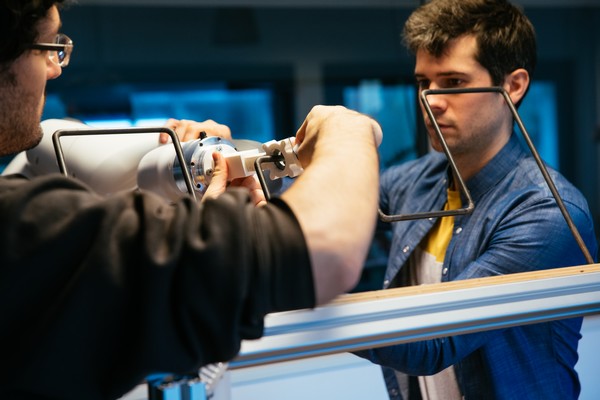
The campus is set to expand its educational offerings by hosting the AUCTUS project team from the Inria Center at the University of Bordeaux, which specializes in collaborative robotics and human-machine interaction. The presence of these scientists on campus provides students with a unique opportunity to engage in meaningful exchanges with these professionals and gain access to cutting-edge technologies.
The integration of this project team paves the way for greater synergy between teaching and research. Engineering students will have the opportunity to explore the latest advances in collaborative robotics, participate in real-world projects, and become familiar with specialized equipment thanks to the work of five research engineers: dynamic palletizing using two IIWA robots (sensitive robots capable of human-robot collaboration) or the development of devices for people with mobility impairments using equipment provided by Orthopus.
In addition, the pooling of resources between the AUCTUS project team and the campus will facilitate the creation of an industrial robotics demonstration facility. This facility will serve not only as a teaching resource but also as a technological showcase for local companies and startups. Today, the campus is already home to several innovative companies, ranging from additive manufacturing to artificial intelligence applied to production.
Furthermore, the upcoming arrival of this team aligns perfectly with the institution’s educational strategy, which emphasizesEvolutive Learning Factory(ELF). These immersive platforms offer students hands-on experience with Industry 4.0 technologies.
A catalyst for growth in research and innovation
Beyond its educational contributions, the arrival of the AUCTUS project team also enhances the campus’s appeal in the areas of research and innovation. Specializing in human-machine interaction and the optimization of robotics processes, the team is working on issues central to Industry 5.0.
His approach is based on three main pillars:
- Assess the difficulty of a task, as well as the safety and well-being of operators.
- Develop a methodology for integrating task analysis and human motion analysis into the design of an assistive system.
- Consider the control laws of collaborative robots in terms of human-robot interaction.
Its location in the Technology Hall will foster collaboration among researchers, faculty, and businesses. The Arts et Métiers campus is thus establishing itself in the region as a key player in innovation and training for the industry of tomorrow.