Opening new campuses, developing apprenticeships, launching new bachelor's degree programs, working on the PGE educational model to better integrate skills-based learning, DDRS issues, and AI—these are just some of the initiatives launched by Arts et Métiers provide more and better training!
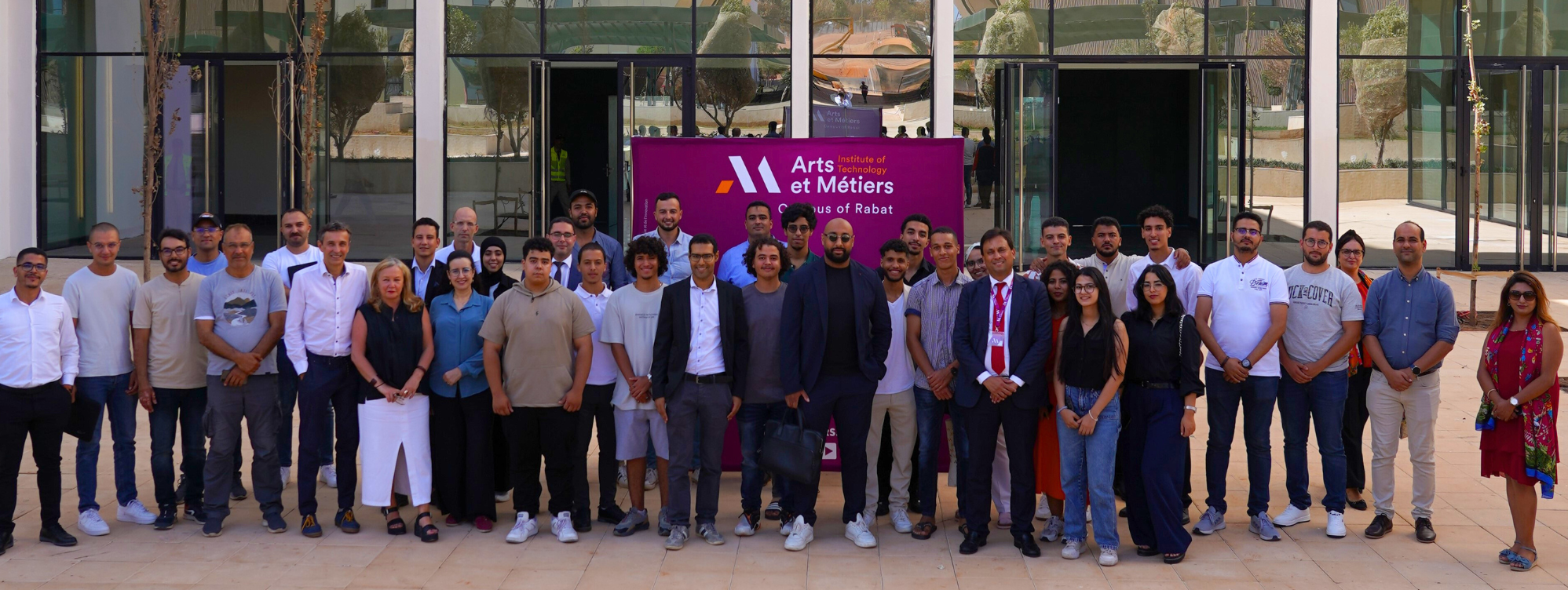
For the first time in 10 years, Arts et Métiers seen its enrollment increase, with a 10% rise in the Grande École program in particular! This increase can be explained in particular by the opening of the Rabat campus, which has around 60 students, and a Mechanical and Mechatronics Engineering Program in Saint-Étienne, with around 50 students enrolled at the start of the last academic year.
An increase in staff numbers that is expected to continue
" This increase is expected to continue in the coming years, as a new site is scheduled to open in Le Havre in 2026," says Nadège Troussier, Deputy Director of Training. Another encouraging sign is that while other engineering schools are seeing a decline in the number of apprentices due to increasingly unfavorable conditions, Arts et Métiers its percentage at 20%. " This proves that we are increasing the number of our students for and with companies," emphasizes Nadège Troussier.
Finally, the success of the Bachelor's degree program, which is celebrating its 10th anniversary, is also contributing to the growth in enrollment.
Developing the PGE's skills-based approach
Here too, numerous initiatives have been launched. The aim is to develop active teaching methods in professional situations, whether in companies or schools.
Fundamental work is being carried out on the teaching model for the Grande École Program, particularly with a view to developing the skills-based approach. The RNCP (National Register of Professional Certifications) file has been updated and working groups have just been set up to define how each skill set should be assessed.
A new Grande Ecole Engineering Programme PGE) apprenticeship track in Paris
In addition, to attract candidates already in apprenticeships and to develop opportunities within companies, apprenticeships will be developed within the Grande École Program with the launch of a new course in Paris at the start of the 2025 academic year.
This course will offer a completely redesigned educational model that experiments with new practices. " Some projects will be linked to the ELF in Paris, which is dedicated to sustainable health," say Frédéric Duband, co-director of ICIFTech, who is involved in the project, and Mickaël Rivette, director of the campus. They lead a working group made up of around fifteen teachers, a representative from the EU, Dafor, Maxime Ricbourg, head of the accreditation department, Emmanuelle Lobbes, head of continuous improvement, and Saïda Mraihi, head of the digital education department.
The content of the first year will be presented at CEVE next December.
" This new program will provide food for thought for the one that will be offered in Le Havre," says Frédéric Duband.
" This project will develop student life on the campus, which did not offer a PGE program in the first year, " enthuses Mickaël Rivette.
Developing professional situations at school
Initiatives are also being taken to develop professional situations at school. Arts et Métiers therefore Arts et Métiers to prioritize interventions from the socio-economic world that are beneficial to students, teachers, and businesses alike. A center has also been created within the Human Resources department to improve and facilitate the management of temporary staff.
Above all, the ELF program helps develop skills in situations that are relevant to a connected, sustainable, and responsible industry.
Finally, work is being done to further integrate DDRS and CSR issues into training programs. The PGE's teaching syllabi will therefore be adjusted.
" Arts et Métiers chosen not to offer specific courses, but rather to incorporate these concepts into all of its programs," explain Amaëlle Mayer, Chief of Staff in charge of CSR, and Guillaume Grampeix, Head of Socio-Environmental Integration in Training. The goal is for students to be trained and to project themselves into the four ADEME scenarios and be able to develop them in their professional experience. For example, as part of the PJTs, they analyze how their project integrates one or more scenarios. In fact, initiatives are being launched on a case-by-case basis on campuses such as Metz, Cluny, and Aix-en-Provence. "