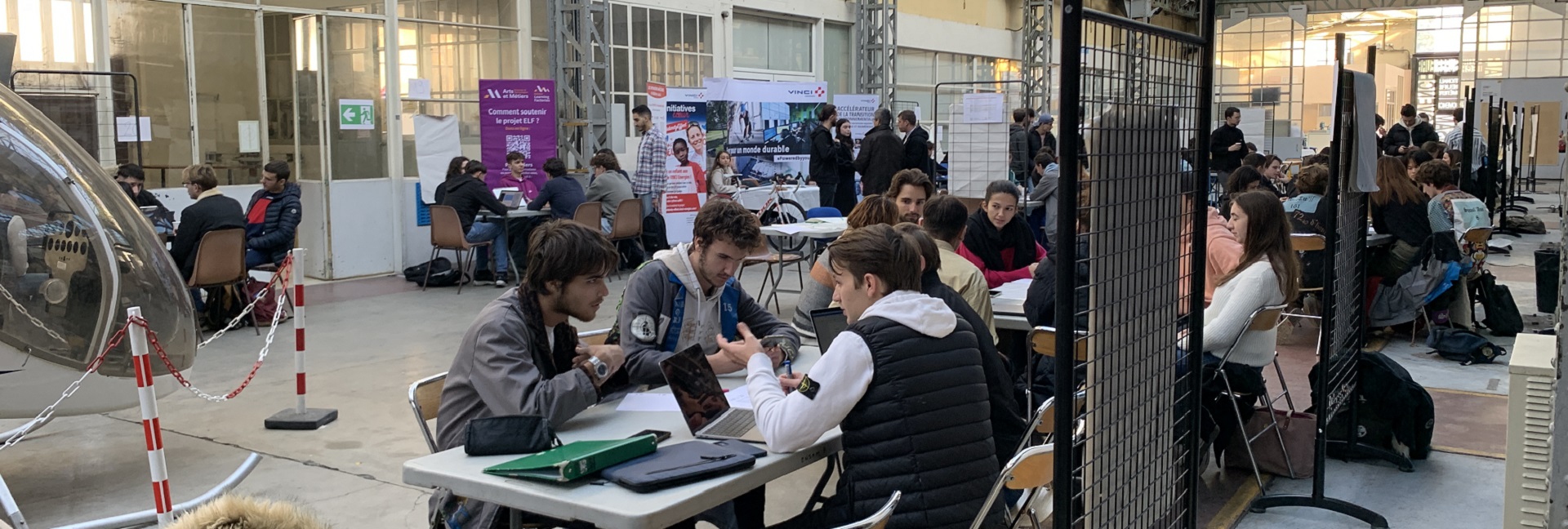
On December 5, 10 coaches, business leaders, startup founders, and executives from major corporations will mentor the 67 first-year students in the Grande Ecole Engineering Programme Arts et Métiers the 42 bachelor’s students atESSCA, a business school, during the 6th edition of JITCAM ( Arts et Métiers Campus Technological Innovation Days).
This edition of JITCAM is the result of a collaborative effort.
led by 13 joint Arts et Métiers teams, work that began last September during the inter-campus InnoDay on entrepreneurship.
What is a business game at Arts et Métiers?
Entrepreneurship is one of the key skills for engineering students. Arts et Métiers numerous initiatives throughout the three-year Grande Ecole Engineering Programme, ranging from introductory activities in the first year (business game) to project development through a specialized track in the second year (Entrepreneurship and Innovation track) and a specialization in the third year (Business Creation and Business Development).
The goal is to enable every student to explore this potential career path. The objective, on the one hand, is to identify future entrepreneurs who will receive support as they continue their studies, but also to equip all students with skills sought after by companies, which they can apply to their future career choices.
The Business Game: a scenario from ideation to prototype
This new edition of JITCAM is taking place in two stages and benefits from a strong academic partnership with ESSCA, a management school.ESSCA, a management school.
- The first highlight took place on September 19 with the InnoDAY event, which allowed teams of students to work on innovative technical solutions related to themes proposed by partner companies. Alstom, EDF and VINCI Energies.
InnoDAY is an event that is part of the national program to raise awareness of innovation and entrepreneurship.
Its aim is to offer students their first experience of collective ideation, technological problem solving in response to an industrial need, and building an innovative proposal using methodological tools such as design thinking, reverse thinking, and pitch training.
This year's theme is to present solutions that facilitate the production and storage of hydrogen and encourage its adoption by consumers.
- JITCAM is the second highlight. Over the past few weeks, the teams have been able to take advantage of working sessions and bring their projects to fruition (completing the business model, preparing the pitch, etc.). They have prepared to take turns on stage to defend their technical solutions. They will be accompanied by facilitators.
Mutual enrichment among team members is expected; some will contribute technological solutions, while others will provide assistance in terms of business, communication, and marketing.
Facilitating exchanges with industrial partners
This event also helps to strengthen lasting ties between industry partners and students. In order to build stronger relationships with students, during and after JITCAM, representatives from Alstom, EDF, and VINCI Energies will offer them special opportunities to discuss their career plans (internships, work-study programs, job opportunities, presentations of technology projects, etc.).
Themes to address tomorrow's challenges
Two days to promote innovation by addressing today's issues and tomorrow's challenges:
- Hydrogen production
How can we optimize small-scale hydrogen production systems for local communities?
Decentralized or localized hydrogen production can give communities their own energy sources. However, current small-scale production systems are either inefficient or too expensive. Let's think about how we can design affordable and efficient systems to enable local communities, especially in remote or developing areas, to produce their own hydrogen for energy or fuel.
- Hydrogen storage
How can a mobile hydrogen generator be given an intrinsic autonomy of several hours while complying with constraints in terms of weight, volume, safety, and cost?
Generators used to power construction sites, sites temporarily off the grid, or to meet occasional needs in addition to the grid will have to be replaced by quieter equivalents that emit no CO2 or pollutants. This is particularly true in zero- or low-emission zones. To come as close as possible to current solutions, the systems must have intrinsic autonomy that can be supplemented, as needed, by local hydrogen logistics. This will allow continuous use of this type of system regardless of the operating time on site.
- Consumer adoption of hydrogen
How can we make hydrogen-powered consumer products more attractive and accessible?
Despite hydrogen's potential as a clean fuel, adoption of hydrogen-powered products in consumer markets remains low. Think about how we can design solutions that make hydrogen-powered vehicles, appliances, or devices more appealing, affordable, and accessible to everyday consumers.
The top 5 teams rewarded
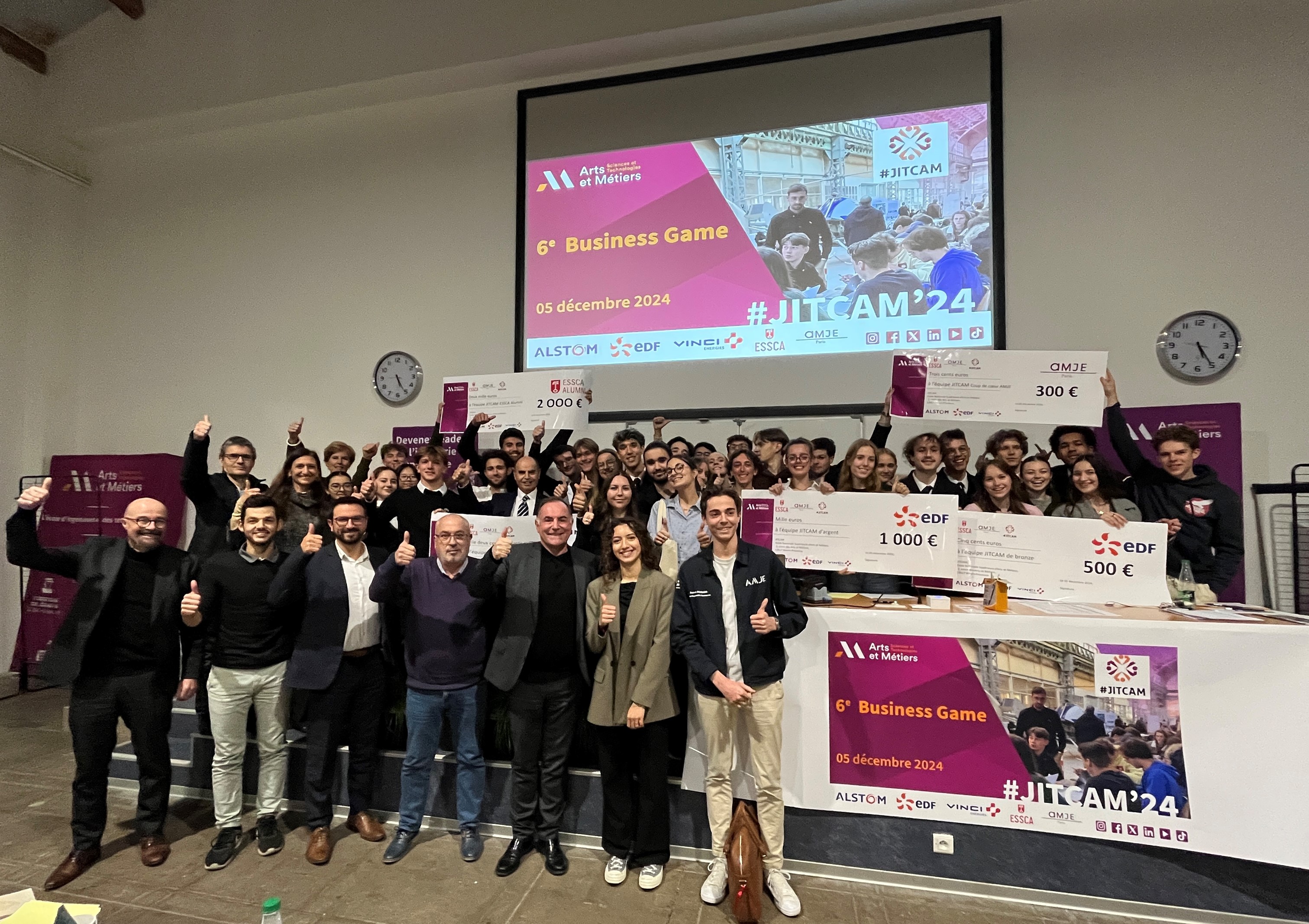
The teams pitched their ideas to a final jury composed of Claire Bourgeois, Director of ESSCA, Franck Cleymand, Deputy Director of Campus Training, Cédric Battaglia from VINCI Energies, Eric Lagrange from EDF/Capenergies, Bastien Caillette from Alstom, Laetitia Armange from Entrep’, and Leila Bouazzaoui, president of AMJE Junior Etude.
Congratulations to the five winning teams
🎖️ The JITCAM Grand Prize was awarded by ESSCA Alumni to the HYPERION team for its AI-managed hydrogen storage solution.
👏 to Lucas Garnero, Antoine Saliceti, Eliott Martin, Arthur Goullet de Rugy, and Ilan Bruski!
🥇 The JITCAM Gold Award was presented by VINCI Energies to the ENS2CAM team, whose project focuses on designing hydrogen power plants in ski resorts to offer a new ecosystem in mountain areas.
👏 to Mattéo Martin, Antoine Mollet, Faustine Falchero, Maéva Baldi, and Alessio Faget!
🥈 EDF awarded the silver JITCAM to the COM'NEUF team for their hydrogen torch used to remove rust.
👏 to Gauthier Bonhomme, Camille Buisson, Raphaël Labarthe, Raphaël Millet, and Guillaume Koulmann!
🥉 The bronze JITCAM award was presented by EDF to the CHOUET’SC’AM team, whose solution recycles agricultural waste by producing hydrogen and methane (biomass recovery through methanization).
👏 to Mattéo Balestra, Vivian Szerement, Raphaël Coquide, Bob Ghomsi, and Sacha Junging!
🎖️ The Coup de Coeur award was presented by the AMJE Junior Study Group to the HYDROFORCE team, whose solution enables methane to be recovered from cattle barns.
👏 to Alexis Leluin, Alexandre Simoens, Lea Made-Beeton, Arthur Baudry, and Maxime Subias!
Multidisciplinarity and diversity within teams are essential elements in terms of cross-fertilization. Working together is a valuable experience. Be passionate about what you are going to do. This will generate exceptional results! Prof. Féthi Ben Ouezdou, Campus Director