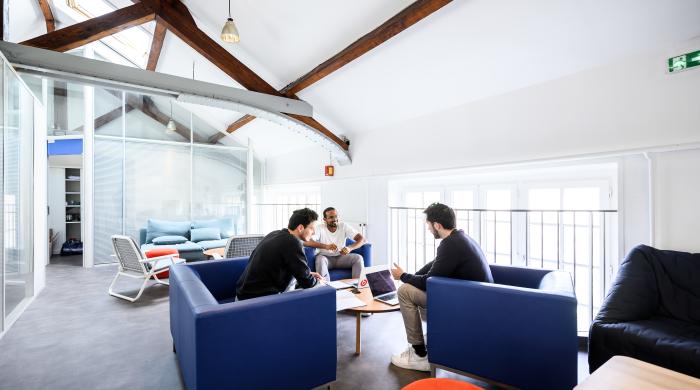

The first general meeting of the CAIRE project took place in early September in Lille. On the agenda: review of the work carried out, conference, and signing of the consortium agreement!
A first major event
The CAIRE general meeting (see below) served a dual purpose, according to Cécile Weltman, project manager recruited in April 2024: "This event is special because it is the very first general meeting. It marks both the official launch of the project and an opportunity to present the work that has been done over the past year." The gathering also aimed to lay the foundations for CAIRE among the 96 participants.
After welcome speeches by Laurent Champaney, CEO, and Catherine Davy, director of the Lille campus, the various managers reviewed the roles, contributors, and past and future outputs of each of the working groups. Participants also attended a conference led by Nathalie Nevejans, professor of private law and artificial intelligence (AI): The challenges posed by AI in education and professional training.
"We also found it interesting to address the legal framework for this first project event, which brought together a diverse audience," explains Cécile Weltman. Finally, the morning ended with the signing of the consortium agreement with the various partners, an important and crucial contractual step for CAIRE.
A first year of collaboration
Since September 2023, the team has been working on producing the first level of CAIRE training, which presents the fundamentals of AI. The first groups of Arts et Métiers staff Arts et Métiers gradually Arts et Métiers trained from November 2024 onwards in order to obtain feedback on the training from trainers and learners. Educational engineers and AI expertsArts et Métiers, CESI, and Cnam have worked on defining the objectives and evaluation criteria, as well as creating a detailed training plan. After this work to structure the training, the production of content was launched: videos, text documents, surveys, quizzes, etc.
"The team has mainly developed the distance learning component and will take care of the face-to-face part in the coming weeks," adds Cécile Weltman. A MOOC funded by CAIRE has also been created thanks to the work of Cécile Dejoux and her team, "la fabrique du numérique" (the digital factory) at Cnam.
At the end of 2024, the priority will be to recruit trainers on campus. There is no need to be an AI specialist, as dedicated training courses will be organized: "The idea is to have CAIRE correspondents on each campus," explains Cécile Weltman.
Objectives achieved by the teams
The general meeting was also an opportunity to thank the teams for their hard work. Cécile Weltman praised the organization and productivity of each of the working groups: "Some are working full-time on the project, while others are spending a lot of time on it despite their other commitments. Without all these contributors, the project would not be where it is today."
She also highlighted the efficiency and speed with which the first level of training was produced: "We are ahead of the targets we set ourselves with the ANR, which were to release a first version of the training course at the start of the 2025 academic year. It is a great achievement to have succeeded in producing a high-quality first version in just nine months!"
The training will be available more widely from 2025 to all staff members. You will be informed of this shortly.
The CAIRE project
CAIRE (Citizen-oriented Artificial Intelligence training for a Responsible Education) is a project aimed at establishing a sustainable and large-scale approach to training citizens in the use of artificial intelligence. Winner of the France 2030 Skills and Jobs of the Future call for expressions of interest, the CAIRE project began in September 2023 and will run for five years. It is coordinated by Arts et Métiers brings together CESI, Cnam, the University of Burgundy, and Paris School of Business.