Located on the Metz campus since its opening, the Vulcain platform enables qualified personnel who use it (teachers, researchers, engineers, technicians, and doctoral students) to meet the needs of manufacturers while developing innovations.
Vulcain, expertise in an experimental, flexible, and agile robotic platform dedicated to manufacturing processes
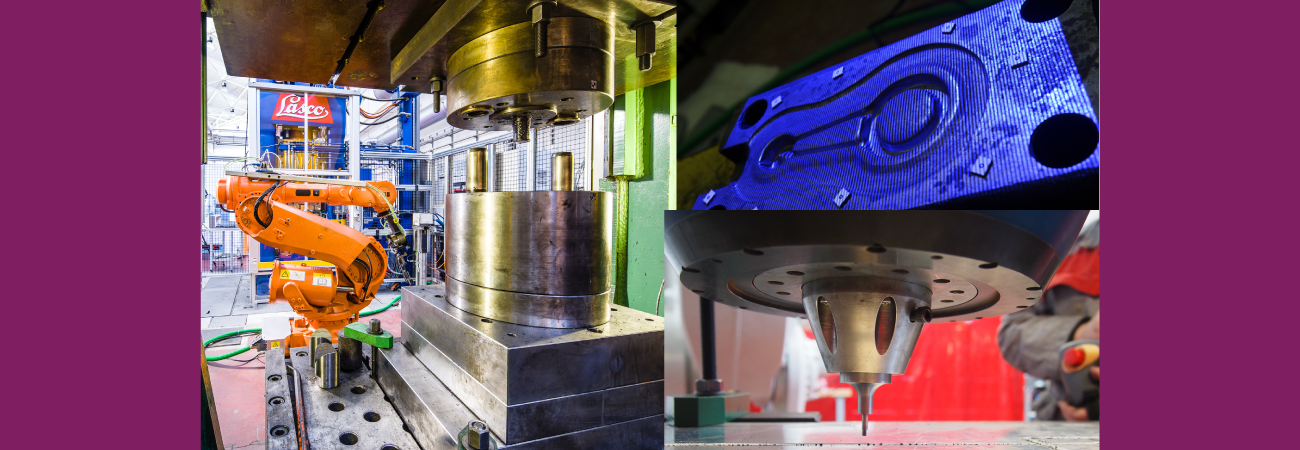
" Vulcain is a technology platform that brings together plastic deformation equipment with two presses, contactless control with 3D scanning, laser trackers, and welding (FSW and fusion) powered by three industrial robots, " explains Cyrille Baudouin, a lecturer and researcher at the Metz campus who is responsible for promoting the platform to manufacturers. But what's important is that behind these resources, we have expertise: scientific expertise through our teaching and research staff, and technical expertise through our technicians and engineers."
The combination of human skills with a flexible robotic platform dedicated to forming, assembly, and additive manufacturing processes, and more broadly to manufacturing processes, is of interest to the scientific community and industry. Tudor Balan, a lecturer and researcher at the Metz campus, participates in the platform's scientific activities:
In general, there is less and less experimentation in the field of processes in France. By continuing to develop and remain at the cutting edge, Vulcain allows us to stand out from the rest of the scientific community.
Skills developed on academic and industrial projects
" The platform is constantly running. Between teaching Arts et Métiers students and those fromESFF, an institution affiliated with Arts et Métiers, research and development projects, the joint laboratory with CETIM and IRT M2P, and more, there are people working on Vulcain every day. It's like a village where everyone knows what they have to do. And the large number of projects means that the staff involved are highly skilled. They will always find a solution to the problems they face, " explains Tudor Balan.
" Over the course of a year, we generally have between 30 and 40 active industrial contracts from all types of companies: large groups as well as SMEs," adds Cyrille Baudouin. Our expertise covers a wide range of areas: designing and manufacturing innovative tools, characterizing materials, developing manufacturing ranges, industrializing parts, producing prototypes, modeling based on data collected during experiments, additive manufacturing, etc. These contracts are managed byAMValor engineers, in collaboration with technicians and teacher-researchers associated with Vulcain.
Added to this are research projects, often conducted in collaboration with industry partners, which Tudor Balan discusses: " A doctoral student has just defended his thesis on defect tracking during the rolling of materials from foundries. Another doctoral student has focused on the use of wire arc welding technology as a new metal additive manufacturing process. Other work is looking at the simulation of sheet metal forming processes. All of them are developing manipulations on Vulcain that are representative of what happens in an industrial setting. "
A platform equipped with tools and open to innovation
As Cyrille Baudouin explains, another strength of the platform is that it is instrumented:
In a factory, there isn't always such a wide variety of sensors collecting data. At Vulcain, we have industrial instrumentation equipment that is designed to be used in specific cases. What's more, most of our measuring equipment can be moved around on site: we can quickly go to a company and analyze what's happening.
The availability of resources is a significant advantage: " Since our resources are not tied up in production, we can take the time to develop innovations. That's how we started developing thixoforging, a very high-temperature forging process under industrial conditions, and how we are developing the EPITHER process for forging solid composite materials. "
A platform that is constantly evolving
The platform has been in place since the Metz campus opened in 1997 and continues to grow, as Tudor Balan explains: " The initial endowment provided some of our production equipment. It is thanks to the determination of the research teams that it has continued to be equipped and kept up to date over time, thanks to public funding (Iseetech, CPER, Institut Carnot) and contracts with industry. The latest major piece of equipment arrived at the end of 2019. It is the robot used for welding. Some doctoral students have already carried out experiments on this equipment and defended their theses, while others are still in progress. "
It is notably the constant contact with manufacturers that allows the platform's stakeholders to stay up to date, and even stay ahead of the curve: " About ten years ago, we set up a centralized data acquisition system for plastic deformation equipment. The results of all the tests have therefore been stored on a local server for several years. We are now working on sharing data so that it can be processed and analyzed in real time from anywhere."