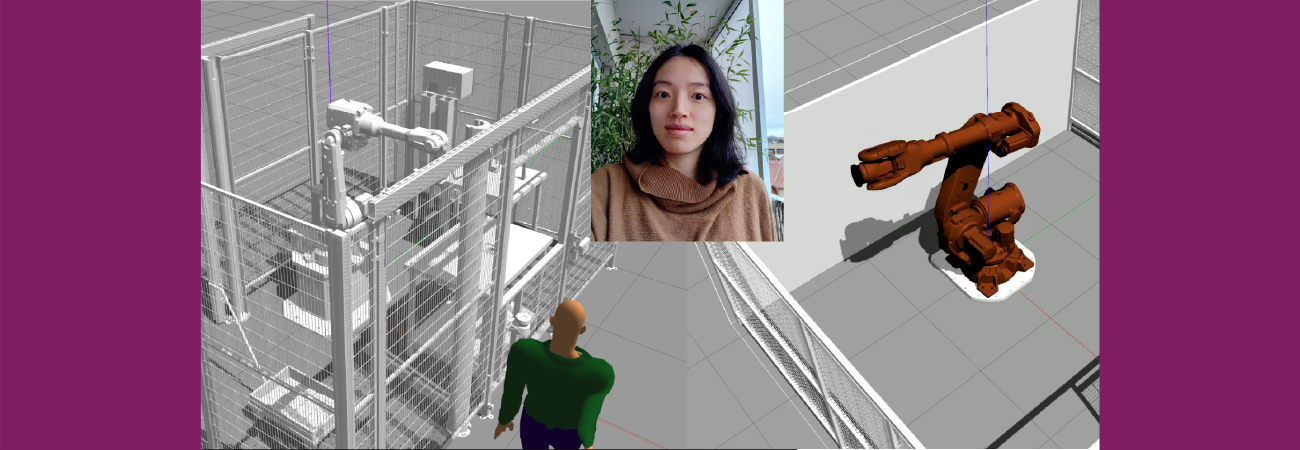
Simulating a robot's trajectory and stopping point to enable operators to work safely in the same space. This is the aim of the research projects coordinated by Yier Wu, a lecturer and researcher at the Design, Manufacturing, and Control Laboratory on the Arts et Métiers campus Arts et Métiers Metz. This work is being carried out in collaboration withINRS as partof a joint laboratory: LC2S.
Objective: improved human/robot collaboration
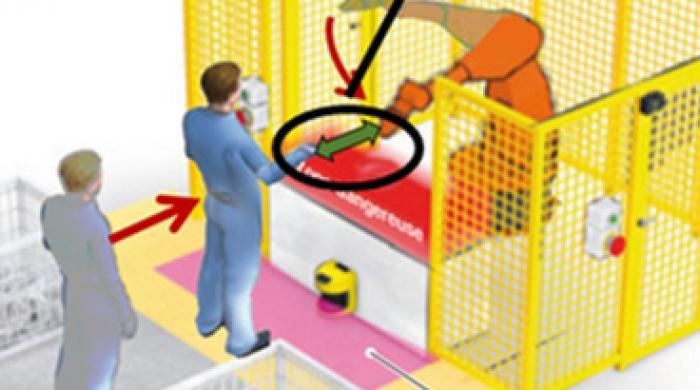
" In industry, robots are usually enclosed in cages and must be stopped when an operator enters the same space, " explains Yier Wu. " In the factory of the future, we imagine that humans will be able to enter the cage, for example to pick up a fallen part, without putting themselves in danger and even while the robot continues its task. That's why it's essential to determine the time and distance the robot travels before it comes to a safe stop. In the event of an emergency stop, for example, the speed of movement and the weight of the part influence the stopping time and the exact path, and this cannot be seen with the naked eye."
Simulation to better understand robot movements
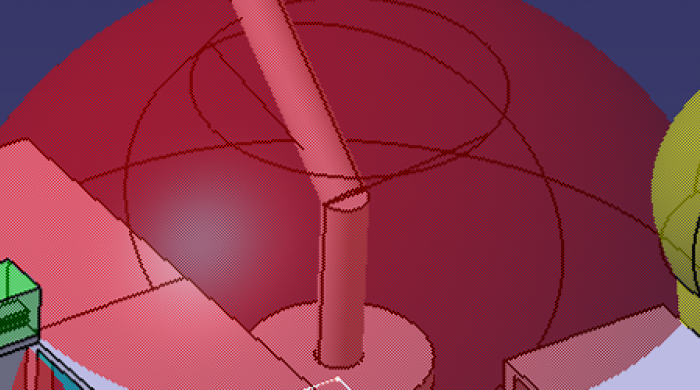
The current work involves modeling robotic cells to closely match industrial requirements. A student interning for Master of Science degree, specializing in robotics, is in charge of this part. Using a specific simulation tool, the student will model the robot—a large-scale model—and its trajectories. “The idea is to create a simulation so that we can later measure its reliability through experiments, ” explains Yier Wu.
The human detection part in the robot's space is managed by INRS: an operator enters the cage: what are their movements, speed, etc.?
Methodological tools at your fingertips
" If we can achieve a simulation that is close enough to reality, it will enable us to optimize the positioning of safety devices. Based on these results, INRS will be able to draft standards for professionals to help them design a safe human/robot collaborative space , " concludes Yier Wu.
The latter intends to submit an ANR project with INRS as soon as the project is sufficiently mature, perhaps by the end of 2021!