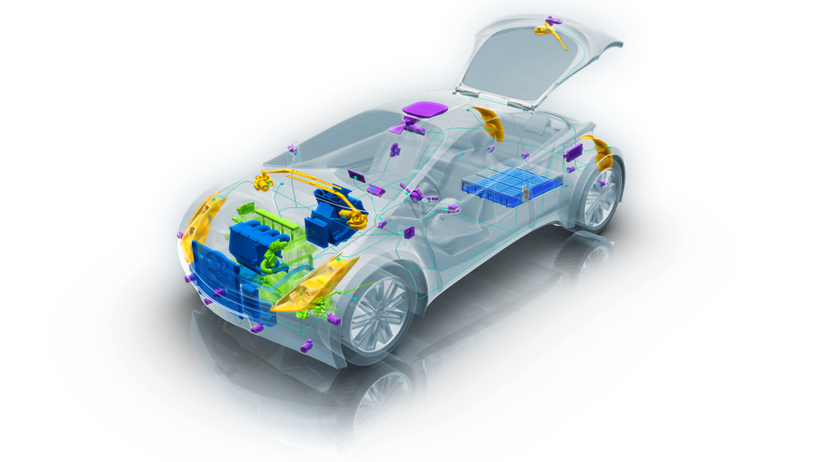
Removing technological barriers relating to the "slender structures" of complex industrial systems while participating in the training of doctoral students: these are the two main objectives of the European THREAD project, in which teams from the LISPEN laboratory on the Lille campus are participating.
"There are two reasons why we are involved in the THREAD project," explains Olivier Thomas, professor of Mechanics and System Dynamics at the Arts et Métiers campus Arts et Métiers Lille. "Firstly, the academic reputation enjoyed by LISPEN and, more generally, Arts et Métiers. Secondly, the strong relationships we have with industry."
A total budget of €3.6 million
The THREAD project, coordinated by Martin Luther University Halle-Wittenberg in Germany, brings together 11 universities and research institutes from eight countries across Europe. It is funded to the tune of €3.6 million over four years by the Horizon 2020 program. This project is part of the Marie Sklodowska-Curie Actions (MSCA) and more specifically the ETN (European Training Network), a collaborative European training network. The aim is to strengthen excellence and structure initial and doctoral training for early-stage researchers (more information).
14 projects for 14 doctoral students
The THREAD project is funding 14 research projects, which will be carried out by 14 doctoral students. "All of them aim to advance simulation tools for 'slender structures' in industrial systems, i.e., flexible elements such as cables, wires, and ribbons, which deform significantly," explains Olivier Thomas. Today, we are forced to manufacture and test them because the physics of these elements is complicated and therefore difficult to simulate. Being able to do this digitally would be much less expensive, which is why manufacturers are so interested in it.That is the goal of the THREAD project."
The 14 research projects thus cover a variety of economic sectors: textiles, medical, aerospace, and more.
Propose new calculation methods
"LISPEN is already working on this topic with automotive equipment manufacturer Valeo as part of a research chair," explains Olivier Thomas. "It's important to note that the less polluting car engines are, the more vibrations they emit when running. Anti-vibration devices are made up of highly flexible components. The THREAD project will complement the work we are already doing within the chair. It will enable us to propose new calculation methods and validate them through physical experiments."
For LISPEN, the THREAD project is funding the salary of a doctoral student and the experimental equipment. The doctoral student hired will also receive additional training at a partner university and will spend three months at Valeo.
The THREAD project kick-off meeting took place on October 24 and 25, 2019, in Halle.