The Specialized Master's in Change Management and Sustainable Innovation offers the opportunity to acquire the managerial skills needed to support the transformation of the manufacturing, construction, and service industries.

With this goal in mind, the Specialized Master's Degree in Change Management and Sustainable Innovation (MCID) provides training in new design alternatives that can be applied to all products and services.
Upon completion of this Specialized Master's degree, you will be able to support changes in management strategy, drive creative innovation, propose new design/sales alternatives, and implement eco-innovation in the overall management of the company. Support is available for those wishing to start their own business.
Program
Since the start of the 2024 academic year, the program has been offered on a work-study basis (apprenticeship contract or professional training contract). Two courses are available.
Full-time program: one semester of academic training (classes + central project) and one semester in a company focused on a professional thesis (report and defense).
Part-time program: one semester of work-study training (two weeks in a company/two weeks of classes) and one semester spent entirely in a company, culminating in a professional thesis.
The courses are common to both programs. During the first semester, periods are set aside for lectures, visits, or testimonials. ...
The training is listed to RNCP- National Directory of Certifications Professional (file 38265; https://www.francecompetences.fr/recherche/rncp/38265/).
4 skill sets have been defined
Block 1 - Managing the organization's environmental and social management system
Block 2 - Conducting an environmental assessment of a product/service
Block 3 - Conducting feasibility studies for technical and organizational eco-innovations
Block 4 - Managing an organization's eco-innovation strategy
The courses offered to acquire the targeted skills are varied: environmental law, REACH, CSR, EMS, territorial and industrial ecology, life cycle analysis (LCA), end-of-life products (recycling, reuse, material or energy recovery, economic return), functional analysis and value analysis, functional economy, product modularity and sustainability, eco-design, communication issues - green marketing, change management, innovation through usage, project management, economic model and return on investment, innovation financing.
Professional thesis
To validate the training, a professional thesis must be defended (report + defense). The topic, chosen by the learners, is related to the tasks carried out in the company.
Some examples of professional theses:
- REP sports and leisure goods sector: what are the challenges and opportunities? (AIR COOP, 2020-2021)
- SIMOND global CO2 trajectory: can a sustainable scenario be developed in this context of climate emergency? (SIMOND, 2020-2021)
- Developing a CSR approach for a group of industrial SMEs (ACROPOSE, 2020-2021)
- Critical metals: what are the solutions for sustainable and local production? The case of NdFeB permanent magnets. (MagREEsource, 2021-2022)
- How can an eco-design approach be systematized while dealing with the diversity of luxury brands within the L'Oréal group? (L'Oréal Operations, 2021-2022)
- Facilitating the implementation of environmental labeling for clothing brands (SAS DATAKHI, 2021-2022)
- How generate innovations in electronics power with one approach low-techlow-tech ? (CEA, 2022-2023)
- Development of a methodology to support the implementation of a plastics strategy for SMEs in the agri-food and cosmetics sectors (ConsultantSeas, 2022-2023)
- How can reuse be integrated into the offerings of companies in the electrical and electronic equipment sector? (CORPOKARMA, 2022-2023)
- Evaluating low-tech solutions (EVEA, 2023-2024)
- CSRD: challenges and impacts for SMEs and mid-cap companies (HUTTOPIA, 2023-2024)
- Towards safe and sustainable chemicals and materials by design: how to create synergy between risk assessment and environmental impact assessment? (CEA, 2023-2024)
- Understanding and developing the reuse of packaging in French-speaking Switzerland (Earth action, 2023-2024)
Benefits of the training
- A rapidly growing topic, with industrial sectors increasingly focused on these issues (transportation, electrical and electronics, sports and outdoor equipment).
- Strong ties with industry, based on the institute's longstanding reputation and high level of recognition in these areas
- Support available for students wishing to start their own business
- Training accredited by the CGE and listed in the RNCP
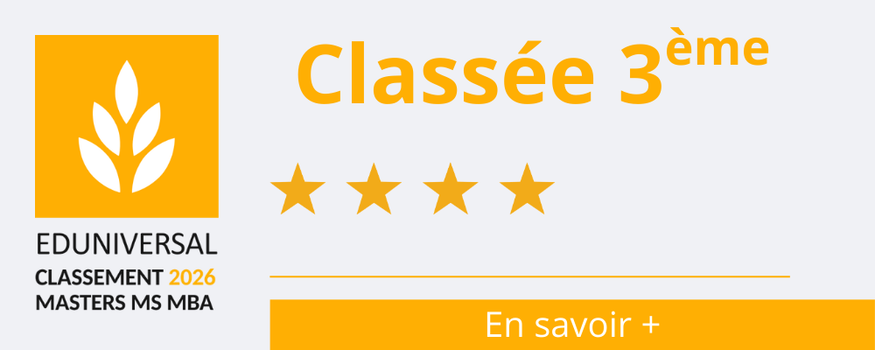
- Ranked 3rd in the 2026 Eduniversal ranking of the best Master’s, MS, and MBA programs in the “Environmental Management and Sustainable Development” category
- 7.88/10 - Reviews of Specialized Master's Degree in Change Management and Sustainable Innovation
Educational objectives
Train specialists in sustainable innovation and management who are capable of:
- Implement an eco-innovation approach across all departments within a company (design offices, human resources, purchasing, etc.).
- Manage projects and support change within the company by integrating constraints related to changes in legislation, regulations, and customer needs in both B2B and B2C.
- Understand and apply business models that enable the marketing and exploitation of products or services tailored to the needs of the modern world.
- Knowing how to promote internally and externally the measures put in place to make them a lever for differentiation in increasingly competitive markets.
- Know and master the tools for identifying design levers that can improve the environmental profile of a product, good, or service.
Skills acquired
The sustainable innovation manager is responsible for:
- Supporting executives in shifting their strategy from product sales to service sales,
- Fostering creative and sustainable innovation,
- Apply and anticipate legislative and regulatory constraints on products/goods/services,
- Conduct a technical, regulatory, functional, and economic assessment of a product/good/service.
- Propose design levers to reduce the environmental impact of products/goods/services.
- Propose new design/sales alternatives,
- Implement an "eco-innovation" process in the overall management of companies.
Career opportunities
Organizations hiring graduates
GE, SMEs, government agencies (ADEME, CCI), research centers (CEA, etc.), consulting firms.
Industrial sectors
Automotive, aerospace, naval and rail, local authorities, electrical and electronic industries, construction, sports and outdoor activities industry, etc.
Functions
Sustainable Innovation Manager / Environment / Sustainable Development / CSR / Eco-innovation, Ecodesign Manager / Eco-innovative Product Manager / Eco-designed Product Manager, Industrial and Territorial Ecology Project Manager / Environmental Assessment, Product and Service Eco-design Expert / Eco-design Manager, Industrial Strategy Consultant / CSR / Sustainable Development and Circular Economy...
STUDENT RESULTS AS OF SEPTEMBER 2025*
• Graduation rate: 100%
• Exam participation rate: 100%
• Extension rate (additional time to acquire missing skills): 0%
• Dropout rate due to changing employers: 0%
• Notification rate of program completion or interruption during training: 0%
• Rate of continuing education: Figures to be released
• Employment placement rate: 90% (80% in employment and 10% in business creation)
* Find data on past promotions on the Data Observatory page at
https://artsetmetiers.fr/fr/observatoire-des-donnees
They welcome interns, work-study students, and/or have recruited
Partner companies vary greatly in terms of both type of activity and size.
ABBVIE, Alstom, AIR COOP, Air France, Alstom Grid, BEABA, Becton Dickinson, CEA, CCI Maine et Loire, Climate Plus, CORPOKARMA, CSTB Decathlon, EcoAct, EDF Hydro, Eurovia, EVEA, Excent, Faurecia, GE – grid solutions, Glimpact, IPC, L’Oréal, Lafuma, Legrand, MagREEsource, MAOBI, MTB Group, Orange, , Pole écoconception, Quantis, Quechua, Saint Gobain, Salomon, Sami, Schneider Electric, Seb, SAS DATAKHI, Simond, TotalEnergies
Teaching methods
In face-to-face, lessons spread over the first 6 months of the training. Teaching methods are diverse: lectures, practical work, seminars, hackathons, and role-playing.
Accessibility
This training course may be accessible to people with disabilities. If you are affected, please contact us to see if specific support can be provided.
Bridge program and/or equivalency
Graduates can continue their studies at the doctoral level.
Admission
Required level:candidates must have sufficient knowledge of general engineering sciences, particularly in product design, materials, and/or biology and chemistry.
- Engineering or university degree (5 years of higher education)
- Bachelor's degree with at least 3 years of professional experience
- Equivalent foreign degree
- By way of derogation L3 or M1
Admission process: Selection is a two-step process: review of application files followed by an interview with a panel to assess the candidate's qualities and motivation.
We require a letter of recommendation to be included with the application file. A template is available at the bottom of this page.
Starting in December 2025: interviews and selection process
Until September: final registration
Interview dates with the admissions panel and deadline for receiving applications
Admissions Committee Date (Application Deadline):
- Afternoon of May 5, 2026 - (Applications must be submitted by 12:00 p.m. on April 30, 2026)
- Afternoon of May 28, 2026 - (Applications must be submitted by noon on May 22)
- June 16, 2026, in the afternoon - (Applications must be submitted by June 11, 2026, at 12:00 p.m.)
- July 9, 2026, in the afternoon - (Applications must be submitted by July 3, 2026, at 12:00 p.m.)
- Application deadline: August 28 at 12:00 p.m.
- Date of interviews: the morning of September 2
Cost of training: €12,500 for individual participants (French or foreign), including courses, written materials, and supervision.
- Application fee: €75
Training may be eligible for funding depending on the trainee's situation and various criteria.
Several options are available: professional training contracts, Transition Pro, CPF, France Travail, etc.
Practical information
Location: Le-Bourget-du-Lac (73)
Located between the lake and the mountains, the Arts et Métiers institute is based at the Savoie Technolac site, which is a start-up incubator, a scientific hub for the University of Savoie Mont Blanc, and home to major research centers such as the National Solar Energy Institute (CEA).
Student life:
- Accommodation available on CROUS university campuses (Chambéry and Le Bourget-du-Lac)
- A network of rooms and studios available in private homes in Chambéry and Aix-les-Bains
- Bus network serving Chambéry and Aix-les-Bains
- Access to the facilities ofthe University of Savoie Mont Blanc (library, gym, sports field, etc.)
Ecomobility Information and housing information
Program language: French
ECTS credits: 75
Contacts
- Véronique Perrot-Bernardet, Program Director, Tel.+33(0)4 79 26 26 82
- Marie-Hélène Ultaro, Administration - MS-MCID@ensam.eu, Tel. +33(0)4 79 26 26 85
- Address: 4, rue du Lac Majeur, PO Box 50295, 73375 Le Bourget du Lac