With the evolution of manufacturing processes from the skills required to the industry of the future 4.0, engineering education must adapt to new future challenges. This program will provide future engineers or researchers with the basic knowledge and skills to understand, use, and develop Industry 4.0 concepts based on smart approaches, including the digital revolution.
Campus
Campus Arts et Métiers
Program profile
With the continuous change of manufacturing processes from the skill to the future industry 4.0, it is necessary to adapt engineer training to the new challenges. The industries of the future addressed in the AM²S training are technological domains that have the potential to transform manufacturing through a better understanding of the physical mechanisms (mechanical, thermal, chemical, electromagnetic) involved in the different processes (machining, assembly, forming, additive manufacturing, surface treatments). The measured data are used to build predictive models to optimize the materials and processes in real time and up to the real scale of the manufacturing process.
This training will provide engineers and researchers with the fundamental knowledge and skills to understand, use, and develop advanced research in the field of Manufacturing and Materials Science.
The Master of Science Specialization in “Advanced Manufacturing and Materials Science” for Transport and Energy (M1-AM²S) serves as a direct pathway to a Master of Science program (e.g., M2-AM²S). The objectives are to prepare engineers for industrial and laboratory research and to deepen their understanding of the physics of manufacturing processes and the fundamentals of materials behavior, with the goal of designing processes to achieve specific physical properties. The courses are offered in collaboration with the MSMP lab and the Learning Factories on the Aix-en-Provence campus.
Program Structure
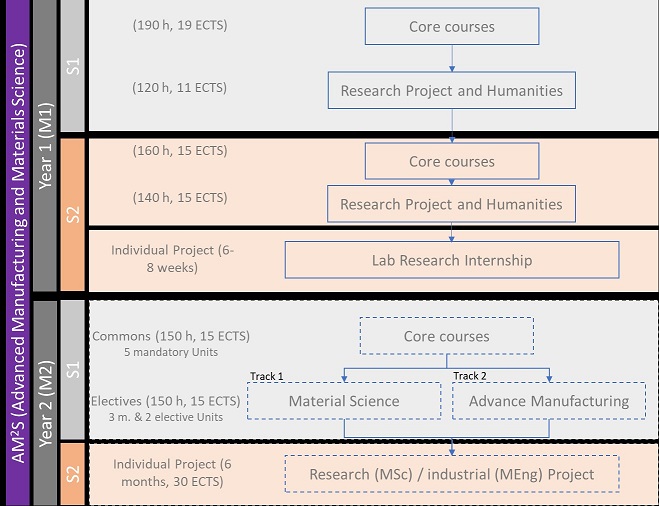
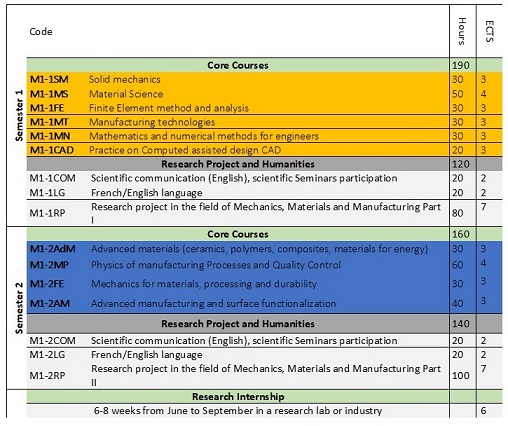
The courses of the M1 track are composed of:
- One semester of core courses for 310 hours and 30 ECTS based on mandatory teaching units (TUs) during the first semester. These units will allow students to gain insights into mechanics and materials science for manufacturing processes and to understand the relationship between materials and processes with i) scientific core courses in mechanics and materials science (2TU), ii) calculation courses with mathematics and numerical methods for engineers and practice on CAD, iii) manufacturing technologies with the most recent developments covering the operating principles, the characteristics and practical applications of each process, iiii) the place of the engineer or the researcher in the world (3 TUs) including a first part on a research project. These last TUs will allow to develop scientific communication, team project organization, and international language skills. It will introduce the key skills to write proposals and scientific publications.
- A second semester of courses with the research project in Manufacturing and Material Science (300 hours and 30 ECTS). Advanced materials and manufacturing processes will be addressed in order to optimize the processes to a targeted surface integrity (topography, residual fields, microstructure). Concepts of functional surface engineering and how they are used to optimize the performance of components are introduced. Physics of manufacturing and quality control courses with hands-on approaches will be provided. The physical interactions between the tool and the material are analyzed with experimental techniques and modeling tools. A mechanical design sequence will allow the manufacturing process to be taken into account in a durability design. The second part of the research project will continue this semester based on the skills of the MSMP laboratory.
- Individual research internship lasting 6 to 8 weeks. The internship will be conducted in a research setting (university laboratory, industry research department). Dates: May-June – 6 ECTS.
The courses are based on lectures, seminar talks, specific training, and computer-based numerical simulation and/or smart computing. For some TUs, a small individual or team research project is used to improve the students' human skills.
Along the courses, an individual laboratory research project (parts I and II) will be carried out in MSMP laboratory and supervised by professors. The subject of the projects will be proposed by the supervisors at the beginning of the first semester.
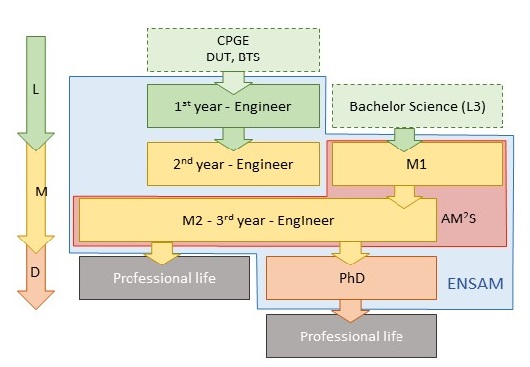
Flow chart showing the program structure of AM²S training, including M1
Course units in the Master of Science
Study and examination regulations
The assessment of knowledge and the evaluation of acquired skills are carried out through traditional examinations and continuous assessment. Grades obtained through continuous assessment are not subject to a second session. The precise assessment rules are validated each year by the steering committee. An exam session is organized at the end of the first semester. A catch-up session is organized 15 days after the last examination of the initial exam session.
Each teaching unit is graded from 0 to 20 and the validation procedures for TUs are those in force in the ENSAM Pedagogic Rules. The control procedures are specified by each TU manager. For lessons in the form of lectures, the test may include one or two written exams, at the discretion of the TU managers. Training, projects, courses, are evaluated both on the basis of continuous monitoring and on the basis of a restitution (report and/or defense).
Graduation requirements
- Validation of TU for 30 ECTS – semester 1
- Validation of TU for 30 ECTS – semester 2
- Validation of internship (individual project) at the end of semester 2
Access to further studies
The AM²S M1 MSc program allows students to continue in all programs requiring this level of study, and enrollment in the M2 MSc program is the preferred path for continuing their studies. Upon academic selection, students are offered the opportunity to pursue a dual degree between the AM²S Master of Science degree and Master of Science at Texas A&M University.
Admission
- Foreign and French students can apply to the program.
- Graduates with a Bachelor of Science or Engineering degree only
- English proficiency: the minimum requirement is a TOEFL iBT score of 81/120 (or equivalent) or an IELTS score of 6.0.
- The selection is based on academic excellence, motivation of the candidate, and consistency of the professional project.
Tuition fees
- Tuition fees: 243 EUR / year (students from the European Union and outside the European Union)
- Social security costs may be added (maximum $250)
Application deadline
To apply online: admissions (opening in January)
Praktische informatie
Program location: Aix-en-Provence - France
Contact
Ahmed Ktari - ahmed.ktari@ensam.eu