This Specialized Master's® program aims to address the challenge of a safe nuclear industry and enables students to acquire the key skills of a nuclear safety engineer.

In addition to technical skills, the Specialized Master's Degree® in Nuclear Safety Expertise enables students to acquire a culture of safety by providing them with essential common references. It aims to foster an open, questioning, and cautious attitude in order to improve nuclear safety performance. It should enable students to develop behaviors characterized by rigor, respect for rules, discussion to validate the choices made through argumentation, responsibility towards the environment, transparency, and objectivity.
PROGRAM
The program runs for one academic year, from early October to late September.
Theoretical training – 400 hours
Industrial sequence:
Professional assignment in a company or organization lasting six months full-time from April to the end of September. This work is the subject of a professional thesis to be written and defended at the end of September.
The training program is listed in the RNCP (National Directory of Professional Certifications) (entry 38458; https://www.francecompetences.fr/recherche/rncp/38458/)
Training content
The training program is structured as follows, with theoretical instruction, practical work, and group work:
- The context of the profession: terminology and stakeholders, technical knowledge of nuclear science, general knowledge of the industry, regulatory framework,
- Job description: main nuclear facilities (PWR reactors, Generation III and IV reactors, nuclear fuel cycle facilities, research facilities, units undergoing permanent shutdown and decommissioning, ITER), transport of dangerous goods,
- Job content: analysis methods, radiation protection, different types of risks (dissemination, criticality, incidents and accidents, human and organizational factors, shutdown and decommissioning), discharges and effluents, waste.
- Lectures and tours (nuclear power plant, research reactor, etc.)
Professional assignment: 6 months full-time.
Calendar
- Duration: 400 hours of training
- Teaching period: October/March
- Professional period: April/September
ASSESSMENT METHODS
- Continuous assessment of knowledge and learning outcomes, written exams, and defense of a professional thesis before a jury.
Strengths
- A program accredited by the Conférence des Grandes Écoles
- A training course registered with the National Directory of Professional Certifications (RNCP)
- Speakers mainly from the nuclear industry
- Industrial partners driving training
- High employability upon completion of the Specialized Master's® program
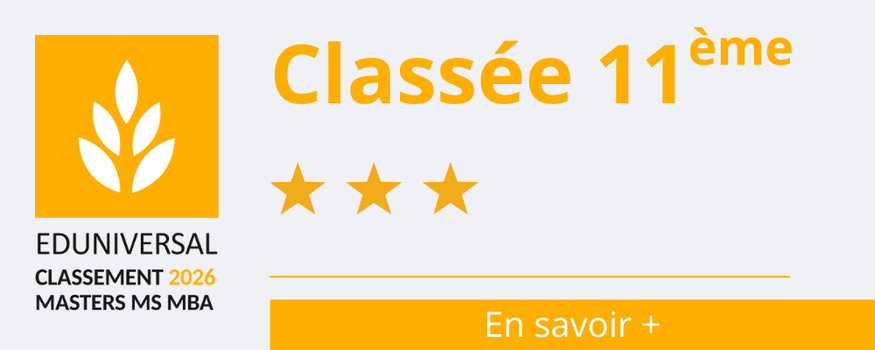
- Ranked 11th in the 2026 Eduniversal ranking of the best Master’s, MS, and MBA programs.
Career opportunities
The main tasks of a nuclear safety expert are: analyzing the safety status of a facility; coordinating safety policy; analyzing events and feedback; developing and distributing safety reference documents; managing technical relations with nuclear safety authorities. They carry out their duties within companies in the nuclear sector: large companies and subcontractors, factories, reactors, various facilities under construction, in production, shut down or being dismantled, research organizations, and organizations that control and monitor nuclear activities.
STUDENT RESULTS AS OF SEPTEMBER 2025*
• Graduation rate: 90%
• Exam participation rate: 100%
• Extension rate (additional time to acquire missing skills): 0%
• Dropout rate due to changing employers: 0%
• Notification rate of program completion or interruption during training: 0%
• Rate of continuing education: Figures to be released
• Employment placement rate: 100%
* Find data on past promotions on the Data Observatory page at
https://artsetmetiers.fr/fr/observatoire-des-donnees
ADMISSION REQUIREMENTS AND PROCEDURE
Public
- Employees
- Students
- Job seekers
Prerequisites
- Engineering or university degree (5 years of higher education)
- Bachelor's degree with at least 3 years of professional experience
- Equivalent foreign degree
- Possible exemption
Admission process
- Recruitment session starting in December
- Online application:Admissions | Arts et métiers artsetmetiers.fr)
- Selection of candidates based on application and interview
- Final registration from April to September
Teaching methods
In-person, 6 months of theoretical training and 6 months of immersion in a company through an internship or professional training contract, when conditions allow.
Accessibility
This training course may be accessible to people with disabilities. If you are affected, please contact us to see if specific support can be provided.
Bridge program and/or equivalency
Graduates can continue their studies at the doctoral level.
TRAINING COSTS
- €12,500 not subject to VAT
These fees include classes, written materials, and educational support.
Application fee: €75 - Training may be eligible for funding depending on the trainee's situation and various criteria.
Several solutions are available: Professional training contract, Transition Pro, CPF, Pôle emploi, etc. To find out what funding you are eligible for and how to access it, please contact us by email at:ContactAMTALENTS@ensam.eu
Program language: French
ECTS credits: 75
CONTACTS
- Jean-Eric Masse, Program Director, ms-sn@ensam.eu - Tel. +33 (0)4 42 93 81 20
- Address: 2, cours des Arts et Métiers 13617 Aix-en-Provence