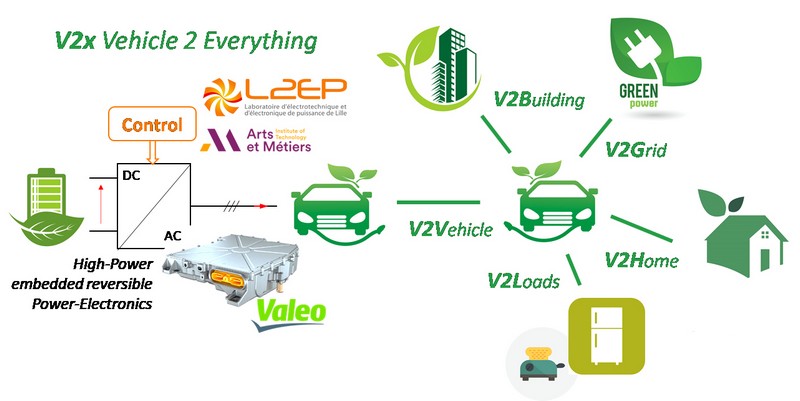
What new features other than simply recharging can an electric vehicle offer? This is the focus of the eV2x (Electrical vehicle reversible Charger for vehicle to everything) project, which looks at how electric vehicle chargers interact with other systems.
Thanks to Grid Forming, a control law that allows a converter to act as a voltage source instead of a current source, electric cars could power a microgrid because their batteries would then act as an energy source.
This would enable, for example:
- Local power supply (e.g., household appliances),
- Powering a single-family home to reduce energy bills or restore power in the event of a power outage.
- The transfer of energy from one electric vehicle to another (Peer to Peer),
- Help to stabilize the power grid when needed.
Develop a universal law of command
This is the objective of the eV2x project, which is working towards the development of a universal control law for all these applications by 2026 and experimental validation with a laboratory prototype and another on-board charger supplied by Valeo.
A project led by L2EP
This research project, led by the L2EP laboratory in Lille and spearheaded by François Gruson, Frédéric Colas, and Antoine Bruyere, with support from Elie Fayad, a doctoral student in Lille, is funded by the BPI through the IPCEI call for projects.
It follows on from the PSPC MOBISIC and KDT-JU/PSPC TRANSFORM projects and aims to extend chargers to as many possible use cases as possible, particularly on three-phase or single-phase networks affected by imbalances, harmonics, and transients such as short circuits.
To achieve this, the charger must be equipped with dedicated control laws that are robust to variations. The L2EP advocates "Grid-Forming" controls, developed for the transmission network, as a universal solution that can be adapted to reversible automotive chargers for V2x.
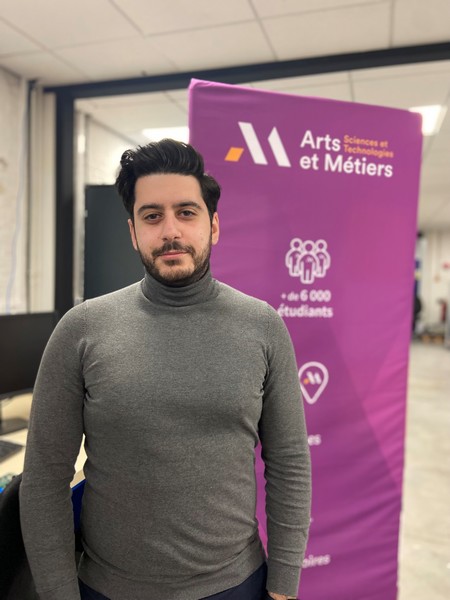
Portrait of Elie Fayad, doctoral student at the L2EP laboratory
 What is your background?
I completed my studies and earned my engineering degree in Lebanon—a Bachelor of Engineering in Electrical Engineering—in 2021. Following this industry-focused degree, I wanted to deepen my knowledge. That is why I chose to continue my studies with a Master of Science in Electrical Engineering for Sustainable Development at Centrale Lille, culminating in a 6-month internship at the L2EP laboratory on the Arts et Métiers campus Arts et Métiers Lille.
My internship at the L2EP laboratory allowed me to contribute to the TRANSFORM project, in collaboration with Valéo, which preceded the EV2X project. At the end of my end-of-studies internship, I continued working on the TRANSFORM project as a research engineer. I then seized the opportunity to continue my research as a doctoral student at the L2EP laboratory, working on the EV2X project, which is also in collaboration with Valéo.
Why did you decide to focus on these research projects and grid forming?
During my engineering studies, I was interested in electrical networks and converter control systems. I worked on both of these topics during my internship. When the opportunity arose, with the electric vehicle market constantly evolving, I got involved in this project because I think it's important and interesting to explore ways of using electric vehicles for purposes other than driving.
In fact, the vehicle can be used in its idle state as a source of electrical energy.
Using the Grid Forming control law developed by L2EP, we can imagine several use cases known as "Vehicle to Everything (V2X)".
How is this research project organized?
There are four of us working on this project. My three supervisors, Antoine Bruyere, François Gruson, and Frédéric Colas, are leading the project and defining the main areas of focus. My role is to bring these ideas to fruition and also contribute my own ideas to enrich everyone's thinking.
The project began three months ago. We are currently in the simulation model development phase. We are also developing the prototype.
What does this bring you on a daily basis?
Contributing to this project is a real asset because it allows me to work in different areas of electrical engineering: power electronics, control systems, and electrical networks.
It therefore allows me to develop my knowledge in this field as an engineer and researcher. During a thesis, you learn new things every day and delve deeper into subjects you thought you already knew well. It's really very enriching.
Furthermore, since this project is a continuation of the TRANSORM project I worked on last year, we were able to get straight to the heart of the matter and draw on the research already carried out to tackle the simulation models.