While most devices end up in the trash without anyone checking to see if any components could be salvaged, the DeReCo project, conducted at the Arts et Métiers campus Arts et Métiers Lille as part of RéCLasSIF, aims to change that. By robotizing the disassembly of electric vehicle motors, researchers are paving the way for a more efficient circular economy.
Just because a device is broken does not mean that all of its components are no longer functional. However, today, due to a lack of options, many technological components end up in the trash without being recycled.
This is the issue addressed by the research project End-of-Life Product Management through Disassembly and Component Recovery (DeReCo) on the Lille campus. Bringing together the LISPEN laboratory in Lille and the I2M laboratory in Bordeaux, and in partnership withthe Institut Mines-Télécom (IMT) Nord Europe school, this project is one of 34 scientific projects funded as part of the Evolutive Learning Factories ELF) RéCLasSIF project.
Disassembling an electric motor
The aim of the project is to create an intelligent robotic solution that will enable manufactured objects to be dismantled step by step. To begin with, the academic teams are tackling a heavyweight object: the electric car motor. " Today, when an electric car is scrapped, the motor, even though it is still in good condition, is not reprocessed. The human and logistical costs would be too high. We need automated systems that make it easier to solve this problem," explains Richard Béarée, project leader.
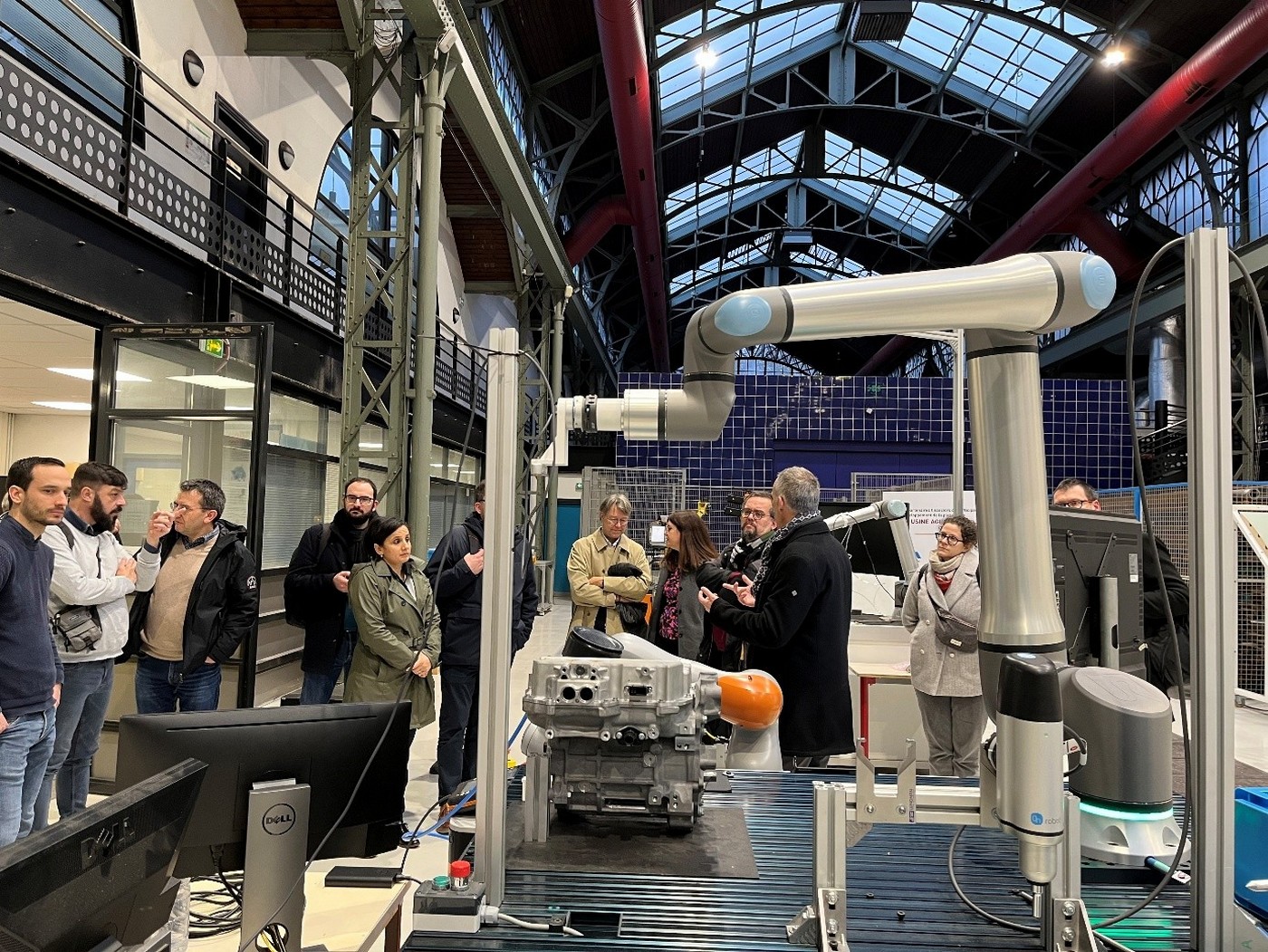
It is within this context that Pietro Sandrini is writing his thesis. Using a disassembly bench consisting of two robots equipped with cameras and various tools, he is working to improve the precision of engine disassembly. " We need to improve both the recognition of the different elements perceived by the camera and the precision of the action that the robot will then perform, " he explains.
Accuracy is key to the project's success: " When a human sees an object, they simply reach out and grab it. For a robot, it's more complex; you have to bring the tool to the right place," adds Adel Olabi, associate professor of robotics and one of Pietro's supervisors. " If you want the robotic arm to remove a screw, a misalignment of less than a millimeter between the screwdriver and the screw head is enough to prevent it from working. "
The precision screwdriver isn't the only tool that robots need to learn how to use. The disassembly bench is designed as a reconfigurable cell that can be adapted to the needs of the operation at hand. " For now, the second robot uses a pneumatic gripper to pick up and remove objects of different sizes, such as a cover," explains Pietro Sandrini. "But the goal is for the robots to have a wide range of autonomous actions and be able to operate on other objects, such as electronic cards or batteries."
Environmental and human issues
As a continuation of the Carnot SDC2 (Smart Disassembly Cell for Circularity) project led by I2M in Bordeaux, DeReCo also responds to the demand to think about engineering through the lens of the circular economy: reuse rather than recreate. But this is not the only issue driving the project. " I had the opportunity to observe disassembly sites in the Hauts-de-France region. These are difficult work sites, where operators perform repetitive, arduous tasks in a noisy and polluted work environment," says Adel Olabi. As with every robotization project, there is a strong desire to help humans, to free them from tasks that add no value so that they can perform more rewarding work. "
Even though research is exploring the idea of a 100% robotized solution, researchers already know that this will not be possible. Robots will work with incomplete knowledge and on dusty objects where not all components will necessarily be identifiable. "This is where the Institut Mines-Télécom comes in, and in particular the RéCLasSIF Meta² project: thanks to their work on cobotics, they provide the complementary human element," says Richard Béarée.
A rich collaboration with IMT
The objective of the Meta² project: to create an algorithm that optimizes a production line to minimize its ecological footprint while also placing people at the center.
"Some robot movements are more costly than others," explains Eric Duviella, one of the project leaders. "We want to measure the impact of a robot and that of a human, and analyze the life cycle of a product in order to offer a solution that reduces both the cost of the production line and its environmental impact."
This dynamic collaboration between these two projects, and even more so between Arts et Métiers IMT, is at the heart of RéCLasSIF. Supported by both institutions as part of the France 2030 program, RéCLasSIF aims to be the leading academic player in the industry of the future. To achieve this, the project relies on a network of several campuses and a portfolio of scientific projects, eight of which are led byIMT Nord Europe and the Arts et Métiers campus Arts et Métiers Lille, creating a breeding ground for regional and interdisciplinary collaborations.