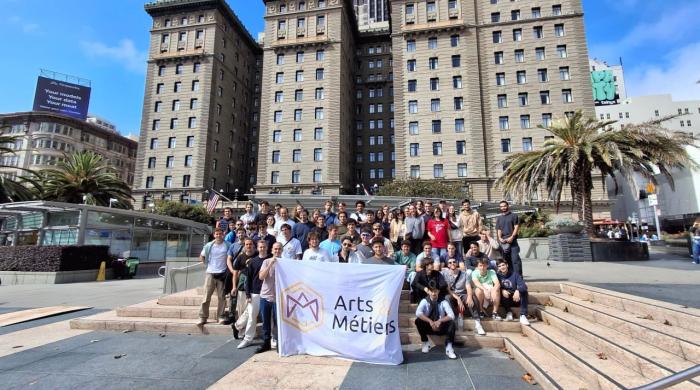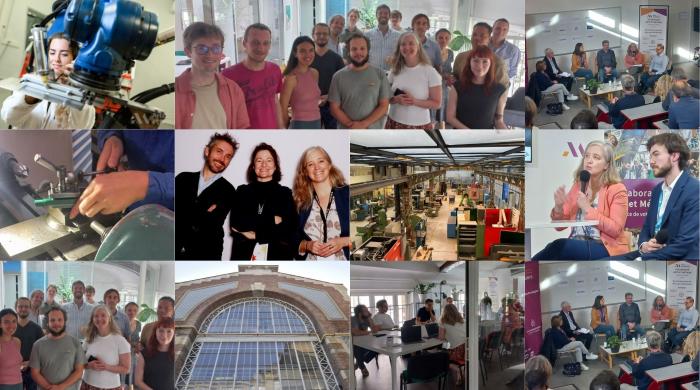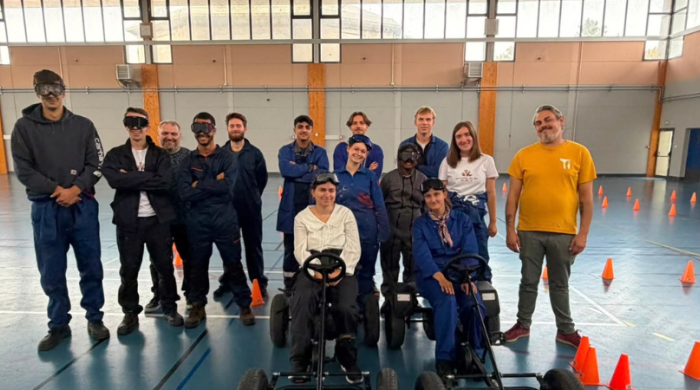
Every year, the Arts et Métiers campus Arts et Métiers Lille welcomesmany internationalstudentsto the "Master of Science KIMP APS" (Knowledge Integration in Mechanical Production – Advanced Production Systems) program. This program, supported by the LISPEN laboratory, introducesengineering studentsto research on topics such as design, the integration of agile production systems, and expertise in robotics, mechatronics, and advanced approaches to artificial intelligence.
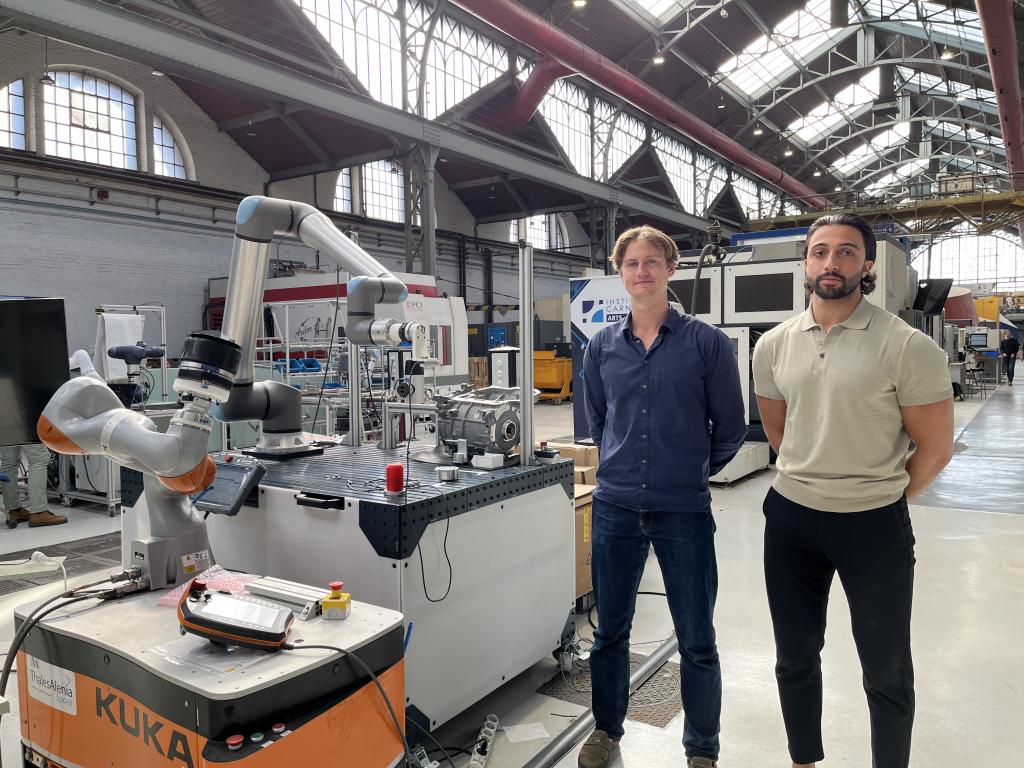
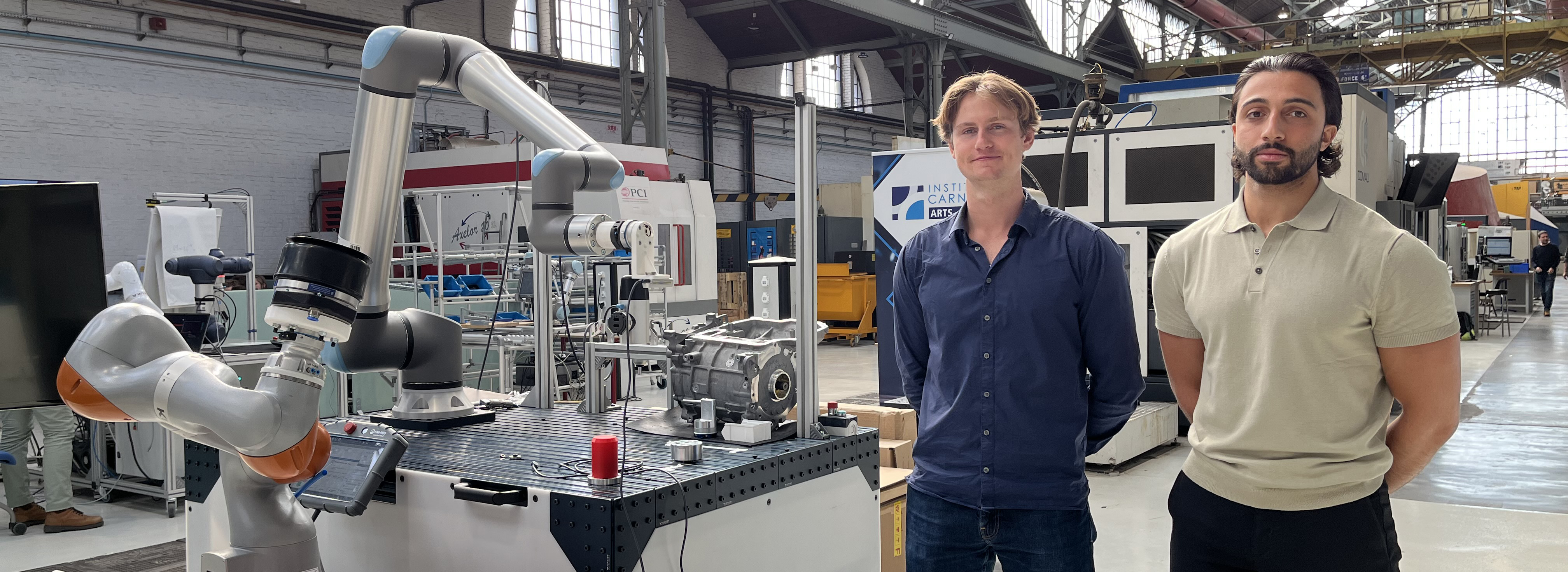
Among thesestudentsare Carl Johan Mokdessi Elias and Arvid Markroth, who are from Sweden. They are enrolled in a one-year exchange program, have completed a semester of coursework on campus, and are currently doing their final-year internship from January through June as part of a dual-degree program offered by their Swedish university and Arts et Métiers. Here’s a look back at their experience.
Two Swedish students in the KIMP-APS dual-degree program share their experiences: international mobility supporting research in robotics and AI
The KIMP-APS Master of Science : A top-tier program focused on the industries of the future
The KIMP-APSMaster of Science Research, offered at the Arts et Métiers campus Arts et Métiers Lille, trains students in the design and integration of agile production systems.
The program, taught in English, consists of one semester of coursework followed by a semester dedicated to a research thesis conducted at a company or in a laboratory, either in France or abroad.
As part of the KIMP-APS program—“Knowledge Integration in Mechanical Production - Advanced Production Systems”—students develop strong skills in robotics, modeling and control, the integration of AI into production processes, and the design of flexible systems to meet the needs of modern industry.
This specialization is part ofArts et Métiers missionArts et Métiers train professionals capable of addressing the technological, economic, and societal challenges associated with the evolution of production systems and innovations in the industry of the future.
This program also has dual-degree agreements with several foreign institutions, including KTH in Sweden, which allows students to gain valuable international experience.
The Lille campus also welcomes students from Iran, Tunisia, and Morocco for a full academic year, as well as students from the ERASMUS program for a semester.
Carl Johan and Arvid’s journey of international mobility from Sweden to the Lille campus
Since January, Carl Johan Mokdessi Elias and Arvid Markroth, fifth-year Swedish engineering students, have joined the Arts et Métiers campus Arts et Métiers Lille to complete their final-year internship as part of their KIMP-APS dual degree program.
An opportunity discovered along the way and turned into a research project
It was through courses taught by Pietro Sandrini, a doctoral student at the LISPEN laboratory in Lille, and Adel Olabi, director of the KIMP-APS program, that the two students learned about the opportunity to study abroad in France.
Impressed by the research topics presented, they approached Adel Olabi on their own initiative and offered to join the team working on the robotic disassembly station.
Very quickly, their interest in the subject turned into a genuine commitment: they decided to define their own research question, building on their previous studies in robotics and artificial intelligence.
Their research project: to expand the use of robotics and artificial intelligence for disassembly, as part of the RéCLasSIF project.
“Today, in the industry, most disassembly operations are still performed manually. Existing robotic solutions are often limited because they are programmed for a specific object and offer little flexibility,” they say.
The overarching research focus of the LISPEN laboratory in this area is the use of AI in the context of disassembly to enhance robotic autonomy. It involves developing a generic and adaptable method, using artificial intelligence to enable robots to recognize different objects and adapt their movements and actions without human intervention. This project is part of the RéCLasSIF Déroco program.
Carl-Johan and Arvid are particularly interested in one specific application: The emerging challenge of recycling electric car motors
They explain: “With the growing number of electric vehicles worldwide, an increasing volume of motors will soon need to be recycled. However, these motors contain valuable materials, the extraction of which requires not only precise human handling but also the ability to operate in environments that are difficult to access.”
"Currently, robots lack the ability to determine the sequence of disassembly. Our research project therefore relies on AI algorithms capable of functioning 'like a brain' to analyze complex situations and guide the robot in deciding which actions to perform during disassembly."
Their interest in this project stems in particular from the expected impacts:
- environmental: improved waste management and reduction, responsible recycling
- technological and industrial: providing more robust automated solutions that are attractive to businesses.
A rewarding Franco-Swedish experience
Carl Johan was already familiar with France thanks to his studies at the Lycée Français Saint Louis in Stockholm and his summer visits. Lille was a first for him. For Arvid, it was a new adventure. Both particularly appreciate the availability and support of Julie Deflandre, head of international relations at the Lille campus, who helped them settle in and integrate, as well as the warm welcome from the entire research team.
“We’ve been fortunate to be part of a modern and flexible academic and research environment, thanks not only to the state-of-the-art laboratory equipment but also to the scalable and adaptable educational modules focused on practical applications, particularly in robotics. We also appreciate the exchange of knowledge: being able to share what we’ve learned in Sweden while testing new tools or research approaches.”
Thanks to the KIMP-APS dual degree program, Carl Johan and Arvid were able to conduct an educational research project on intelligent disassembly, while gaining a rich international experience both personally and academically.
Their testimonials highlight a program that trains engineers in research and the major challenges facing the industry of the future, within a framework focused on innovation and international collaboration.
The partnership with Sweden's KTH University by the numbers
Each year, KTH welcomes approximately:
- 5 Arts et Métiers students Arts et Métiers a dual Master of Science degree
- 6 Arts et Métiers students Arts et Métiers a dual engineering degree
- 2 Arts et Métiers students Arts et Métiers semester S9
In return, 2 to 5 KTH students are hosted each year on the Paris or Lille campuses