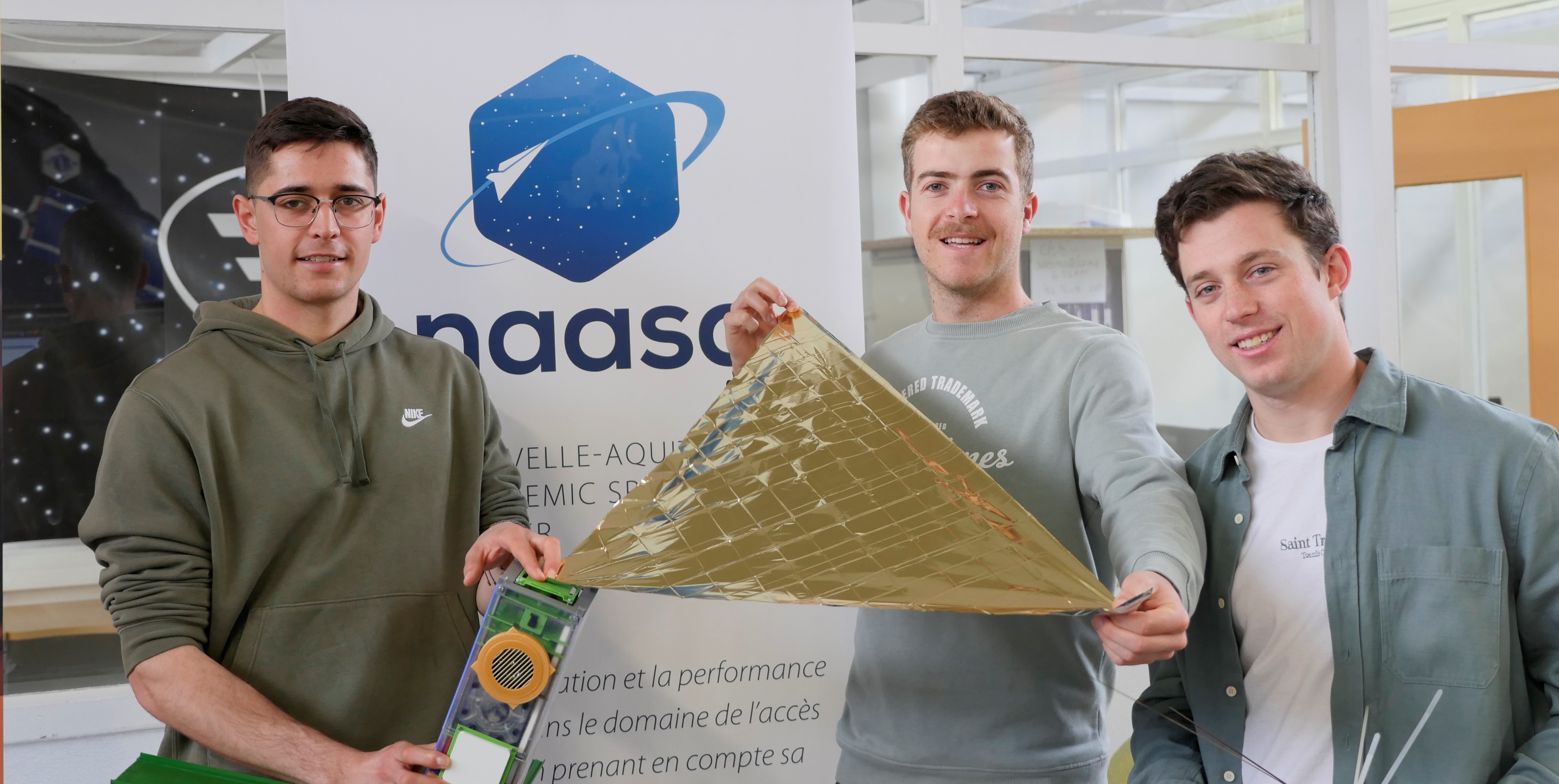
Nicolas GARCIA, Miguel DE SAJA, and Pedro IZQUIERDO, three students pursuing dual degrees Arts et Métiers the University of Valladolid, have been working on a NAASC (Nouvelle-Aquitaine Academic Space Center) project since arriving on the Bordeaux campus in September 2022.
These three students are supervised by Clément Lingois, a recent graduate of ISAE-ENSMA in Poitiers, where he set up a start-up to develop a braking system for nanosatellites using residual atmosphere. Clément now works at Way4Space.
Their work is part of the NAASCube program launched in September 2020, which aims to launch the first student satellite in Nouvelle-Aquitaine by 2025. This is a collaboration between institutions in Nouvelle-Aquitaine (ESTIA Bidart, Sciences Po Bordeaux, ISAE-ENSMA Poitiers, and Bordeaux INP ENSEIRB-MATMECA), bringing together each year teacher-researchers and students in supervised projects or internships on a subset of the satellite or ground facilities.
Our three Spanish students are developing a deorbiting device for nanosatellites, which will be deployed at the end of the satellite's life to deorbit it in less than a year. It is important to note that without a thruster and without this type of device (which could become mandatory), the satellite becomes debris that can remain in space for more than 10 years. The device, called DEDALE, is based on an aerodynamic sail that will be folded inside the nanosatellite and deployed to increase the surface area of friction with the residual air (air is found in space up to several thousand kilometers). It will therefore help to limit space pollution.
To simplify their work, the device will be built on a scale of 2:1, with the aim of verifying the proper functioning of the sail deployment mechanism, based on the properties of superelastic masts.
This research first requires consulting the bibliography, then conducting numerous tests (3D models) to determine the choice of materials, the size of the sail and its masts, the angle of the masts, and the folds to be made so that everything unfolds correctly.