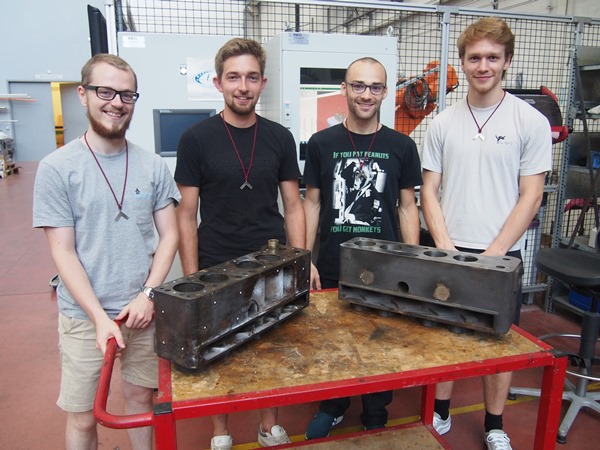
The starting point: an old Bignan car in need of restoration. The cylinder block, the heart of the engine, was too damaged to be repaired. With the help of teaching and technical staff at the Arts et Métiers campus Arts et Métiers Metz, four students reverse-engineered a new block using Industry 4.0 tools. This was the first step in getting the car back on the road.
An educational project proposed by students
Each year, first- and second-year students in the Grande École Engineering Program must carry out a team project. The goal is to learn how to work in a group on technical, technological, and organizational issues. They are always supported by a group of teachers and can draw on campus resources (qualified technical staff, software, technology platforms, etc.).
Maximilien Rousselle, a second-year student and owner of the vehicle to be restored, proposed this project to a teacher last year. Nicolas Bonnet, a foundry teacher, outlines the details: " There was a concrete project and a goal. Based on the starting point, I quickly assessed the skills they could acquire: project management, of course, with scheduling, budgeting, team organization, etc. But also the use of modern tools such as reverse engineering and specialized simulation software. "
Reconstruction of the room using a 3D scanner
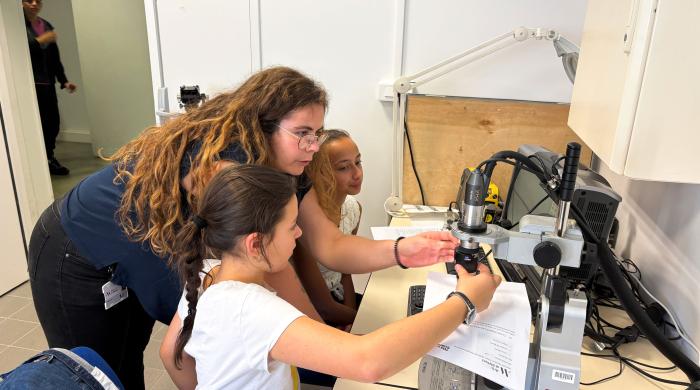
The students have no plans to work from when redesigning the part. They use a 3D scanner to obtain an initial geometry: stickers serve as reference points for the scanner, which digitizes the outer surfaces of the part. A few key parts are measured more precisely using a three-dimensional machine. Once this work is complete, the students have an image of the surface of the part.
Using computer-aided design (CAD) software, in this case Catia® V5, which is widely used in the industry, they design the part to achieve a geometry that meets the expected functions of the engine block.
Manufacturing the right part the first time with digital twins
The students choose to manufacture the part in a foundry, as most engine blocks are still manufactured today. To use modern manufacturing methods, the mold is produced using 3D printing. The students then work on designing all the elements necessary for its manufacture: filling system, air vents, etc.
To ensure that they have correctly dimensioned all the elements, they create a digital twin of their mold using Magmasoft®.This is a numerical simulation software program for the casting process, which is also widely used in the industry. The digital twin is a digital reconstruction of reality: the computer predicts the process of obtaining the final part as accurately as possible. By varying carefully selected parameters (filling time, section and shape of the casting channel, etc.), they are able to optimize their mold to ensure that they obtain the desired part on the first attempt: only one casting is financially feasible.
Partner management and company visits
Once all the plans have been finalized, the four students provide the 3D files to the companies they have approached to carry out the work.
One of these companies, Fonderies Vignon, is responsible for casting the part. The students also enjoy a tour of the company and watch the casting and de-molding of the part, which take place as predicted by the digital simulations.
Final step: simulate and then perform machining
All that remains is to finalize the surfaces: this is the role of machining. This involves removing material in order to achieve superior quality and a compliant geometry that will enable the engine to function properly.
Once again, students use digital tools to simulate the process and define the correct machining trajectories. This is a crucial step in the engine's resurrection. It is known as Computer-Aided Manufacturing (CAM). Using Catia® V5 software, they define the different machines used, the order of machining operations, tool paths, cutting tools, and their operating parameters (cutting speed, feed rate, etc.). Virtual machining ensures that the actual machining will proceed without major problems.
The part is now machined. In total, the students worked an average of 300 hours on the specialized software and 400 hours on the manufacturing processes.
Congratulations to Maximilien Rousselle, Guillaume Conrad, Nathan Niederlender, and Louis Plard.