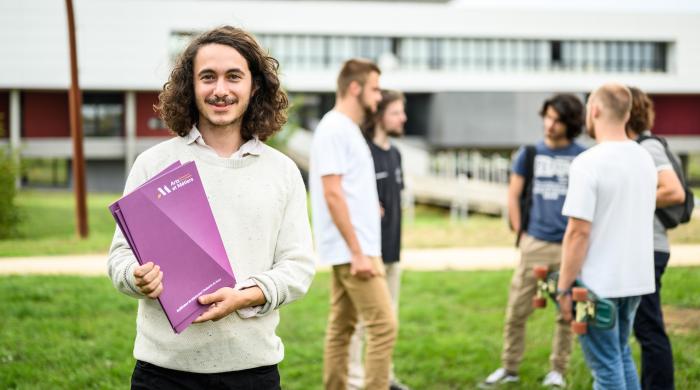
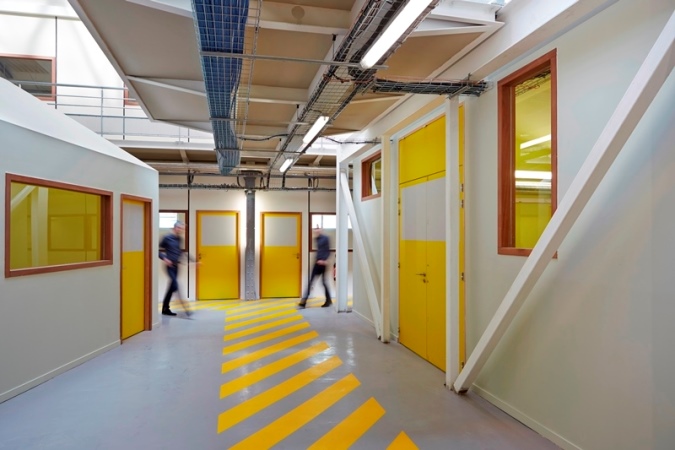
Étienne Boisseau, doctoral student at the Product Design and Innovation Laboratory in Paris.
After obtaining his engineering degree fromArts et Métiers, Étienne chose to pursue a doctorate in order to open up as many opportunities as possible.
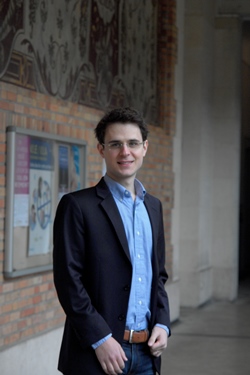 When he enrolled at Arts et Métiers Étienne chose the dual French-German program offered on the Metz campus to complete his general engineering degree. He was particularly interested in product design, and put this into practice in various ways during his internships: as a research engineer in a German university laboratory, in an SME working on a multidisciplinary project, and as part of a research and development team at a major car manufacturer.
Engineer with a doctorate: a profile highly sought after by manufacturers
Étienne wants to dispel common misconceptions about the PhD: "My two years in Germany taught me to debunk the French stereotype that views a PhD holder as a 'lab rat' who is hyper-specialized in a niche field—in short, someone who doesn't fit into the corporate world. Across the Rhine, the status of a PhD holder is so significant that Germans display their title on their business cards, ID cards... and even their mailboxes!A PhD also acts as a career accelerator, particularly abroad. “At a certain point, it’s very difficult to climb the corporate ladder if you don’t have a doctorate,” he confirms. “So, I decided that my first job would be a PhD as a career strategy, especially since I had realized how valuable it would be for an international career path. But it was also my interest in scientific research—which I had discovered during my Master of Science that convinced me to take the plunge.”
A project supported by the laboratory
Étienne explains the process of developing a dissertation and securing funding: "A dissertation is the coming together of four elements: a topic, supervision (a dissertation advisor and a research lab), a candidate, and funding. Once I had my degrees in hand, I went back to see my Master of Science in Master of Science thesis advisor, Professor Carole Bouchard of the LCPI. I also spoke with another faculty member at the lab, Jean-François Omhover. As luck would have it, they were already working together and agreed to supervise my thesis. As a team, we narrowed down the topic: “Next, we defined a research topic that aligned with my interests, their areas of expertise, and had scientific merit. We focused on open-source in product design. Finally, we sought funding: it’s impossible to start a thesis without it. We applied to several calls for proposals, and I eventually secured a HéSam Paris-Nouveau Monde grant.”
With all four criteria met, he began his thesis in the fall of 2014.
A very open future
At this stage, Étienne has not yet made up his mind about his career path: "I'm not sure I want to devote my entire professional life to an academic career, even though I enjoy both research and teaching. The future remains open, although I would like to return to industry to do, rather than just study people doing, as is the case in my thesis. In any case, the skills acquired during my doctorate (management of complex projects and innovation; autonomy and rapid skill development; analytical and communication skills; technical excellence and scientific rigor; openness, collaboration, and interdisciplinarity) are valuable far beyond the academic world: between large companies and start-ups, in France or abroad, I am fortunate to have a future full of opportunities!"
PhD student at Arts et Métiers strong ties with industry
Étienne attests to the value of completing his studies at the institution, both in terms of establishing contacts with companies and the numerous industrial collaborations during his thesis period. "For those who might be concerned about the lack of practical application in scientific research, the advantage isArts et Métiers strong tiesArts et Métiers industry. This allows us to keep sight of the practical application of our research: in engineering disciplines, the industrial relevance of the thesis is also valued, alongside its scientific contribution. There is a pragmatic vision that blends harmoniously with the demands of high-level research."