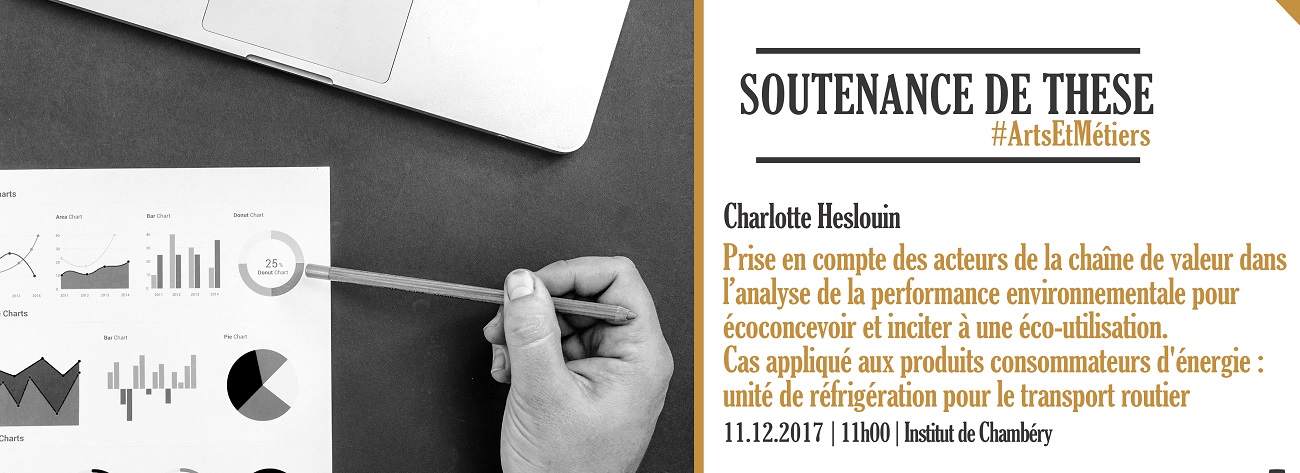
Charlotte Heslouin, a doctoral student at the I2M laboratory on the Bordeaux campus, who spent three years at the Arts et Métiers institute Arts et Métiers Chambéry, will defend her thesis at 11 a.m. on Monday, December 11, at the institute's premises.
The subject of his thesis focuses on taking value chain stakeholders into account in environmental performance analysis for eco-design and encouraging eco-use. Case study applied to energy-consuming products: refrigeration units for road transport.
In order to implement eco-design strategies, it is necessary to assess environmental performance. The use of Environmental Performance Indicators (EPIs) is a good way to achieve this. These EPIs must be adapted to the various actors in the value chain, both internal and external to the company, who are likely to be involved in improving environmental performance in order for them to be effective. These different stakeholders have different information needs (details, type of information), and these needs may be contradictory. In this work, we propose a method for selecting EPIs that takes into account the stakeholders in the value chain and their needs. Once the EPIs have been defined, they should make it possible to assess the situation, define eco-design strategies, and monitor changes in environmental performance. For certain energy-consuming products in the use phase, the usage scenario can significantly alter environmental performance. The focus is therefore on implementing eco-use strategies.
The strategies implemented must enable customers/users to reduce their environmental impact and the company to gain a competitive advantage while improving the environmental performance of its products. In this work, this translates into: 1) adapting existing eco-design tools to integrate value chain actors; 2) defining a personalized diagnostic method for product use. These methods have been applied and validated in a case study of refrigeration units for temperature-controlled road transport.