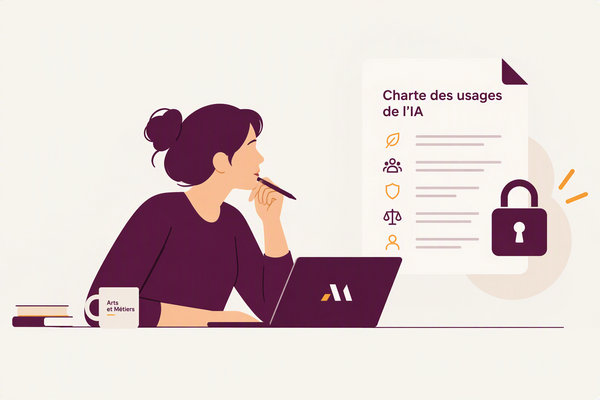
With the adoptionof a charter on the use of artificial intelligence, the institution is establishing a common framework and continuing to integrate AI into its operations and educational programs.
Artificial intelligence is playing an increasingly important role in professional practices and engineering fields. To support this evolution, on September 24, 2026, the Arts et Métiers adopted a charter on the use of AI, following consultation with the F3SCT (Specialized Training in Health, Safety, and Working Conditions). This initiative is part of a broader discussion on the role of these technologies in teaching, research, and the institution’s operations. “The primary challenge for an engineering school like ours is to promote and train our students and staff in the responsible and thoughtful use of AI,” emphasizes Véronique Favier, Deputy Director General. The institution also intends to support its teaching teams, develop its expertise in industry-applied AI, and explore the possibilities these tools offer for its management.
A charter to guide usage
As early as January 2025, an initial memo encouraged staff to experiment with AI to understand its possibilities and limitations. After more than a year of experimentation and in response to requests for a more precise framework, the legal department and the Information Systems Division (ISD) worked to develop a joint charter. This charter is based on five principles: transparency and integrity, accountability and ethics, security and confidentiality, fairness and sustainability, and the primacy of the human element. In practical terms, users of these tools must disclose any significant contribution made by AI to their work, verify the results obtained, and protect sensitive information. “Accountability and ethics remind us that the user remains responsible for what they use, disseminate, or decide: this responsibility cannot be delegated to a tool,” explains Véronique Favier.
Practical guides to support teams
To incorporate the charter’s principles into daily operations, three working groups focused on research, training, and support functions are currently being formed. Their mission will be to produce practical, operational guidelines tailored to the various job roles.
The charter also provides for an AI monitoring committee and an initial evaluation after twelve months of implementation. Feedback, particularly that gathered during the CAIRE project’s training sessions, may help shape the recommendations. Changes in European regulations and ministerial guidelines will also be taken into account.
This initiative is accompanied by a review of research needs. In particular, a seminar held in July highlighted the use of AI across all of the school’s laboratories. The expectations expressed now focus on skills development, access to technical resources, and the utilization of scientific data.
In training, understand before you use
This commitment to integration is reflected in the curriculum. In Metz, the MINA (Advanced Mathematics and Computer Science) module of the Grande École Program uses AI to illustrate concepts already taught, particularly technical data management and optimization algorithms. “The administration asked us to use AI for illustrative purposes, not as a pedagogical objective,” explains Alain Etienne, a professor at the Metz campus. The targeted skills and how they are assessed therefore remain unchanged. “Students will not acquire new AI skills in this module, but it helps demystify how these types of algorithms work and make connections with the curriculum,” he continues.
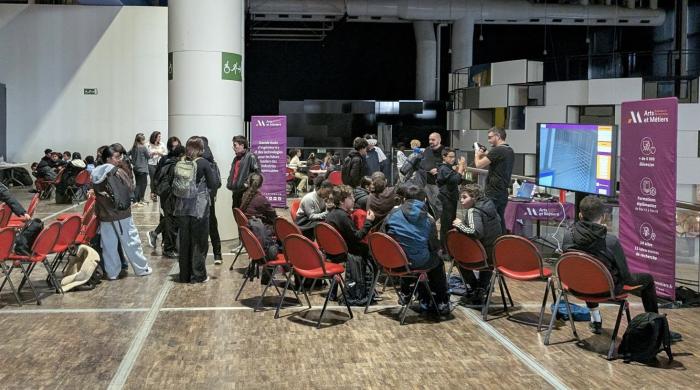
AI has been part of third-year programs for several years now. Alain Etienne specifically cites the KIMP research Master of Science , which includes a module dedicated to AI for design, as well as the Global Performance Management track, where students experiment with different methods of data analysis. A one-day hackathon challenges them to work with a dataset that they must prepare, process, and analyze by comparing several AI approaches before drawing their conclusions. “This puts students in a real-world situation, which is a great way to support their learning,” emphasizes Alain Etienne. The LCFC laboratory also offers training to companies on these approaches, with the same goal: to understand the essential steps of an AI process in order to master its applications.