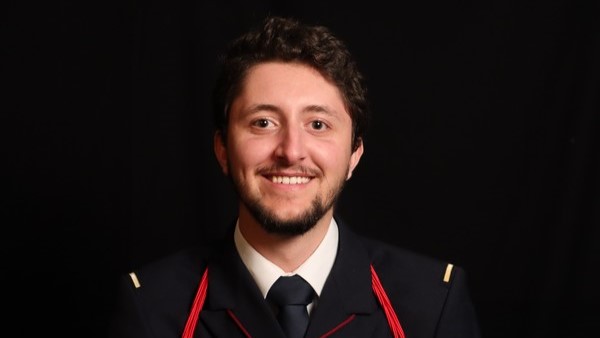
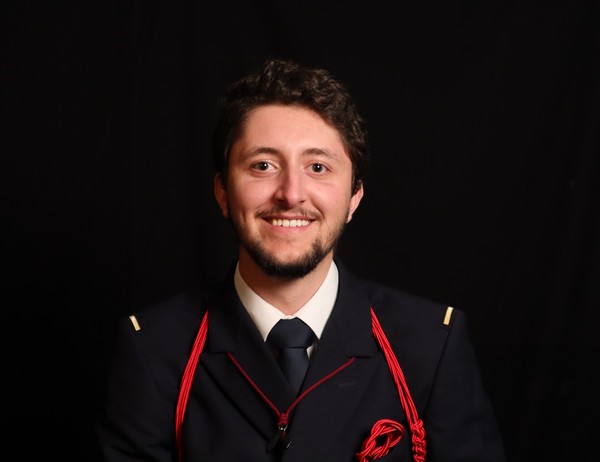
Read an interview with Rafaël JENOT, PhD student at the Microstructures and Materials Mechanics Laboratory (LEM3) on the Arts et Métiers campus Arts et Métiers Metz, as part of Instant Doc.
 Why did you decide to pursue a doctorate after completing your engineering degree?
As soon as I finished high school, I knew I wanted to teach, but rather at the post-baccalaureate level. In prep school, I spoke with several professors who had written a thesis and who advised me to do the same: in their opinion, it's a real plus for teaching.
When I arrived at Arts et Métiers 2021 as part of the Grande École Program, I discovered the Master of Science Materials and Structural Mechanics, which made me even more eager to continue.
I was also encouraged by my mentor at the institution, who is also writing a thesis. Being a year ahead of me in his studies, he helps me with several topics.
What is the topic of your thesis?
I work on the computational design of cobalt-free complex composition alloys (CCAs). The idea is to replace current industrial alloys with alloys that have equivalent properties but are more environmentally friendly, ethical, and functional.
I am working on a type of alloy that was discovered only twenty years ago: it is still very new. Maybe it will be useless, or maybe it will be revolutionary! This element of the unknown makes the research particularly exciting.
What difficulties are you facing?
I face quite a few practical challenges: how to design the alloys, how to guarantee their performance, how to carry out the tests... Whenever I get stuck, I dive into the literature to see what has already been done.
Fortunately, I am not alone. My co-supervisor defended his thesis in 2020 on a subject very similar to mine. We talk a lot. Whenever we encounter an obstacle, we brainstorm together. Our personalities work very well together, and we come up with ideas very quickly.
What does this experience bring you?
A PhD is about learning how to manage a project from start to finish. For three years, I am the pilot, even though I am supervised. It is a very formative experience. And being at Arts et Métiers an asset: there are a lot of laboratories, with a variety of profiles. This offers a large network and the opportunity to exchange ideas with researchers who have different points of view.
What are your plans after your thesis?
Originally, I wanted to do a PhD to become a teacher-researcher. But today, I'm keeping an open mind. I've discovered research, and I really enjoy it. I could continue in this field, becoming a lecturer, for example.
But if one day I no longer enjoy teaching or research, I could also become an engineer. I'm keeping my options open.
Any advice for those who are hesitant to embark on a research career?
I would say: go and take a closer look! There are lots of students who are interested in research but don't really know what it involves. I encourage you to visit the labs on your campus, talk to researchers, and find out what it's really like. You might find it interesting!