The JENII general meeting, which will take place at the end of November, will be an opportunity to test the digital twins developed as part of the project. Explanations with Sébastien Fernandez, ELF Development Director and JENII Project Manager.
What progress has JENII made in recent months?
We have reached a crucial phase in the project. The digital twins are now functional and concrete educational scenarios have been integrated into them. We have focused our efforts on deploying them in educational environments, with full-scale experiments involving teachers and learners.
We have also worked on collaborative versions and have begun distributing them via a cloud platform.
However, certain technical challenges, such as infrastructure and license management, are still being resolved.
Has there been any particularly notable progress?
This is the introduction of accessibility features in all digital twins thanks to recommendations from the working group working on their improvement (WP3). This marks an important step in ensuring that the tools developed by JENII can be used by all learners, regardless of their situation, difficulty, and learning method.
Furthermore, as our ambition is to offer increasingly high-performance immersive environments tailored to educational needs, we have developed a virtual campus with a foundry platform.
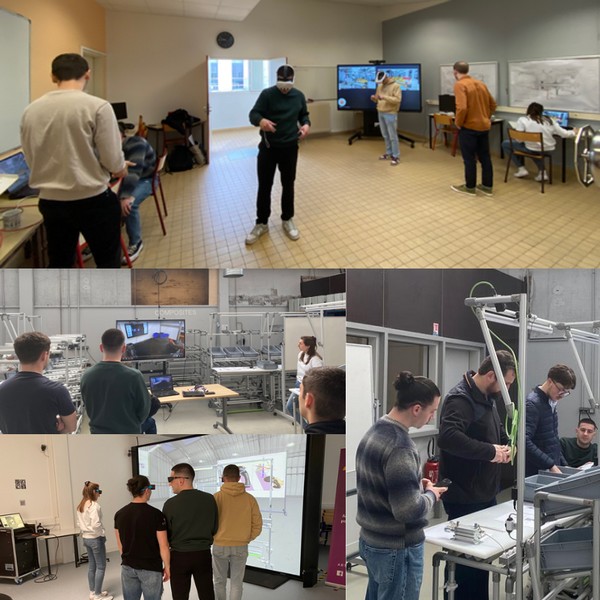
We organized educational experiments with students. For example, in March, engineering students studying production engineering and maintenance at the Bordeaux campus were divided into subgroups. The students alternated between manipulating a physical twin on an assembly line and immersing themselves in virtual reality to test a digital twin. This combined approach enabled them to better understand the stages of the process while exploring the limitations and advantages of physical and virtual environments.
The students' feedback, which was overwhelmingly positive, highlighted the value of this methodology for acquiring technical skills and projecting them into real industrial contexts.
So there will be an update to the white paper?
This book, which contains recommendations and feedback on the use of digital twins, has made great progress this year! An operational and illustrated version will soon be published, incorporating initial feedback from educational experiments conducted with digital twins. This document will be expanded in 2025, the final year of the project, to reflect all of the contributions and results obtained. The goal is for it to become a reference resource for the educational community and industries wishing to integrate digital twins into their practices.
What is at stake at this final general meeting on November 28?
This is a key step in taking stock of the project as a whole and considering its future beyond 2025. We will present the major advances made, share feedback from this year's experiments, and open discussions on the prospects for large-scale deployment of the tools developed. It will also be an opportunity to strengthen collaborations with our partners and explore new ideas for sustaining JENII solutions.
How do you plan to sustain the project beyond 2025?
In 2024, we worked with members of EdTech France. This association brings together all organizations using technology and innovation for education. Together, we explored viable economic models for disseminating and maintaining digital twins after the end of project funding. The development of a catalog of digital twins, accompanied by a series of webinars to engage teachers, demonstrates our commitment to ensuring the sustainable adoption of these educational tools.