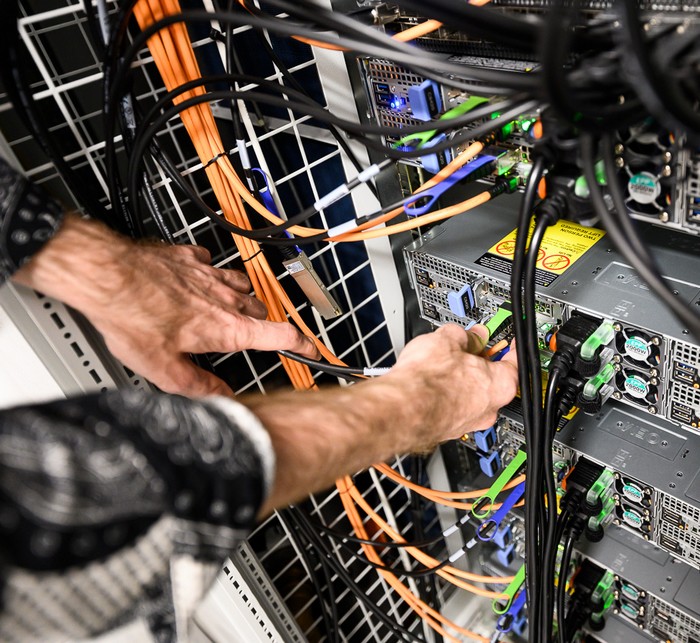
The project, set up as part of the ELF program, aims to empower supercomputer users and encourage them to reduce their carbon footprint.
What is the environmental impact of high-performance computing (HPC), which is now used extensively? This is the issue addressed by the EcoHPC project developed by Mohamad Jebahi, professor and researcher, and Boris Piotrowski, research engineer at the Metz campus.
This project aims to propose easily generalizable intelligent models for estimating the environmental impact of HPC.
A proof of concept on Cassiopée
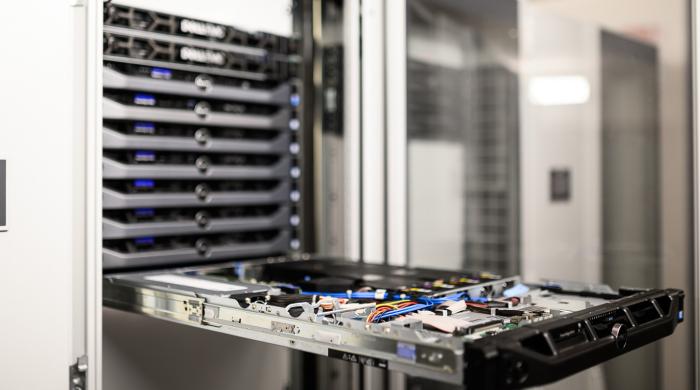
A proof of concept will first be proposed based on the digital activities of the LEM3 teams on the Cassiopée clusterArts et Métiers.
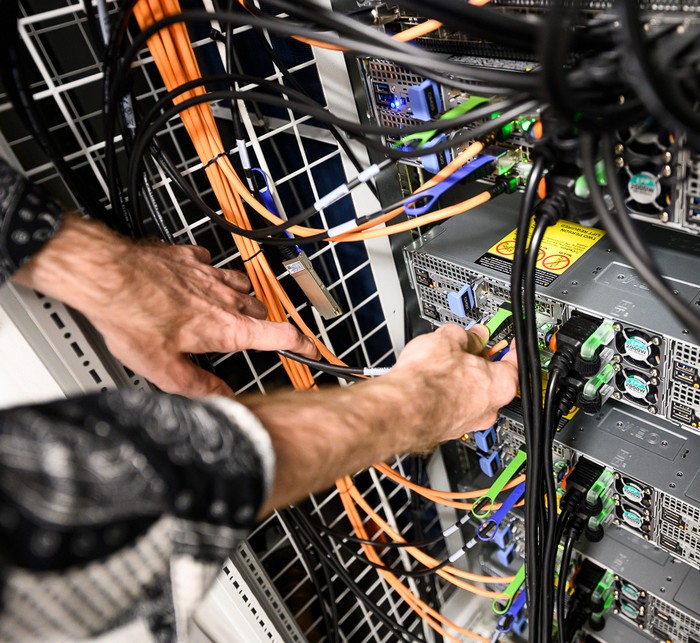
To this end, instrumentation will be installed on the computing cluster to estimate the energy consumption generated by digital calculations. The electrical equipment will be equipped with power sensors connected to an IoT platform to collect, store, and visualize all data.
These sensors will measure the impact of calculations at different scales (processors, computing servers, data servers, administration servers, network managers) as well as PUE index measurements (ratio between total electrical power and computing electrical power). This index, which is a benchmark in the computing community, classifies the energy efficiency of air conditioning systems.
The carbon impact models proposed for Cassiopée will be generalized using artificial intelligence tools. This step requires the development of a database representative of the computing practices used on the cluster.
An app to measure digital activity
Finally, the proposed models will be made available to users via an application that will predict the carbon footprint of their digital activity based on their computing strategies. This application will be an important decision-making aid in making AI as frugal as possible and will offer users trade-offs to optimize the triptych of computing time, computing finesse, and carbon footprint.
This project has multiple training benefits. It can be used to raise learners' awareness of the environmental impact of digital activities. It offers an opportunity to apply the theoretical concepts learned in class to a real-world problem.
The necessary investments are a computing server dedicated to electrical measurements and electrical power sensors.
The funding required for this project is €58,400 excluding tax. It is partly provided by CAMEXIA, the school, AMVALOR, and alumni sponsorship.