Interview with Sébastien Jégou, Academic Director of Master of Science AM²S and Nour-Eddine Laadel, a doctoral student and graduate of Master of Science AM²S Master of Science program.
"It is important to give future engineers and researchers the knowledge and skills to understand, use, and develop tomorrow's manufacturing process optimization tools," explains Sebastian Jegou, Academic Director of Master of Science program.
Master of Science AM²S meets the requirements of the industry of the future. The advent of digital methods based on artificial intelligence and big data, coupled with the rise of mass instrumentation, is leading to unprecedented digitization of manufacturing processes.
The objectives of the Master of Science program: a multiphysics and multiscale approach
The objective of the M1+M2 program is to develop the relationship between materials, usage properties, and manufacturing processes using a cross-disciplinary (experimental and digital) and multidisciplinary (materials, mechanics, and manufacturing processes) approach, all within the context of process digitization and smart manufacturing.
The Materials Science section provides in-depth knowledge of microstructural changes during material transformation and their impact on usage properties.
The Manufacturing division develops advanced and digital manufacturing methods in order to understand the multi-physical phenomena involved in the transformation of materials.
A world-class Master of Science
The Master of Science program is taught in English on the Aix campus. It is affiliated with the multi-site research laboratory MSMP the campuses of Aix-en-Provence, Lille, and Châlons-en-Champagne, and in collaboration with Texas A&M University (TAMU) as part of the Transatlantic Partnership for the Industry of the Future ".
Sébastien Jégou explains that “for students in Grande Ecole Engineering Programme Arts et Métiers Grande Ecole Engineering Programme , the full M1+M2 track leads to an international dual degree (Arts et Métiers Texas A&M University), including a year on the TAMU campus in College Station, with favorable financial terms.”
What happens to learners after they graduate?
After graduating, students either go on to work in industry R&D departments or pursue a doctoral thesis, like Nour-Eddine Laadel, who is currently in his second year of doctoral studies at the MSMP laboratory on the Aix-en-Provence campus. He is working on innovative solutions for hydrogen storage and transport.
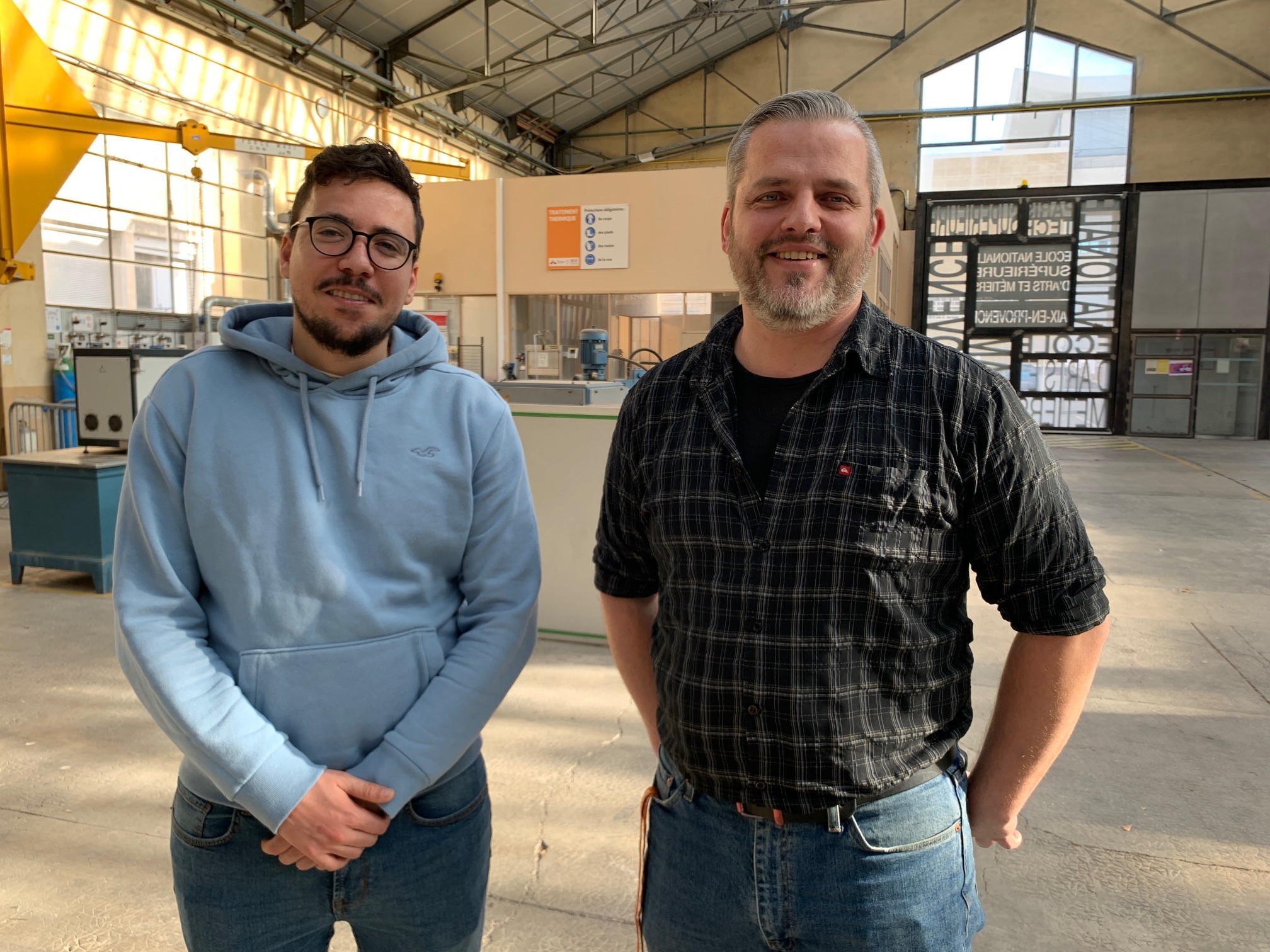
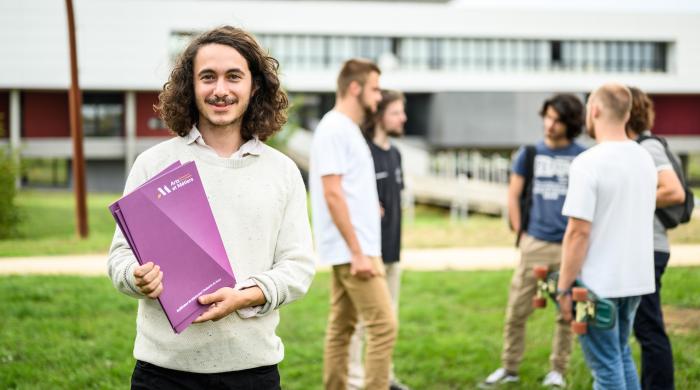
Nour-Eddine Laaden, a doctoral student, and Sébastien Jégou, an associate professor and academic director of the AM²S Master of Science program
Interview with Nour-Eddine Laadel, a Ph.D. candidate and graduate of Master of Science AM²S Master of Science program
Why did you choose this Master of Science program?
I found the content of the modules to be well-suited to the current challenges facing industry and research in the field of materials science. I was drawn to the international focus of Master of Science the opportunity to take courses in English and to deepen my knowledge of materials science through research-oriented instruction.
All these aspects coincide perfectly with my ambition to pursue a career in research.
What are the highlights of this Master of Science program?
The training provided me with a wealth of theoretical and practical knowledge in the field of materials science and manufacturing processes.
The main strengths of this program lie in its ability to prepare students for current and future industry challenges, with an emphasis on innovative Industry 4.0 concepts.
The courses taught in the program allowed me to deepen my understanding of material-manufacturing process relationships and master digital tools for modeling and simulating material behavior and optimizing material design.
In addition, the program offers a balanced combination of theoretical knowledge and practical skills, particularly in the characterization of material properties.
Why did you decide to pursue a PhD?
The decision to pursue a PhD stems from a deep passion for research in the field of materials science, particularly the fundamental understanding of the properties of materials and their behavior, from both a theoretical and experimental perspective.
During my Master of Science program, I took advantage of a course titled “Scientific Project” to conduct a review of the current state of the art in my current thesis topic. I then completed my research internship at the MSMP laboratory, working on the same topic. After obtaining promising results, it was decided to submit a funding proposal for a thesis project, which was accepted.
What is the topic of your current thesis?
In the current context of energy transition, my thesis topic focuses on the development of innovative ceramic materials for hydrogen storage and transport.
This is a CIFRE thesis in collaboration between the MSMP laboratory and the Saint-Gobain Research Provence research center located in Cavaillon (84).
One of the major challenges facing the hydrogen industry is hydrogen-material compatibility. In particular, the diffusion and trapping of hydrogen in metals leads to the degradation of their properties. Using the specific properties of ceramic materials, our objective in this thesis is to develop barrier solutions that protect metals from this degradation phenomenon and ensure the technical and economic competitiveness of the hydrogen industry.
Contacts
- Sébastien Jégou, Academic Director of the AM²S Master of Science program
- Mohamed El Mansori, director of the MSMP laboratory and thesis supervisor for Laadel Nour-Eddine
- Nour-Eddine Laadel, doctoral student