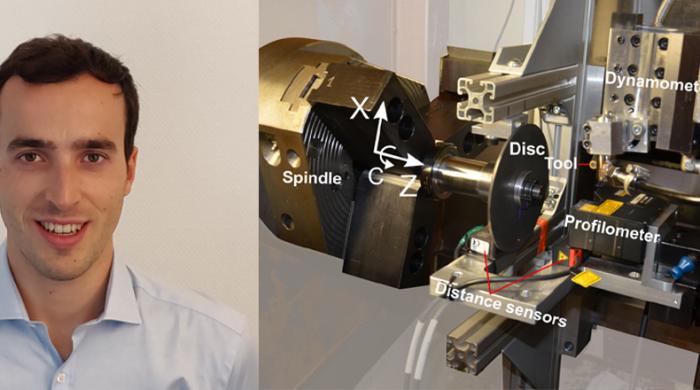
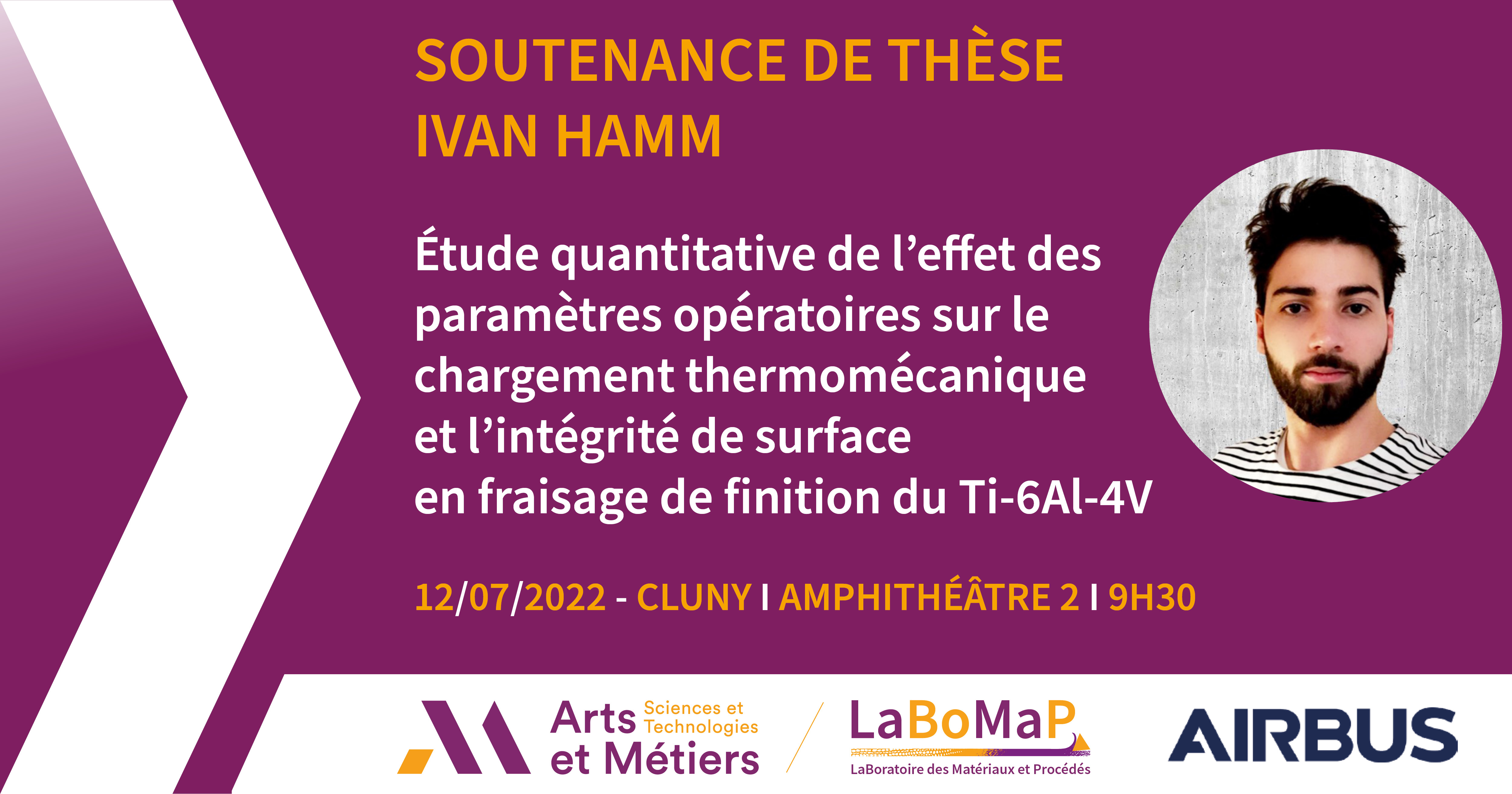
Ivan Hamm, PhD student at LaBoMaP,is defending his CIFRE thesis with Airbuson: "Quantitative study of the effect of operating parameters on thermomechanical loading and surface integrity in the finish milling of Ti-6Al-4V."
This defense can be followed remotely via an internet link to be provided.
Members of the jury
- Katia MOCELLIN, Senior Researcher, CEMEF, Mines Paris Tech / Examiner
- Aldo ATTANASIO, University Professor, University of Brescia / Rapporteur
- Vincent WAGNER, Senior Lecturer, LGP, ENIT / Rapporteur
- Gérard POULACHON, University Professor, LaBoMaP, Arts et Métiers Examiner
- Frédéric ROSSI, Senior Lecturer, LaBoMaP, Arts et Métiers Examiner
- Nicolas MAURY, Doctor of Engineering, AIRBUS OPERATIONS SAS / Examiner
- Hélène BIREMBAUX, Lecturer-researcher, LaBoMaP, Arts et Métiers Guest speaker
Summary
Aeronautical structures, such as propulsion systems, are typically made up of metal parts designed to withstand significant thermomechanical loads. These parts are obtained from blanks that are then machined to their final dimensions before being assembled. The machining process is therefore a key step in the manufacturing cycle of a part, ensuring that both dimensional requirements and metallurgical and mechanical properties are met.
In other words, it is essential to be able to guarantee that the machined surface has all the characteristics, in particular the stress state or metallurgical state, that will enable it to fulfill its function for a predefined period of time according to its design. Furthermore, developments in techniques and production methods aimed at increasing productivity and process robustness lead to regular changes in manufacturing ranges. It therefore becomes necessary, although sometimes difficult, to guarantee the quality and performance of the parts produced while taking these changes in the manufacturing process into account. The importance of surface integrity is particularly relevant for aerospace parts that are subject to high cyclic mechanical loads. Fatigue resistance is directly and strongly influenced by several parameters characteristic of surface integrity, such as surface condition, residual stresses, and metallurgical quality. The aim of this work is to analyze the machining parameters of the finishing milling operation of the Ti-6Al-4V titanium alloy, with the aim of establishing the inverse relationship between surface integrity and manufacturing process parameters.
This work is structured around the concept of Process Signature, which initially involves quantifying the thermal and mechanical load applied to the manufactured surface according to the process conditions. Based on these stresses, thermomechanical modeling is used to define the temperature and displacement fields of the surface material generated. Experimental tests are then carried out to establish the link between this thermomechanical load and the surface integrity obtained (residual stresses, microstructure, surface condition, etc.). This is the very principle of the Process Signature concept, which links loads to surface integrity. Once this link has been established, it is then possible to develop an inverse demonstrator capable of predicting the effect of the milling process and its parameters on the surface integrity obtained.
Keywords
Signature Process / Reverse Method /Surface integrity / Thermomechanical loading / Ti-6Al-4V / Finishing milling