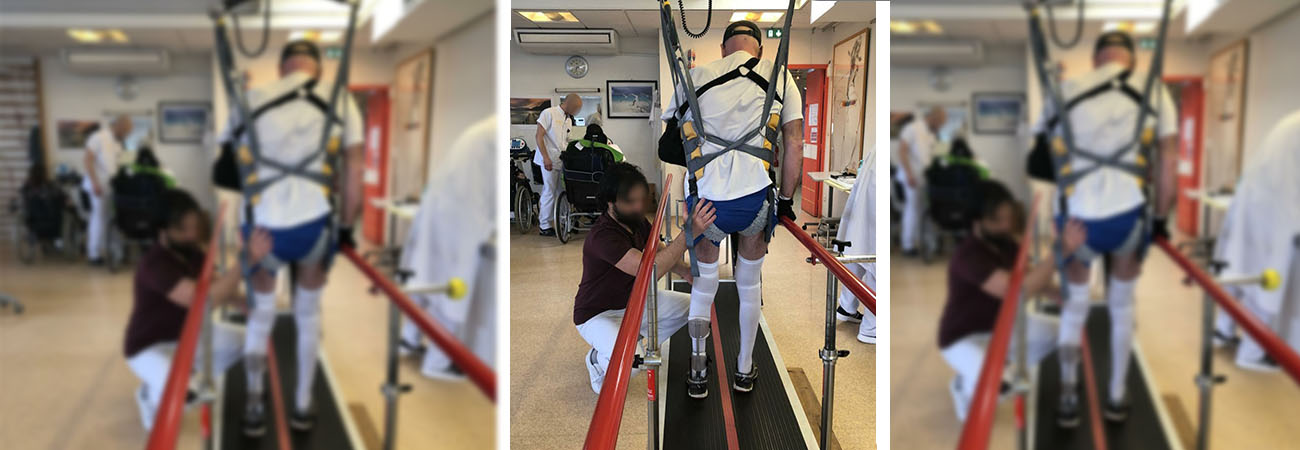
The RehabByExo project, a key project of the the Carnot ARTS Institute, aims to develop an exoskeleton for the rehabilitation of patients with severe hemiplegia with a view to helping them regain functional walking abilities. As part of this project, Valentin Spiroux is conducting research for his thesis at LAMPA (Laboratoire Angevin de Mécanique, Procédés et innovAtion) on the Angers campus. His goal is to optimize the structure of the exoskeleton.
In what context was the RehabByExo research project born?
For several years now, there has been an increase in the number of people suffering from strokes—in France alone, this represents around 150,000 cases per year! These strokes can cause significant damage. Strokes cause a lack of blood flow to the brain, which can affect many organs and limbs, damaging their functioning and sometimes leading to paralysis. Rehabilitation can help restore certain functions. However, it requires a significant investment in terms of both time and physical effort on the part of patients and physical therapists. It was with this support in mind that the idea of developing an exoskeleton to help hemiplegic patients walk again was born.
Who are the stakeholders involved in this project?
The RehabByExo project stems from a thesis conducted by a physical therapist at Bordeaux University Hospital. As part of his research, he developed an initial prototype exoskeleton. The project aims to improve its ergonomics and performance by bringing together the expertise of several laboratories. The LAMIH (Laboratory of Automation, Mechanics, and Industrial and Human Computer Science) in Valenciennes, where another doctoral student is conducting parallel research on the actuation and movement of the exoskeleton. Three Arts et Métiers laboratories,the IBHGC (Georges Charpak Institute of Human Biomechanics), which specializes in biomechanics, LISPEN (Laboratoire d'Ingénierie des Systèmes Physiques Et Numériques), and finally LAMPA at the Arts et Métiers campus Arts et Métiers , where I am conducting my research. My thesis is co-financed by Angers Loire Développement (ALDEV).
What is your thesis about?
Since November 2019, I have been in charge of everything related to the exoskeleton's structure, i.e., its mechanical components and dimensions, drawing on the expertise of LAMPA, a laboratory specializing in this field.
The structure of the exoskeleton must be able to provide a gait that is adapted to the patient by correctly reproducing the body's movements. It must be able to adapt to all body types: we are working on a very wide range of sizes, weights, and connection points between the exoskeleton and the patient's body.
Naturally, other aspects such as cost, structural durability (by conducting research on the fatigue resistance of the chosen materials), lightness, and ease of use must be taken into account in the development of the structure. I have already been able to establish the appropriate kinematic diagram. Now I need to work on optimizing the materials and integrating sensors to collect the patient's medical data and monitor the wear and tear of the exoskeleton.
To make progress on my dissertation, I am also drawing on student projects from Grande Ecole Engineering Programme. To date, five projects over two academic years have focused on finding solutions and on the technical design of certain components of the exoskeleton’s structure.
What made you want to join such a project?
I completed a Master of Science Mechanical and Materials Engineering in Lorient, during which I was able to gain familiarity with the field of research. Once I had my degree, I wanted to continue exploring this field by pursuing a Ph.D. I came across the thesis opportunity posted for the RehabByExo project, and it immediately caught my interest: the thesis combined the skills I had acquired during Master of Science, my interest in the medical field (which my family is involved in), and my passion for innovation.
The development of exoskeletons is still in its infancy, and their field of application is vast. This opens up many exciting possibilities!