Launched in 2019, the Create-ID chair with ESI Group, a global software publisher and specialist in virtual prototyping services, aims to develop research and training in real-time digital simulation and artificial intelligence. For the past two years, the LAMPA research laboratory at the Arts et Métiers campus Arts et Métiers has been contributing to this chair.
For the past two years, the LAMPA research laboratory at the Arts et Métiers campus Arts et Métiers has been contributing to the ESI Group research chair on topics related to model reduction, multi-scale approaches in time, and the link between physical models and virtual reality. We meet with Amine AMMAR, Deputy Director of LAMPA and project leader in Angers, who tells us about this chair and its work on the digitization of industrial professions.
 What are the objectives of this chair and its challenges?
This chair, which combines fundamental and applied research, focuses on the digitization of industrial professions. The chair has two objectives: to identify correlations that will help inform decision-making and to demonstrate that the results will have significant benefits, particularly in terms of human comfort when interacting with the environment.
The Chair has two components: teaching and research, which focus on real-time production simulation based on physical models; modeling and simulation driven by data and artificial intelligence; and, finally, the hybridization of these two components to create different types of digital twins.
Today, we are often faced with situations where data must be used to enrich models, and models must be used to make data more intelligent. The ultimate goal is to predict the behavior of a material, process, organ, structure, or system throughout its life cycle.
What are the specific research topics that LAMPA focuses on?
The themes are defined in close alignment with the needs of the ESI Group and disseminated through Francisco Chinesta, Director of the Create-ID Chair, and Jean-Louis Duval, Director of Innovation at ESI Group.
LAMPA's research activities focus more specifically on different methods of dimensionality reduction. Dimensional reduction is a process studied in mathematics and computer science that involves taking data from a high-dimensional space and replacing it with data from a lower-dimensional space. Model reduction makes it possible to reduce the computing time (CPU) of a simulation, process, or flow, for example.
Dimensional reduction can thus be applied in various fields, whether for casting or welding processes, or even in virtual and augmented reality. It also makes it possible to address multi-scale problems in space and time, with a focus on material fatigue or turbulence in fluid behavior.
Another area of research at LAMPA involves continuing developments in the generalized proper decomposition (GPD) approach. This is a new family of dimensional reduction methods designed to solve physics problems by writing the solution in the form of function products. Its advantages are significant: this method makes it possible to calculate the results of physics problems in a very short time and to store these results while minimizing the amount of computer memory consumed.
LAMPA also conducts research on virtual twins that work by combining physics-based and data-based models (artificial intelligence). A digital twin is a digital replica of an object or a simulation of reality. Then, using virtual reality, the user can view the representation of the digital twin, often a 3D model, while immersed in a dedicated environment.
How does LAMPA's research meet the needs of ESI Group and, more broadly, the needs of industry?
Although current computing resources can solve models with several hundred million unknowns, it is now necessary to propose new methods to optimize the use of computing resources. LAMPA conducts upstream research on the development of numerical simulation tools developed by ESI Group. The challenge is to develop computer codes in line with the needs of Industry 4.0.
As part of our research into digital twins, we are studying the relationship between material properties and processes. Using digital twins, we can predict the state of a material during flow and how this flow will affect the orientation or microscopic organization of the material. These local properties determine the mechanical strength of parts during their life cycle. The challenge is to be able to anticipate, through simulation, how parts will perform in service. For ESI Group, the goal is to integrate our research on the product life cycle (from shaping to integration into an operating system) into their calculation codes.
More broadly for the industry, this simulation-based approach makes it possible to identify the risk of failure upstream and ultimately reduce the costs of experiments conducted on actual parts.
What are the main advances made by LAMPA over the past two years?
Several studies have focused on highlighting the contribution of learning methods in situations where it is difficult to implement a model described by one or more equations. By way of illustration, we can present an example that aims to model the molecular dynamics of suspensions composed of flexible linear molecules.
The molecules below are represented by a series of connected beads, whose dynamics are governed by three potentials: the extension potential, affecting the elongation of the segments connecting consecutive beads; the potential governing the bending of molecules; and finally the Lennard-Jones potential describing the interaction of non-consecutive beads (atoms). This simulation work carried out at the heart of the atom chain, illustrated below, makes it possible to predict the microscopic state and thus estimate the mechanical strength of a part. Each material has a microscopic molecular state that depends on its chemical composition.
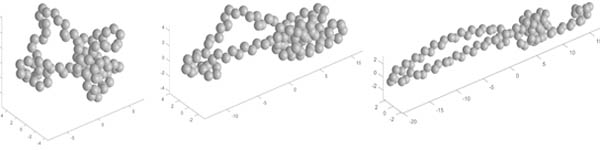
Caption: An example of the stretching of a molecular chain using a "molecular dynamics" simulation at different points in time.
In 2021 and 2022, what are the priorities for continuing LAMPA's research work?
We have two theses for the 2020-2021 academic year. The first thesis is co-funded by Angers Loire Métropole as part of the chair. It focuses on predicting defects during the casting process. It draws on the casting expertise we have on the Angers campus with Aude CAILLAUD and Julien ARTOZOUL. This is an example of work that illustrates the scientific cross-disciplinary nature and complementary skills of the LAMPA laboratory.
The context of this project is part of an effort to optimize the quality of raw castings. The goal is to develop a digital tool capable of providing a real-time response on the acceptability of a casting's quality following a deviation in the process input parameters. The approach consists of building this tool based on simulation data enriched by experimental measurements. This digital tool will be a decision-making aid for implementing process parameter control and will enable real-time control of product properties.
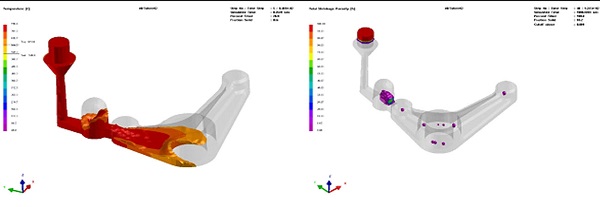
Example of simulation result: mold being filled / Example of simulation result: sink marks generated (defect)
The second thesis focuses on the use of an in-plane/out-of-plane approach to predict the behavior of thin sheets. The implementation of such predictions is of great interest for car body manufacturing processes in particular, but more generally for any thin-walled part. The aim of this thesis is to determine as accurately as possible what happens in the direction of the sheet thickness, either from direct simulations or from measurement data. Additive manufacturing is also one of the processes that is of particular interest in this type of prediction and will be a future challenge for us.
The work carried out at LAMPA as part of the ESI Chair is a concrete illustration of the establishment of collaborative research serving industry and responding to industrial needs. This project is also a collective effort involving teachers, researchers, and doctoral students, which creates a very rich environment for our research work.