The aim of the second-year educational project "Scientific Partners for the Classroom" (the new name for the ASTEP program: scientific and technological support in primary schools), in which the Arts et Métiers campus Arts et Métiers is a partner, is to stimulate the curiosity of primary school children and raise their awareness of science and technology. Let's take a look back at the projects carried out for this 14th edition!
Spark children's curiosity!
Their mission was to popularize scientific subjects among students in order to spark their curiosity about science and show them that they could already use their knowledge to develop a scientific approach. The engineering students competed to come up with ingenious ways to convey complex concepts to children eager to learn about science.
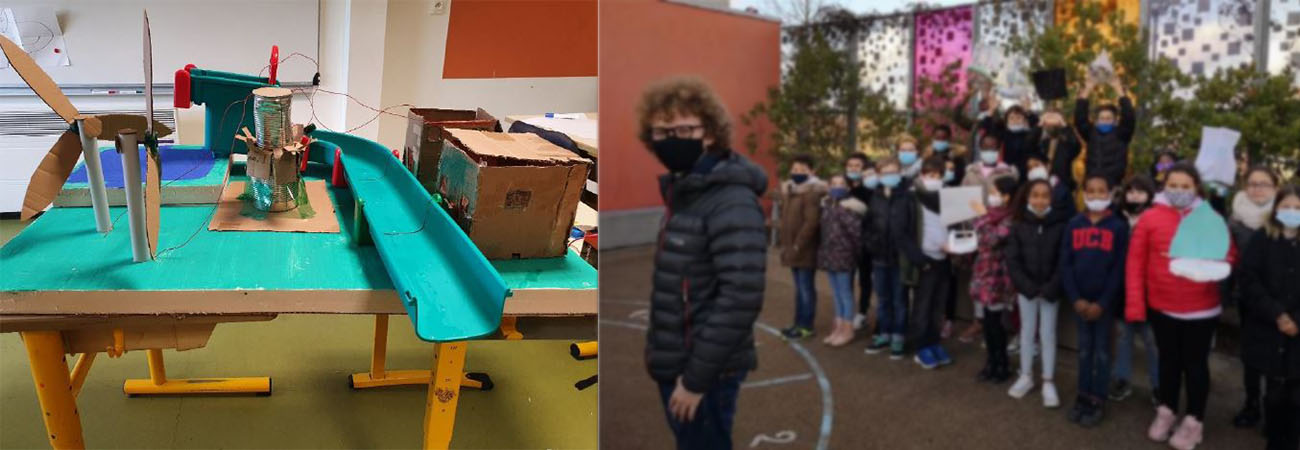
For Marie CHAVANE DE DALMASSY, Charles-Antoine POYNOT, Laureline PORCCEDA, and Thomas DARNAULT, the four students involved this semester , "we wanted to join this project to share our knowledge and help children, particularly those in priority education areas. This unusual project allowed us to apply the knowledge we acquired during our studies, particularly throughout our science courses, to spark children's interest in science," they explain . Through activities adapted for children, the engineering students illustrated concrete applications of science and technology in everyday life. Some built model boats related to the Vendée Globe and maritime navigation, others conducted experiments around a water tower to discuss access to water in France, and others built models of wind turbines and dams to talk about electricity—concrete topics that fascinated the children!
From initial contact to the role of teacher
After meeting with the school teachers, a relationship of trust was established with them so that we could get down to business. Being able to work confidently within a classroom is key to the success of this educational project. "The first meeting with the teacher was very warm. With Covid, he was happy to be able to offer his students a project again," explains Charles-Antoine, as does Marie, for whom "the first meeting with my teacher went very well. We immediately established a relationship of trust that lasted throughout the project."
After an observation session, the engineering students were able to step into the role of teacher and dive right in, leading seven 90-minute sessions.
Theimportant thing was to spark the students' curiosity. Whether in person or remotely, we wanted to stimulate the children intellectually so that they would participate actively. It seems obvious that practical activities, such as model building, were a huge success!
Organize a teaching sequence
To organize these sessions, each student had to strike a balance between theory and practical work to keep the pupils motivated. "The challenge was to hold their attention throughout the session and avoid a 'lecture' format. So I decided to combine theory and practice in each session to make learning as fun as possible," explains Marie.
During this educational project, the engineering students demonstrated imagination and innovation. A fourth-grade class is a demanding audience. Keeping their attention is essential. To achieve this, a variety of activities were offered: attractive visuals, videos, question-and-answer sessions, and, of course, hands-on activities.
A project that develops an engineer's cross-functional skills
This educational project enabled second-year students to develop the cross-disciplinary skills required of an Arts et Métiers engineer. From project organization to preparing classroom presentations, human relations and communication, time management, scientific outreach, and the implementation of a scientific approach and analytical skills, students also had to develop their ability to adapt and bounce back when faced with difficulties!
This project allowed us to discover our ability to synthesize scientific concepts, manage group activities, and present ideas in a dynamic and lively way. Through this project, we were able to share and pass on knowledge to the children, which we hope has given them a taste for science.
An action that wins everyone's vote
The students are unanimous in their opinion that this educational project is very rewarding both professionally and personally. "Our greatest source of pride was getting students interested, especially those from disadvantaged backgrounds, and seeing them progress in the scientific process. The teacher's recognition of the work we did was also very satisfying!" theyconclude .