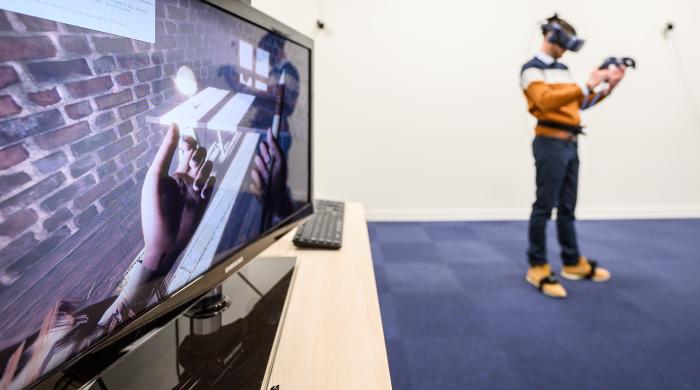
As we know, safety and security are key priorities for the SNCF. That is why the company has called upon the expertise of students in Master of Science and Management of 3D Interactive Technologies (MTI3D)program atthe Institut Arts et Métiers Lavalto develop an innovative virtual reality training program for controllers in the areas of safety and security: “Virtual Safety.”
Developing innovative technical training that closely reflects real-world conditions
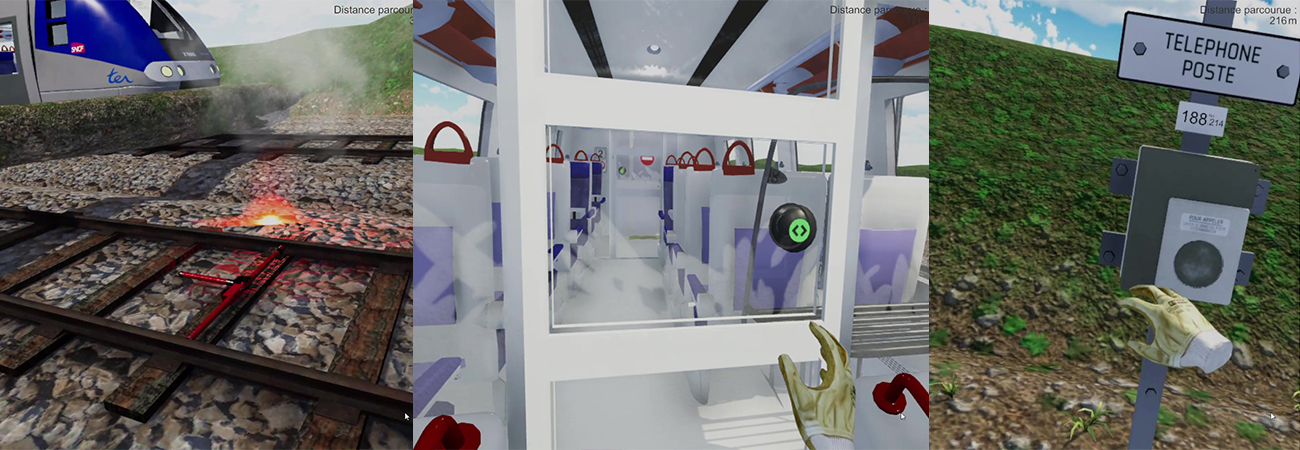
The SNCF’s goal was to develop an innovative training program for train conductors (of whom there are 11,000 in France). This goal has been achieved with the “Virtual Safety” training program, which aims to train as many staff members as possible using virtual reality, enabling them to quickly and accurately master the skills required for their jobs. A team of students from Arts et Métiers Laval, enrolled inMaster of Science andManagement of Interactive 3D Technologies (MTI3D) program, worked for six months on this program with Samuel Barillet, a visual management coordinator for TER/TGV trains and a safety trainer at SNCF. "The task was quite complex, as we had to convert rare and sensitive processes to create an immersive experience that closely mirrors real-world conditions," he explains.
Realism at its peak, a requirement for effective training
The computer graphics and modeling skills of Arts et Métiers students Arts et Métiers greatly appreciated in simulating a real railway environment interface. "Realism was very important for this application, and we were very attentive to the needs of the SNCF, " explains Benjamin Poussard, virtual reality/augmented reality research engineer at the Arts et Métiers Institute Arts et Métiers Laval, who worked with the students. "The stakes are high because when it comes to training in the field of safety and security, responsiveness and precision in the execution of the process are essential, " he explains. Controllers are trained in "obstacle clearance distance," which allows them to learn, without danger, how to react in the event of an accident between a train and an obstacle. Samuel Barillet is convinced that "being virtually immersed in exceptional situations allows for a better understanding when the agent is faced with an accident." Other advantages include the fact that simulating, for example, a tree falling on a track in virtual reality saves time and requires less financial investment.
An innovative training program recognized at the SNCF Awards
This innovative "Virtual Safety" program won an award at the SNCF Awards ceremony held last June at the Cirque d'Hiver in Paris. The SNCF Awards aim to highlight good ideas and talent among employees across the country so that they can then be standardized, a kind of participatory innovation. It has been a great journey for the team, as out of 700 entries submitted in France, "Virtual Safety" won the Grand Est region competition and was among the 100 national entries selected.
Currently deployed in Champagne-Ardenne, the collaborative project between SNCF and Arts et Métiers, "Virtual Safety," is now on track to be rolled out more widely across France.