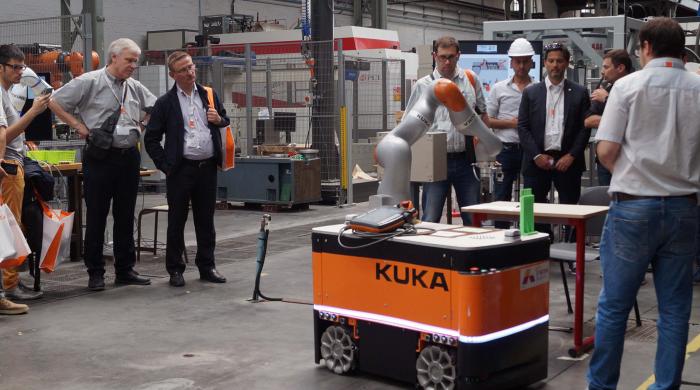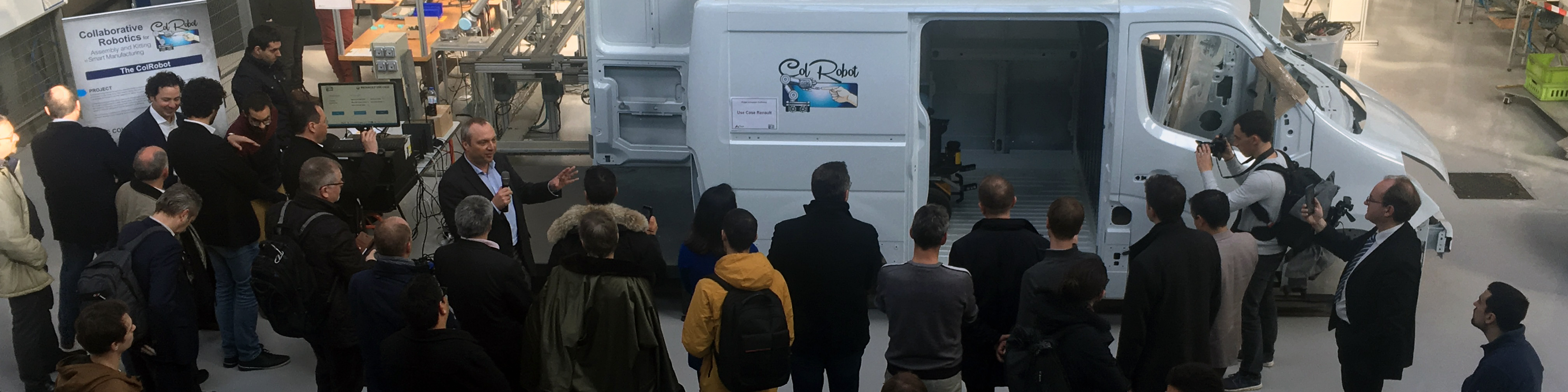
The mobile and collaborative robotic demonstrators developed as part of the European ColRobot project were presented to representatives of the European Commission and around 60 partners on March 14. A look back at a success story led by Arts et Métiers.
A €4 million European project involving 11 partners and coordinated by Arts et Métiers, ColRobot combines the latest European technological innovations in robotics in the fields of assembly processes in the automotive and aerospace industries to create an integrated collaborative mobile robotics system.
First cobot integrated into clean room at Thalès Alénia Space
Two years of research and development were required to integrate a collaborative mobile robot into the satellite clean room at Thalès Alénia Space (Cannes site). In collaboration with CITC, AKEO+, the University of Coimbra, and Technaid, Arts et Métiers its expertise in the in-depth analysis of human-robot interaction and the integration of parts-handling technologies and cobot mobility management at a high level of industrial maturity. The manufacturing processes and risks associated with robotic interaction were also analyzed in detail to inform the design of robotic prototypes, in order to avoid any risk to operators working with or alongside the robot. ColRobot provides a comprehensive definition of requirements for industrial aerospace use cases where robots are operated.A mobile robot assists operators in the meticulous and tedious work of preparing screw kits. The robot also acts as a "third hand" by providing the operator with kits, tools, and parts. It also holds "heavy" parts while the operator assembles them on the satellite.
The Renault demonstrator capable of entering and moving around independently inside a commercial vehicle to perform high-precision assembly tasks.
The cobot designed for the automotive industry, particularly for Renault, offers numerous advantages by helping to reduce or even eliminate repetitive and non-ergonomic operations, particularly during assembly. Capable of entering and moving around independently inside a commercial vehicle, the ColRobot performs assembly tasks (screwing, tightening) while ensuring a high degree of precision. ColRobot has demonstrated its ability to perform screwing operations considered non-ergonomic for operators at a cycle time suitable for an automotive production line. Easy to program and implement, this cobot allows operators to focus on other activities such as quality control.
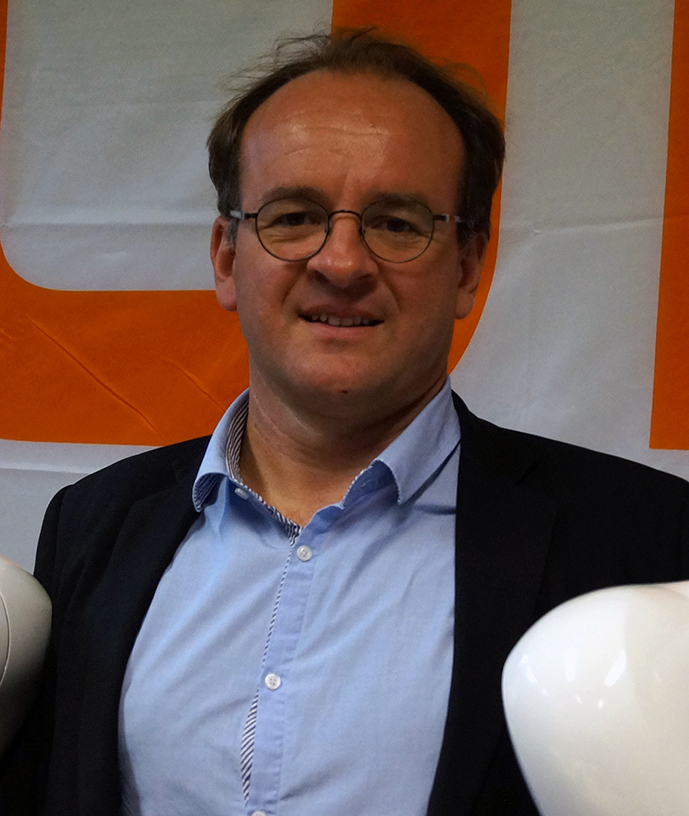
ColRobot will improve working conditions for factory operators, making them more competitive. We have reached the final demonstration phase of the project with a high level of industrial maturity and are eager to continue integrating our technologies so that the factories of tomorrow can benefit from the flexibility, agility, and safety offered by these cobots.
Olivier Gibaru, professor at Arts et Métiers University and leader of the European ColRobot project