Thesis defense on Conwip Optimization in a multi-product environment

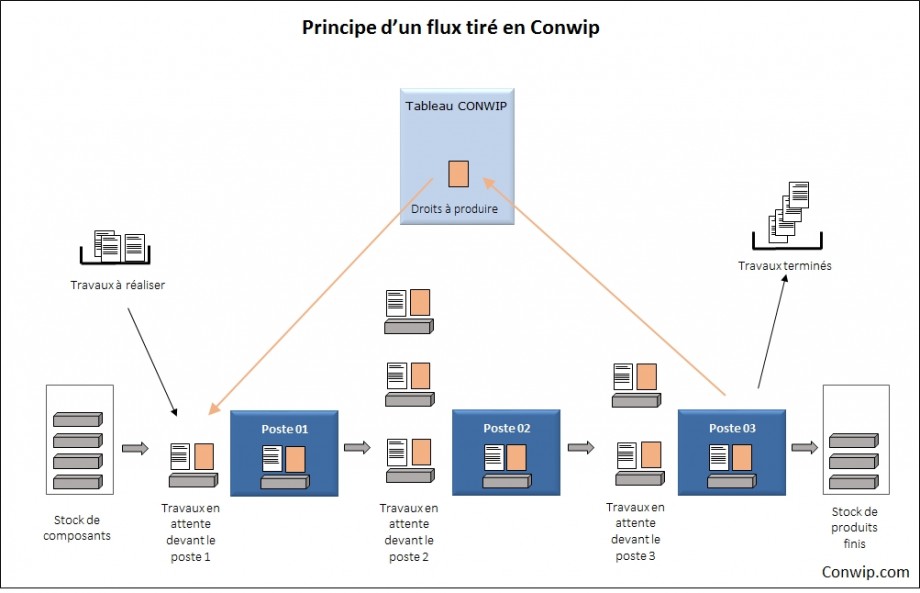
The Convip method
December 7
Arts et Métiers Campus Arts et Métiers Paris - 155 Boulevard de l'Hôpital, 75013 Paris
News
Research

You are cordially invited to the thesis defense of Yann JAEGLER, who willbe defending his thesis toobtain adoctorate from the École Nationale SupérieureArts et Métiers, specializing in Industrial Engineering.

Over the past decade, the Constant Work In Progress (CONWIP) production control system (PCS) has been studied by a growing number of publications. Given current industrial challenges, such as the need to adapt, increasing product customization, shorter lead times, and the growing importance of customer service, CONWIP appears to be an effective and agile PCS for manufacturers.

This thesis begins with a systematic review of work on ConWip dating back to 2003, based on an original classification method. This method allows papers to be categorized according to their focus on sizing, performance, implementation context, and comparison with other PCSs. In addition to providing a key to interpreting research approaches, the criteria considered answer questions about how to implement, how to optimize, and why to use ConWip.

A study of the research avenues proposed or applicable to ConWip then made it possible to highlight the most promising ones and extract the main trends. The objective here is to identify gaps in existing research on ConWip. One of these gaps raises key questions related to the implementation of ConWip in an environment characterized by a high product mix and/or a high operational range mix. In this context, four algorithms that generate different generic ranges are then presented. These ranges, called "envelope ranges," are implemented in Wipsim, an engineering tool used in ConWip assembly line design and improvement projects, which allows the calculation of optimized ConWip parameters for each of the ranges. A sample of data, derived from an industrial case, is used to test the four algorithms. We compare them in terms of their sensitivity to the product mix and according to the impact of introducing different atypical products into the mix.

Our experience shows that our algorithms generate relevant envelope ranges and help practitioners choose the one best suited to their specific context.

Practical information

The defense will take place on Friday, December 7 at 10:00 a.m. in the Thesis Room on the Arts et Métiers campus Arts et Métiers Paris.

The thesis is entitled: " Optimization of Conwip in a multi-product environment."  ."

Thesis advisor: Samir Lamouri

Jury


The jury will be composed of:

  • Mr. Pierre BAPTISTE, Polytechnique Montréal, (Canada) Professor.                            
  • Ms. Caroline THIERRY, University of Toulouse, Professor.                                             
  • Mr. Bernard GRABOT, ENI Tarbes Professor.                                                                              
  • Mr. Damien TRENTESAU, Hauts de France Polytechnic University, Professor.       
  • Mr. Patrick Burlat, Saint Etienne School of Mines, Professor                                       
  • Mr. Samir Lamouri, Arts et Métiers , Professor.       

Abstract

Over the past decade, a growing body of literature has investigated the CONstant Work In Progress (ConWip) production control system (PCS). In view of the current industrial challenges involving adaptability, product customization, decreasing lead times, and customer satisfaction, ConWip appears to be an effective and adaptive PCS for manufacturers. A systematic review of ConWip dating back to 2003 provides a guide to understanding it through an original classification method. This method enables the differentiation of papers that concentrate on ConWip sizing, performance, and context, as well as a comparison with other PCSs. In addition to providing a key to interpreting the research approaches, the criteria considered answer questions on how to implement, how to optimize, and why and when to use ConWip. The survey of research avenues proposed or applicable to CONWIP classifies them, highlights the most promising, and extracts the main trends. The final aim is to identify some gaps. One of them deals with key questions related to the implementation of ConWip in a high product mix and/or high routing mix environment. Four algorithms that generate different generic routings are presented. These routings are implemented into Wipsim, an engineering tool used in projects to design and improve ConWip assembly lines, which allows the optimized ConWip parameters for each routing to be calculated. A sample of data, derived from an industrial case, is used to test the four models. We compare them via their sensitivity to the product mix and through the impact of the introduction of different, atypical products. Our experiments show that our algorithms generated worthwhile generic routings and help practitioners choose among them, depending on a specific context.

Latest news

Arts et Métiers the appointment of Jérôme Pailhès as director of its Bordeaux-Talence campus.

News, Focus

Starting in September 2026, the Arts et Métiers campus Arts et Métiers Metz will offer a new Bachelor's degree in Science and Technology, specializing in Materials and Energy, which will be accessible directly after high school graduation.

News, Training

Combining adventure, teamwork, and pushing their limits, Esteban and Lucas—two third-year apprentices in the Mechanical Engineering Specialization Program at the Aix-en-Provence campus—have decided to take on the challenge of the 4L Trophy.

Student life

The Arts et Métiers campus Arts et Métiers Lille welcomesmany students every year

Training, Testimonials, Research