
December 16
By videoconference
Research
Jean-Rémy Chardonnet, member oftheArts et Métiers instituteArts et Métiers Chalon-sur-Saône, will defend his Habilitation à Diriger des Recherches (HDR) on Thursday, December 16 at 2 p.m.
Jean-Remy Chardonnet, lecturer and researcher, defends his HDR thesis on the following topic: "Development of virtual immersion navigation techniques: towards personalized interaction."
Members of the jury
- Mr. Daniel MESTRE - Institute of Movement Sciences
- Mr. Malik MALLEM - University of Evry-Val-d'Essonne
- Ms. Jivka OVTCHAROVA - Karlsruhe Institute of Technology
- Ms. Betty LEMAIRE-SEMAIL - Polytech’Lille/University of Lille 1
- Mr. Frédéric MERIENNE - Arts et Métiers
- Mr. Andras KEMENY - Arts et Métiers
- Mr. Jean-Christophe POPIEUL - University of Technology of Hauts-de-France
Summary
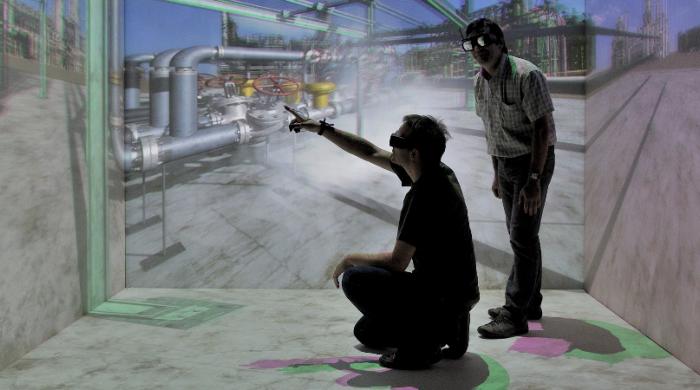
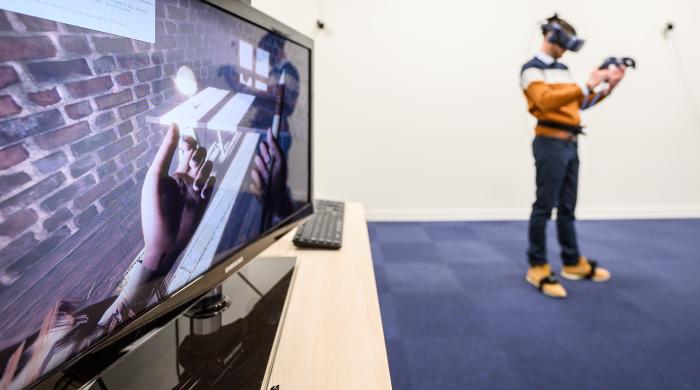
Virtual reality has been experiencing significant growth in recent years thanks to the arrival on the market of increasingly accessible devices (virtual reality headsets, development tools). This growth is reflected in a growing number of applications in a variety of fields, with tangible benefits for users.
However, enthusiasm for these technologies is hampered by significant scientific obstacles that are still the subject of intense research. On the one hand, it is well known that immersion in a virtual environment induces a characteristic discomfort known as cyber sickness, which is even more pronounced when performing navigation tasks. On the other hand, since the specific feature of virtual reality is to enable interaction between the user and the virtual environment, interfaces and interaction methods must be developed; however, these prove difficult for an inexperienced user to grasp. Finally, although virtual reality is supposed to be user-centered, interaction methods are developed to be uniform, regardless of the user, their profile, or their specific characteristics.
This research accreditation presents the research work carried out to address these issues. The main objective of my work is to propose innovative approaches for interacting, and more specifically navigating, in virtual environments in an affordable and ergonomic way, while considering their influence on the user, and to initiate the personalization of interaction and, more generally, of virtual reality, which is necessary for the wider dissemination of these technologies.
I will present the studies we have conducted on the influence of navigation on users, particularly cyber discomfort, followed by the development of several navigation methods we have proposed based on this information, taking into account the constraints of intuitiveness and reduction of cyber discomfort. Finally, I will show an initial approach to adapting navigation methods to the user, a prelude to advanced personalization and virtual reality intelligence.