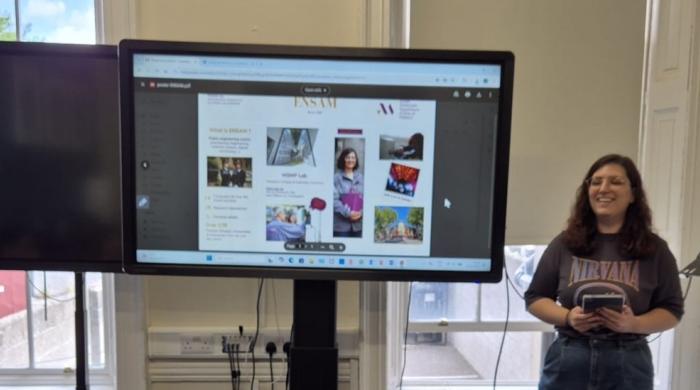
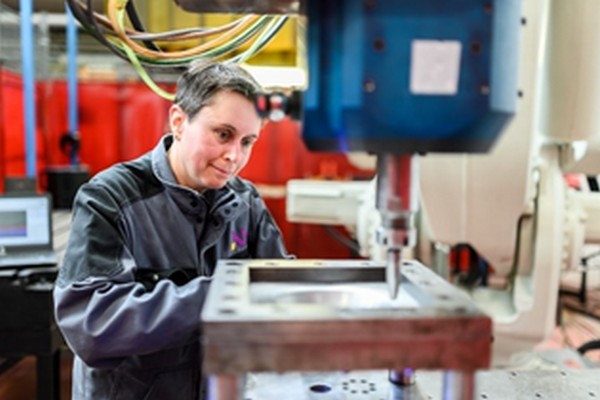
Meeting with Sandra Chevret, lecturer and researcher at LCFC and coordinator of the TOMORO project. This project also involves partnerships with LAMPA in Angers and the Production Engineering Laboratory (LGP) at the National Engineering School of Tarbes.
The origins of the project
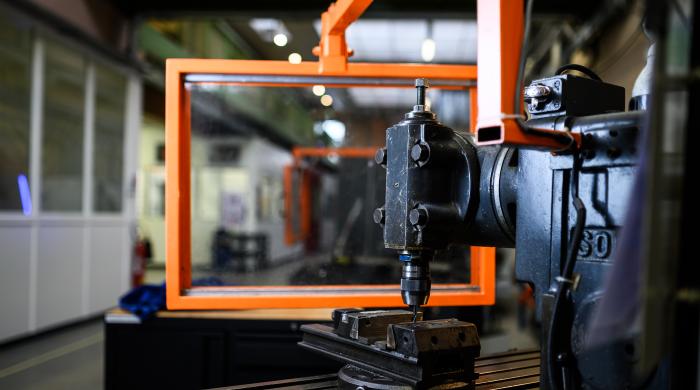
The concept behind the ANR TOMORO project, funded by the French National Research Agency (ANR), stems from a specific premise: when the robotic incremental forming process involves tool-material interaction, the robot deforms the material under the action of applied forces. The actual trajectory therefore deviates from the desired trajectory. This poses a challenge for manufacturers seeking to produce large, precise parts while adhering to manufacturing constraints.
One key word: optimization
Sandra Chevret, the project coordinator, explains that the goal is to optimize the automation of the incremental forming process. This involves creating a digital simulation chain to model tool-material interaction and designing a control algorithm that takes into account the behavior of the workpiece, temperature variations, and interaction forces.
To achieve this goal, the LCFC is collaborating with two other partner laboratories in the project: the LGP and the LAMPA.
The project revolves around four Word Packages (WP), with each laboratory focusing on a specific aspect:
- WP1: Study of tool-material interaction as a function of operating parameters and tool paths;
- WP2: Numerical simulation to account for elastic feedback and robot behavior in order to incorporate them into the simulations (thesis supervised by LAMPA);
- WP3: Development of control laws to create a hybrid force-position control law (driven by the LCFC);
- WP4: Demonstration and testing (at the Metz campus).
For use in other types of robotics
Sandra Chevret offers a vision for the future of this work: in addition to completing the project, she hopes that the hybrid force-position control algorithms to be developed in WP3 will be applied to other types of robotics. Today, the project is in the WP2 phase.
During a previous seminar with the LCFC, Sandra Chevret presented the robotic incremental forming process and her research questions. This led to the initial research objectives, which launched the project and a first application to the ANR. The project was ultimately selected during the second application round.