Focus on the work of the Materials and Processes Laboratory (LaBoMaP), which designs and produces two digital twins: the first dedicated to wood peeling machines and the second dedicated to high-speed machining (HSM) workshop machines.
A digital twin is a digital replica of an object, process, or system that is directly connected to it. In education, there are many benefits: visualizing phenomena invisible to the naked eye, distance learning, repeating experiments outside of class hours, making practical work accessible to students with disabilities, and many other applications that remain to be discovered and explored!
Attach mechanical models
The first step in creating a digital twin is to produce a 3D geometric model of the machine. Today, many manufacturers provide 3D models of their machines to facilitate their implementation in an industrial workshop environment. Without this, the existing machine must be digitized using scanners, photogrammetry, or CAD modeling.
Far from a 3D representation, the implementation of a digital twin requires the addition of mechanical models in order to recreate the physical behavior of the machine. This provides real-time access to tool movements, cutting forces, and tool wear. These different models are based on research conducted in our laboratories and those of our partners (CESI, Cnam, CEA-List).
Create a communication loop
In order to adjust the simulation parameters, it is essential to create a communication loop between the digital twin and its real-world counterpart. This requires the development of software that can connect to the machines in order to retrieve information from sensors, values stored in the numerical control system, and instructions sent to the PLC, so that the machine's behavior can be replicated as accurately as possible. The machining of a part takes place simultaneously on the real machine and virtually on the digital twin.
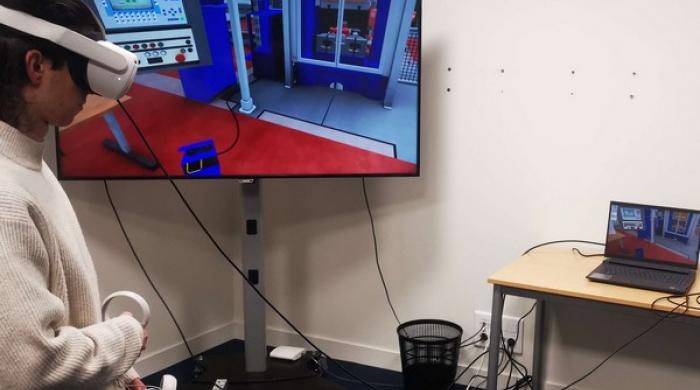
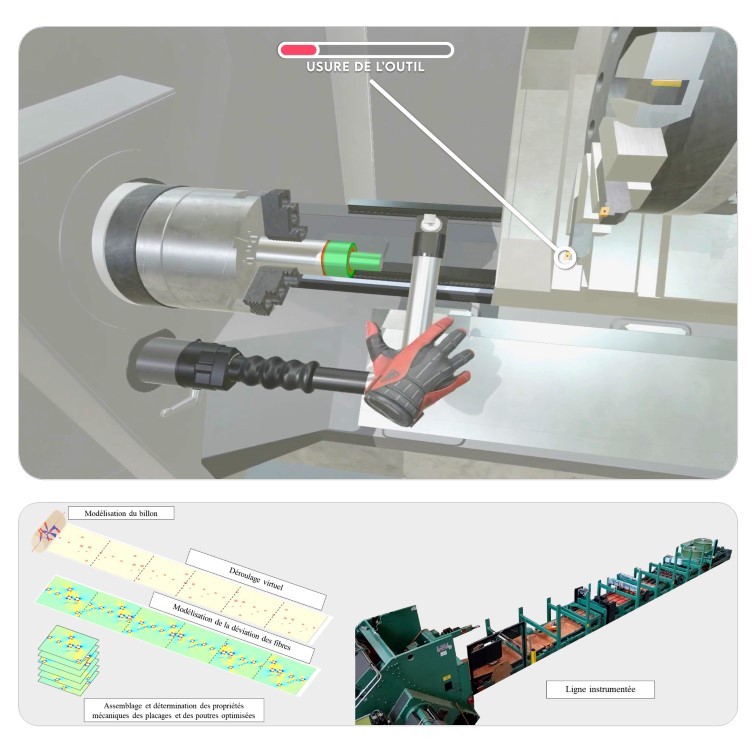
Finally, a set of representation and interaction metaphors must be developed so that the user can visualize and manipulate the digital data. In practical terms, through a screen affixed to the machine's window, with augmented reality glasses or simply a smartphone screen, it becomes possible to see in 3D the future trajectory of the tool, colors on the machined part representing the cutting forces measured at that location, or even a gauge indicating tool wear in real time.
A major breakthrough in teaching methods
The implementation of these digital tools represents a major advance in teaching methods: immersion in a virtual scene creates a sense of presence that transforms the learner's passive state by stimulating new cognitive functions. This improves learner engagement, as they become active participants in the training process, while also promoting knowledge retention.
Students are ready to imagine the factory of tomorrow and take on the challenges of the future, having been familiarized with innovative tools developed through research on our campuses.
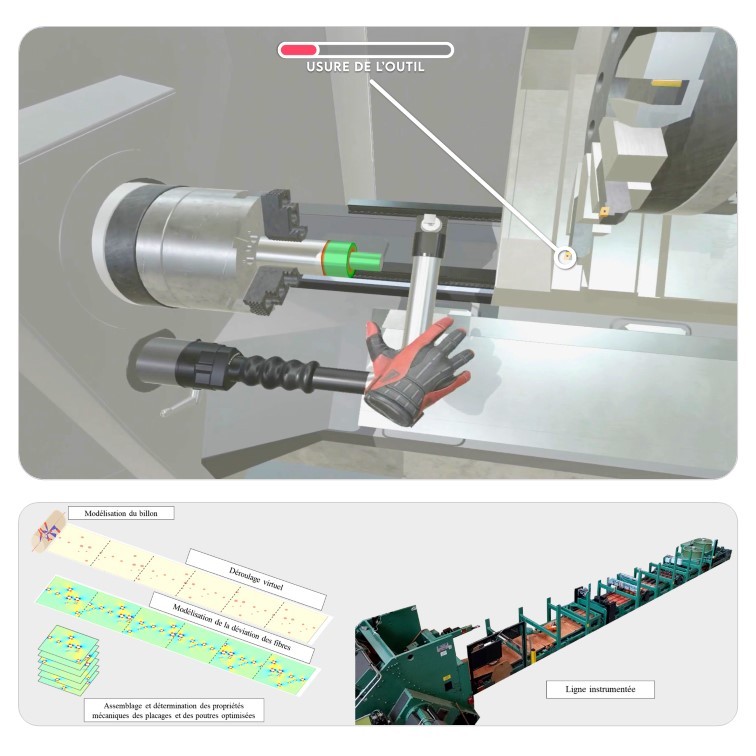
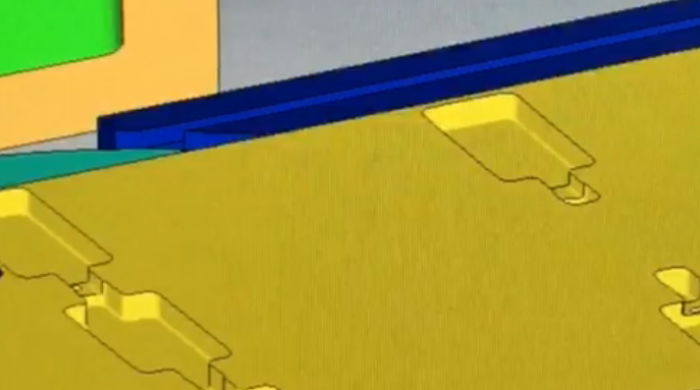
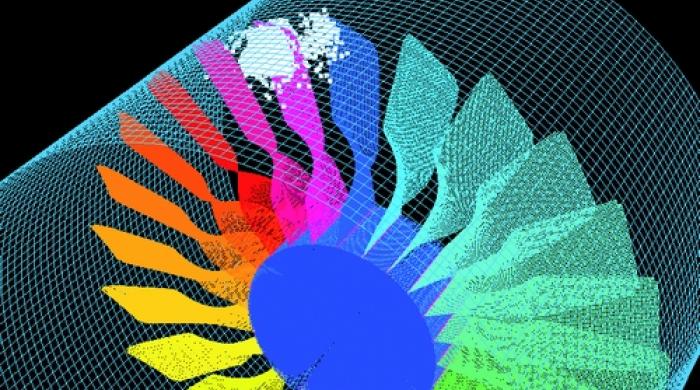
Top: digital twin of a CNC lathe allowing information to be superimposed for understanding and learning machining. Bottom: simplified digital model of rotary-cut veneers and LaBoMaP's Equipex rotary cutting line.
Which digital twin for wood peeling and veneer manufacturing?
Answer with Louis Denaud, pilot of the JENII dedicated to the Bois uncoiling machine.
LaBoMaP has built a technical platform dedicated to veneer peeling that is unique internationally. It stands out for its industrial scale and the richness and diversity of the data extracted from the process in real time (cutting forces, knife temperature, veneer thickness, local veneer profile, peeler and cutter data, mapping of the local orientation of veneers including fiber angle and moisture) and integrated into a single scalable software program developed by LaBoMaP, Xylomat©, as part of the Equipex Xyloforest project.
Given the complexity of the physical phenomena involved, the digital twin will be built on the basis of this data (using phenomenological or learning models, supplemented by simple physical models where possible). It should enable the basic phenomena observed during unwinding and specific to rotating machines to be reproduced, producing a realistic rendering of veneers incorporating the texture of the wood using virtual immersion methods and tools (virtual and/or augmented reality).
In particular, the digital twin will be able to simulate the various phenomena involved in peeling and their manifestations (forces, vibrations, veneer thickness, local bulges, log bending), enabling the characterization of process control, understanding of the physical phenomena involved, and simulation of the properties of the veneers produced.
The digital twin must offer:
- an educational resource offering multiple possibilities to complement courses or practical work (immersive learning)
- Widespread dissemination of knowledge about the process and the possibility of progressing from high school to a doctorate.
- three targeted educational scenarios (introductory, 100% distance learning, intermediate combining different media, and expert for continuing education).