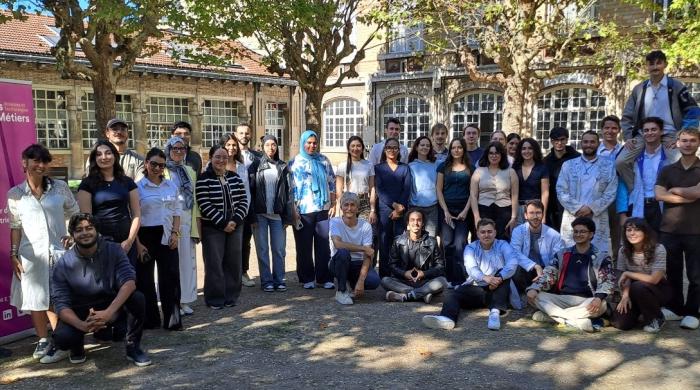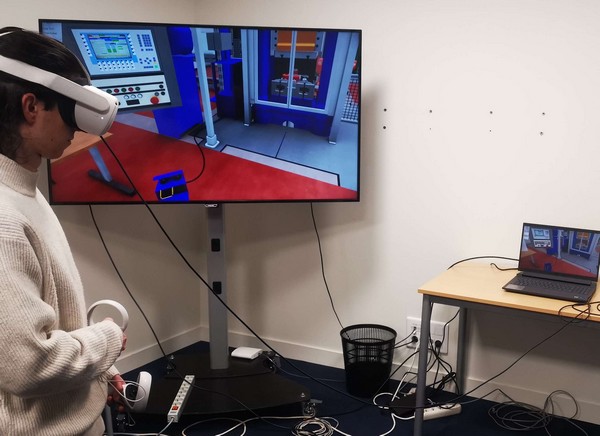
Is a virtual reality course more stimulating than a face-to-face course? This is the question Pierre Bondesan asks in his thesis conducted with the team at the Laval Institute.
Having joined the Laval Institute in September 2022, Pierre Bondesan is conducting research on"the educational effectiveness of digital twins in immersive virtual environments," therebystrengthening the Laval Institute team as part of the national JENII (Jumeaux d'Enseignement Numériques Immersifs et Interactifs) project, which aims to develop digital twins for teaching.
As part of his thesis, Pierre Bondesan will evaluate three of the fifteen digital twins developed by JENII: thoseArts et Métiers, the Conservatoire National des Arts et Métiers CNAM), and the Centre des études supérieures industrielles (CESI).
Understanding the cognitive and emotional aspects of a student in an immersive situation
After earning a bachelor’s degree in psychology and a Master of Science from the University of Savoie Mont-Blanc in Chambéry, Pierre developed a passion for human-machine interaction. “What interests me is understanding how to adapt a system or a machine to human cognitive abilities—such as brain function, reasoning, memory, and language,”he explains.
He hopestodeepen this knowledge as part of his thesis to assess how to train future engineers through a human-centered approach rather than one focused solely on technology. “Learning through virtual reality engages our cognitive abilities. We therefore need to understand and know how our brain functions in this virtual environment compared to traditional learning,”he explains.
In practical terms, when a student is in a classroom in front of a blackboard or a teacher, their attention is focused on what is in front of them. In virtual reality, it’s different: the learner finds themselves immersed in a 3D virtual environment with an increased risk of being distracted.
Through his thesis, Pierre will identify how students’ emotional and motivational states are activated and compare the variation in these states between virtual reality and real-world conditions. “What interests us is evaluating students’ learning performance, but also everything surrounding it: the cognitive abilities involved and their emotional state.Is a virtual reality class more stimulating than a face-to-face classroom setting?”
Compare learning performance between on-site and virtual reality courses
After reviewing the state of the art in scientific literature, Pierre will soon conduct his first assessment using a rigorous experimental protocol with first- and fourth-year CESI students on a metal additive manufacturing machine."One group will visit the CESI site, while another group of students will take a virtual reality tour. I will then compare the groups by asking them the same questions about their understanding of the visit, their emotional state, and whether it was tiring, for example." This initial experiment will lay the foundations for his thesis and, depending on the results, will be used to assess whether students learn better or less well in virtual reality. If this is the case, the challenge will be to see how to improve learning performance with the ergonomic features of virtual reality.
In 2024, Pierre will conduct an experiment over several months or class sessions. His study will provide a concrete assessment of whether virtual reality can replace access to certain machines that are not necessarily physically available on site and whether it can support student engagement.
This will answer many questions: Does virtual reality allow for greater student involvement? How can a sense of belonging be created between students and teachers, as in a physical class? Will the expected skill level be the same in virtual reality as on site?
"During my final year of my thesis, I will evaluate, for example, how to represent teachers in the virtual reality scene. How can we ensure that the teacher's avatar is consistent with the real teacher? Because if we pay more attention to the avatar's clothing than to what they say, ultimately, there's no point,"explains Pierre.
See you in three years to find out the results and, who knows, maybe take classes on a digital twin of a foundry in virtual reality!