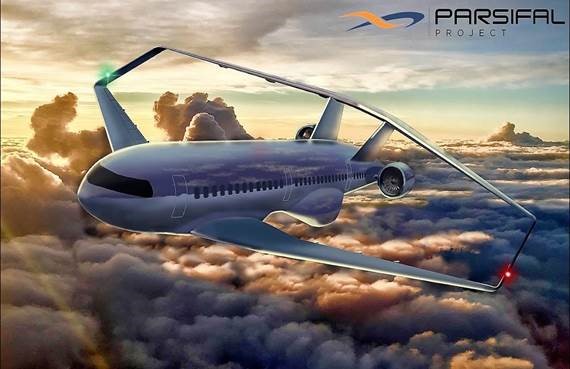
The PARSIFAL project addresses several fundamental aspects in the preliminary design of the aircraft: socio-economic studies (to analyze user needs/requirements and existing infrastructure), flight mechanics, aerodynamics and noise emissions, aeroelasticity, and structural analysis of the wing and fuselage architecture (with a view to optimization).
This project represents an ambitious initiative in the field of civil aviation and paves the way for the introduction of an innovative aircraft architecture known as the "PrandtlPlane." This new configuration will make it possible to reduce emissions per passenger and utilize existing infrastructure, as the PrandtlPlane can significantly increase passenger capacity without increasing the aircraft's size. Thus, an A320/B737 could accommodate a number of passengers equivalent to that of an A330/B767, without increasing its size.
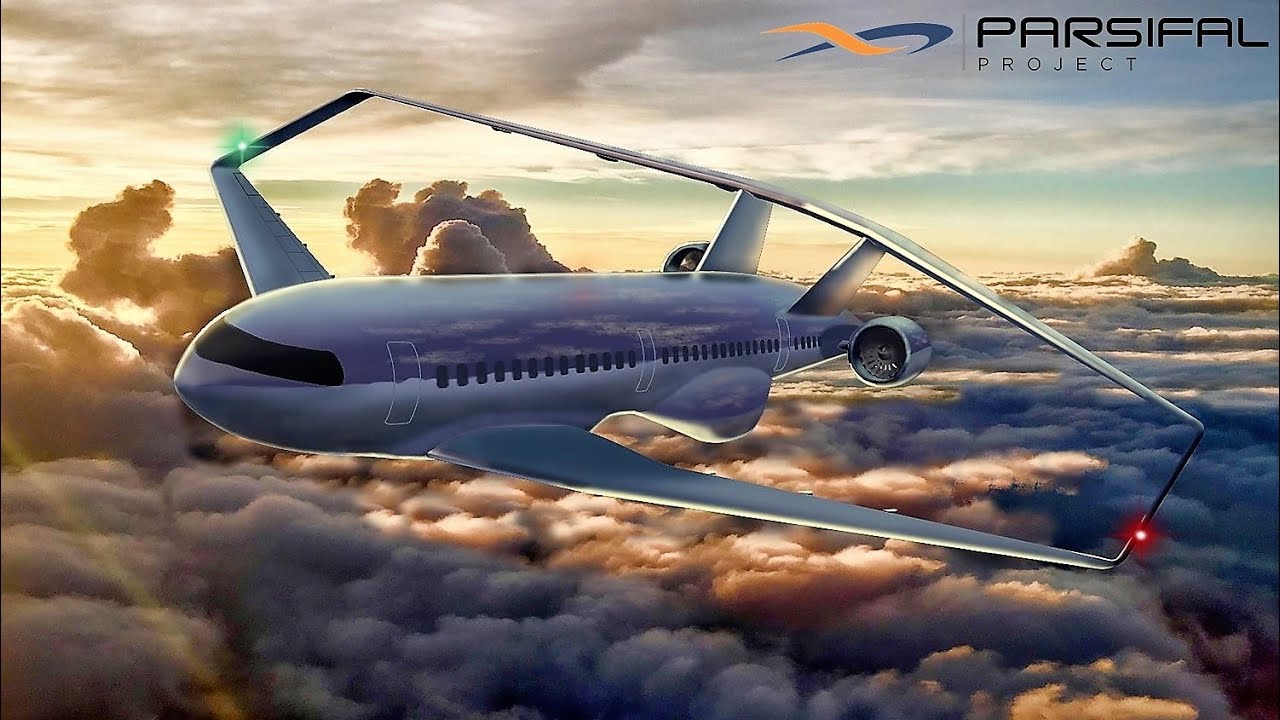
This architecture is characterized by a closed wing that is connected to the fuselage at two different points (known as "box-wing architecture"). Instead of a conventional wing, the PrandtlPlane configuration features two horizontal wings connected by two vertical wings. This innovation requires careful study of aspects relating to aerodynamics, flight mechanics, and structural design.
Our School participated in drafting the project, highlighting the specific features of the design and optimization approaches developed within the IMC department of the I2M Laboratory. The Arts et Métiers campus Arts et Métiers Bordeaux-Talenceis responsible for designing/optimizing the aircraft structure (fuselage and wings), taking into account several design criteria: lightness, stiffness, buckling, strength, etc. The specific approach, developed to address the complexity of the problem, uses multi-scale digital methods and tools, integrated into an original genetic optimization algorithm developed by the IMC. In addition, an experimental study of optimized stiffened panels, manufactured by the Compositeadour technology platform (Bayonne), will take place in the coming months. The aim of these tests will be to experimentally validate the numerical approach adopted for the optimization of composite structures.
The multidisciplinary design of such an aircraft is a challenge that has been taken up by a consortium of complementary academic and research institutions, including Arts et Métiers. This consortium brings together: the University of Pisa (Italy), ENSAM, ONERA (France), TUDelft (Netherlands), DLR (Germany), and the SME SkyBox.