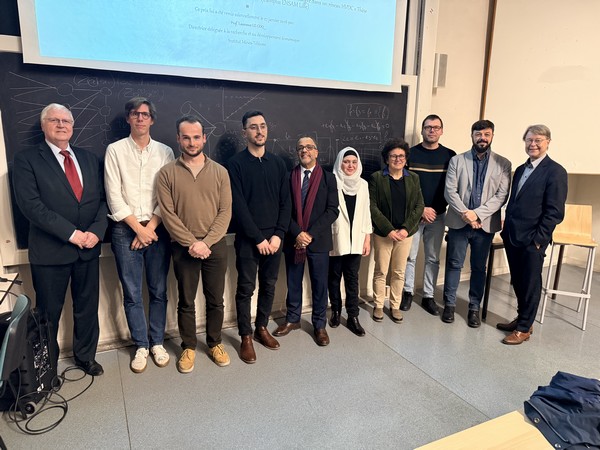
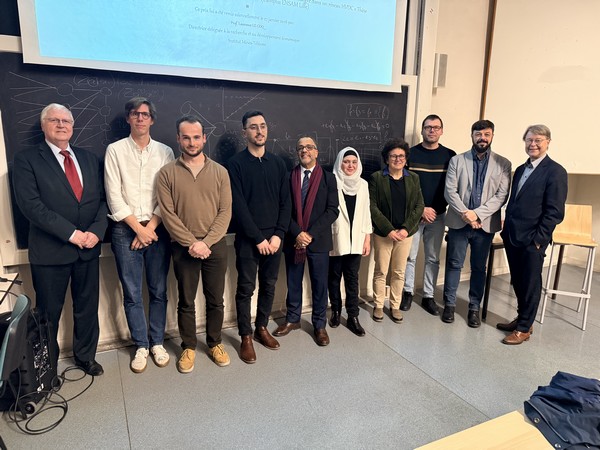
The Pierre Bézier Award ceremony took place on Tuesday, January 31, 2026, at the Arts et Métiers campus Arts et Métiers Paris for the five 2024 winners.
The Bézier Prize: Excellence in Research at Arts et Métiers
The Pierre Bézier Prize is an award created in 2005 by the Arts et Métiers Foundation. This prize recognizes the best doctoral research in the fields of science, technology, and innovation. Pierre Bézier, an Arts et Métiers engineer Arts et Métiers mechanics and electricity, dedicated his life to research.
Each year, one to five prizes worth €1,500 are awarded by the Arts et Métiers Foundation.
The winners of the 2024 Bézier Prize
" The Pierre Bézier Prize recognizes excellence and highlights research work with a strong societal impact, building bridges between science, technology, and society," explains Fodil Meraghni, director ofthe doctoral school.
This is evidenced by the five 2024 winners who received their awards on January 31, 2026:
- Aurélien Bienner for "Effects of real gas on freestream transition and losses within ORC turbines" (thesis completed at the DynFluid laboratory, Paris campus).
By combining a better understanding of fundamental phenomena with the practical provision of resources, his thesis contributes to the development of more efficient ORC turbines and thus to the acceleration of the energy transition. - Mohammed El Fallaki Idrissi for "Model Order Reduction and Artificial Neural Networks Towards Fast and Accurate Multiscale Simulations of Composite Materials with Periodic Microstructure" (thesis completed at the LEM3 laboratory, Metz campus).
His thesis project aims to promote the large-scale adoption of woven composite materials by overcoming technological barriers (complexity of multiscale modeling and high computational costs) through the development of hybrid digital twins. - Caroline Marc for "Characterization of peeling cracks and densitometry using terahertz waves: from the local properties of veneer to the mechanical performance of LV" (thesis completed at the LaBoMaP laboratory, Cluny campus).
Her thesis develops non-destructive characterization methods to accurately quantify two key characteristics of veneers: peeling cracks and local density. The aim is to provide manufacturers with reliable, fast, and automated tools to optimize the sorting, manufacturing, and final performance of plywood panels. - Frédéric Panthier for "Pulse modulation and endocorporeal laser lithotripsy: impact of thulium-doped lasers" (thesis completed at the PIMM laboratory, Paris campus).
Laser energy is essential for the endoscopic treatment of urinary stones, and choosing the right tool for lithotripsy is therefore of the utmost importance. The thesis evaluates and compares three laser energies in in vitro experiments and in vivo clinical studies, before integrating these data into a physics-informed reduction model using machine learning. - Ghazala Shafique for "DC voltage control and stability analysis of a DC/DC converter integrated into an HVDC network" (thesis completed at the L2EP laboratory, Lille campus).
Her thesis contributes to the future of energy systems by helping to make long-distance electricity transmission more reliable, flexible, and better suited to renewable energy sources.
How are candidates selected?
During a thesis defense, a unanimous jury may nominate a candidate for the Bézier Prize. An initial selection is made, retaining approximately 25% of the hundred or so theses defended each year.
Next, a jury co-chaired by Ivan Iordanoff, Deputy Director of Research and Innovation, and Fodil Meraghni, and composed of representatives from the Arts et Métiers Foundation, renowned figures from industry, and internal and external scientists, examines the applications in depth.
Applications must be submitted in the form of a detailed dossier, including the thesis manuscript, defense reports, a summary of the socio-economic impact, and a list of publications.
The jury's selection of winners takes several criteria into account, including:
- the societal impact of research,
- the innovative nature of the thesis,
- major technological advances,
- the competitiveness of industrial work,
- the originality and novelty of the subject matter,
- the promotion and dissemination of results,
- the potential economic benefits,
- the quality of the writing and the scientific approach.
An important asset for a career
Between three and five winners are selected, each receiving Arts et Métiers check for €1,500 from the Arts et Métiers Foundation and a diploma certifying their distinction: "This award is a real opportunity for young researchers," emphasizes Fodil Meraghni. "Not only does it recognize academic excellence, but it is also an important asset for their careers, helping them to enter the workforce and raising the profile of their work."