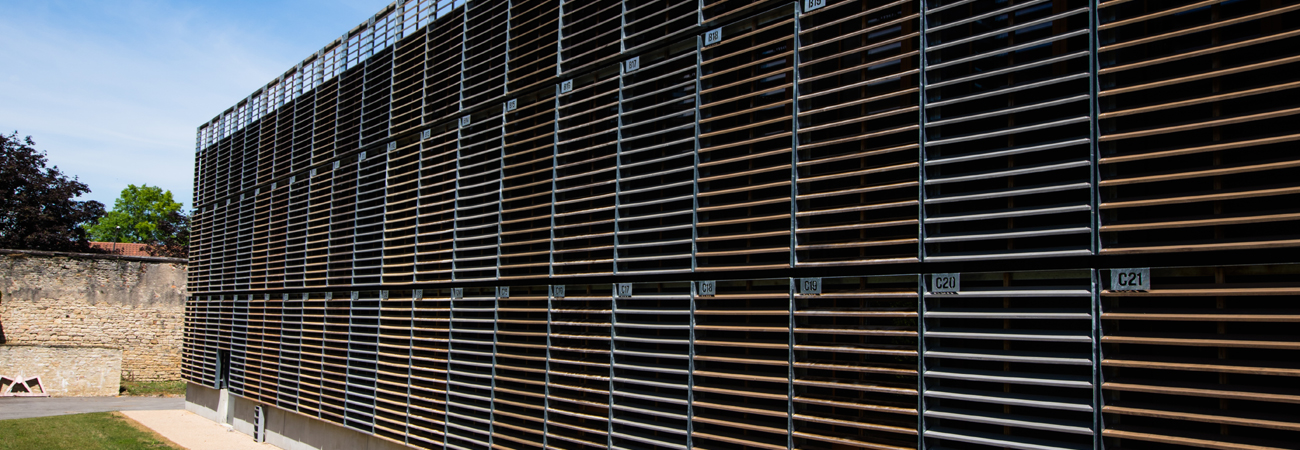
The Halle Bois on the Arts et Métiers campus Arts et Métiers Cluny has recently been adorned with an experimental façade. Covering an area of 302 m², the west façade of the building features 69 removable cladding panels, each made from different types of wood and treated in different ways, allowing the aging of the material to be observed in real time.
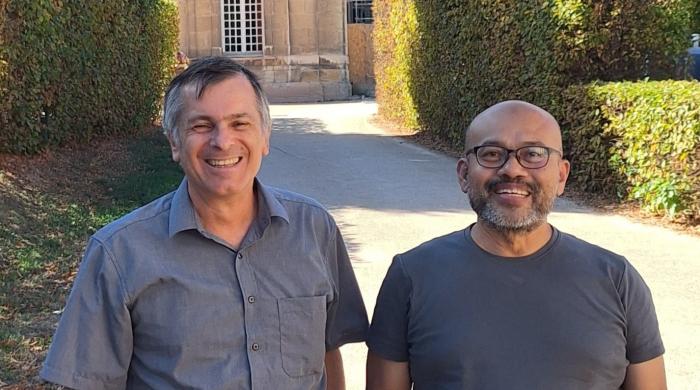
Robert Collet, head of the Wood team at the Arts et Métiers campus Arts et Métiers Cluny, and Thibault Chastagnier, Arts et Métiers engineer Arts et Métiers founder of I-Tech Bois, discuss this project.
Local wood species treated without synthetic products
The final stage of this project, which cost around €2 million, this façade was made possible thanks to the supply of wood as part of a sponsorship initiative by the DUCERF Group and its installation by the company I-Tech-Bois in Cluny.
The experimental façade will enable the natural aging of several combinations of cladding (species/treatments/finishes) to be compared under identical weather exposure conditions (UV, rain, temperature, wind). Photos will be taken at regular intervals to keep a record of this aging process.
The decision was made to use only durable products for outdoor use, i.e., naturally durable species for use in service class 3b when sapwood is removed (Douglas fir/larch/oak), or wood that has been treated to increase its durability (maritime pine/poplar/ash/oak with sapwood/Douglas fir with sapwood).
The use of local species was favored, but others were included for comparison purposes, such as maritime pine and larch.
For wood that has undergone treatment to give it the durability required for use in cladding, we wanted to highlight high-temperature wood treatment, a modern process that guarantees a sustainable solution without the use of synthetic products. The high-temperature treatment (173 and 210°C) was carried out by the company Bois Durables de Bourgogne, with the Arts et Métiers campus contributing to the development of the process.
Finally, outdoor wood and its natural aging process has its supporters and detractors, which is why we wanted to offer the use of wood with a finish. The current trend in finishes is toward saturators. Two finishes have been applied: a pigmented water-based saturator, the first of which guarantees the natural color of the wood (maintenance required every four years), and the second, which is very fashionable today, aims to pre-gray the wood to give it an "already aged" appearance.
The experimental façade will be educational.
Engineering students from the Arts et Métiers campus Arts et Métiers Cluny and visitors to the Abbey will be able to quickly identify the wood species, treatments, and finishes thanks to appropriate signage displaying the "associations" on panels, raising their awareness of the wood species that can be used outdoors and the aesthetic qualities of each.
Given the large number of tourists in the region, it is clear that the debate on the aesthetic appeal of wood and its aging process will only grow, and we hope that the educational role of this book will help to change preconceptions...