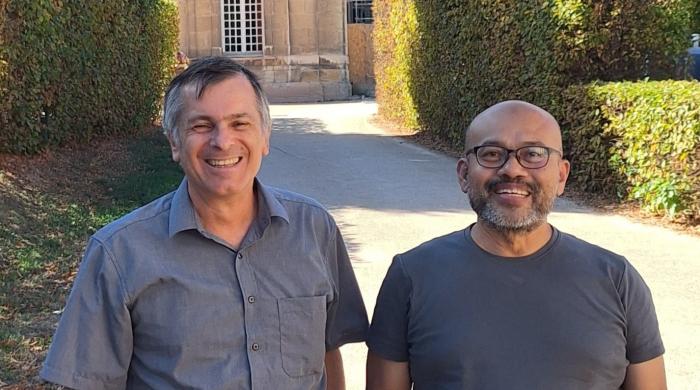

Younes Faydi, a doctoral student specializing in mechanical engineering and woodworking at the Arts et Métiers campus Arts et Métiers Cluny, defended his thesis on Monday, December 11, 2017. He also participated in the My Thesis in 180 Seconds competition, winning two prizes in the HESAM Universities group final in 2016. Let's take a look back at this exercise in style.
Younes conducted his thesis at the LaBoMaP in the Wood team. He also benefited from the expertise of the CIRAD (International Center for Agricultural Research for Development).
My Thesis in 180 Seconds: An Exercise in Style
In 2016, while in his second year of his doctoral program, he entered the competition "My Thesis in 180 Seconds". He had heard about it on social media while he was pursuing Master of Science in Mechanical Engineering and Fiber Science at ENSISA. This exercise in communication, in which candidates must find the right words to explain their thesis topic to a broad audience, immediately caught his interest. “The dissemination of research and knowledge is a key aspect of a researcher’s career. Researchers are constantly interacting with the outside world,” Younes emphasizes.
The dissemination of research and knowledge is an important criterion in a researcher's career, emphasizes Younes Faydi.
His performance convinced the jury in the final, who awarded him two prizes: the Audience Award and the Jury Prize.
His thesis in 180 words
Younes spent three years working on classifying the mechanical strength of oak using vibration methods and measuring fiber orientation. He has once again taken up the challenge and summarized his subject in 180 words.
"Wooden constructions have been rapidly gaining popularity in recent years due to their ecological and aesthetic appeal. Wooden frames are no longer limited to houses or medium-sized buildings, but are now used in colossal structures such as the Nice stadium and the large auditorium at the Maison de la Radio. However, there are still some obstacles to the widespread commercialization of wood for this application. Mechanical grading by machine is one of the key issues that needs to be studied further, particularly for hardwood species, which are found in considerable quantities in France. This thesis addresses this issue. The aim of this study is to develop a model and a measurement technique based on fiber orientation that can measure the mechanical properties of hardwoods, particularly secondary-quality oak. The main challenge is to take into account all the defects in each board that affect its mechanical properties.